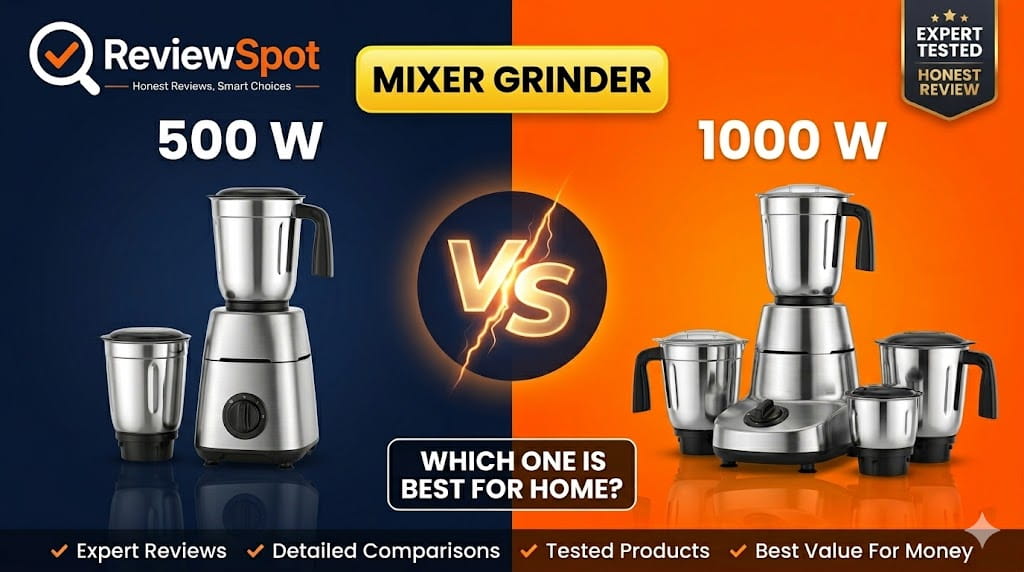
Difference Between 500W and 1000W Mixer Grinder: Which One Is Better for Home?

Choosing between a 500W and 1000W mixer grinder can feel confusing, especially when every brand claims their product is “powerful” and “best for Indian kitchens.” But the truth is simple.
If you mostly make chutneys, shakes, and light grinding, a 500W mixer grinder is enough. If you regularly grind tough ingredients like turmeric, masalas, coconut, idli batter, or large quantities, a 1000W mixer grinder is the better choice.
The biggest difference between 500W and 1000W mixer grinder models is power, grinding speed, motor strength, and ability to handle heavy tasks. A 1000W mixer grinder is faster and stronger, while a 500W model is more affordable and uses less electricity.
Difference Between 500W vs 1000W Mixer Grinder
A 500W mixer grinder is best for small families (2-3 members) doing light daily tasks like making chutneys, blending smoothies, and grinding small quantities of masala. A 1000W mixer grinder is built for large families (5+ members) and heavy-duty tasks like grinding idli/dosa batter, processing turmeric, hard spices, and running the motor for extended periods without overheating.
If you’re an average family of 4 with regular cooking needs, a 750W sits perfectly in between but if you’re choosing strictly between 500W and 1000W, read on to figure out which is right for your kitchen.
What Does Watt Mean in a Mixer Grinder?
Watt simply means motor power. Two mixer grinders of the same wattage can perform very differently based on motor quality, RPM, blade design, and build.
The higher the wattage means strong motor, fast grinding and easy to handle ingredients.
- A 500W mixer grinder works well for normal kitchen tasks
- A 1000W mixer grinder is designed for heavy-duty grinding
Difference Between 500W and 1000W Mixer Grinder
Here’s a quick comparison table:
| Feature | 500W Mixer Grinder | 1000W Mixer Grinder |
|---|---|---|
| Motor Power | 500 Watts | 1000 Watts |
| RPM | 18,000 – 20,000 RPM | 20,000 – 24,000 RPM |
| Ideal Family Size | 2-3 members | 5+ members |
| Continuous Run Time | Up to 10-20 minutes | Up to 30-45 minutes |
| Noise Level | 75 – 85 dB | 85 – 100 dB |
| Electricity Consumption | Low | High |
| Idli/Dosa Batter | Not ideal | Excellent |
| Hard Spice Grinding | Manages, but slower | Fast and efficient |
| Turmeric Grinding | Struggles | Handles well |
| Price Range | ₹1,500 – ₹3,500 | ₹5,000 – ₹12,000+ |
| Number of Jars | Usually 3 | Usually 3-4 |
| Best For | Light daily tasks | Heavy-duty, large families |
| Motor Warranty | Usually 2-3 years | Usually 5 years |
500W and 1000W Mixer Grinder: Which Is Better?
The answer depends on your cooking style. What Type of Cook Are You?
Buy a 500W mixer grinder if:
- You have a small family
- You mostly make juices and chutneys
- You cook simple meals
- You want lower electricity usage
- You are on a budget
Buy a 1000W mixer grinder if:
- You cook daily in large quantities
- You grind masalas often
- You make dosa or idli batter
- You need fast grinding
- You want long-term heavy-duty performance
Does 1000W Mixer Grinder Consume More Electricity?
Assume you use your mixer grinder for 20 minutes per day, every day.
A 500W mixer grinder uses: 0.5 kWh × (20/60) hours = ~0.17 units/day → roughly 5 units/month
A 1000W mixer grinder uses: 1 kWh × (20/60) hours = ~0.33 units/day → roughly 10 units/month
At an average electricity rate of ₹7 per unit, that’s ₹35/month for 500W vs ₹70/month for 1000W.
A 500W mixer running for 15 minutes uses less electricity. A 1000W mixer consumes more power but finishes grinding faster.
Motor RPM: Why It Matters
When comparing a 500W and 1000W mixer grinder, RPM is actually the number that tells you the grinding story.
A 500W machine typically runs at 18,000-20,000 RPM. That’s fast enough for soft ingredients like green chillies, ginger-garlic, tomatoes, and most wet pastes.
A 1000W machine can push 22,000-24,000 RPM. At that speed, hard dried spices, turmeric roots, and tough fibrous vegetables break down quickly and evenly.
Is a 500W Mixer Grinder Enough for Indian Cooking?
When comparing a 500W and 1000W mixer grinder, RPM is actually the number that tells you the grinding story.
A 500W machine typically runs at 18,000-20,000 RPM. That’s fast enough for soft ingredients like green chillies, ginger-garlic, tomatoes, and most wet pastes.
A 1000W machine can push 22,000-24,000 RPM. At that speed, hard dried spices, turmeric roots, and tough fibrous vegetables break down quickly and evenly.
Is a 500W Mixer Grinder Enough for Indian Cooking?
For many homes, yes. A 500W and 1000W mixer comparison shows that a 500W model can easily handle Chutneys, spices, shakes, smoothies and wet masala grinding.
But if your cooking includes thick batter, heavy masalas, coconut grinding in large quantity then you’ll notice the limitations quickly.
500W and 1000W Mixer Grinder Noise Comparison
Noise is a major difference between 500W and 1000W mixer grinder models. 500W Mixers are Quieter, Less vibration and Comfortable for small kitchens. 1000W Mixers are louder motor sound, more vibration and powerful grinding noise.
500W Mixer Grinder: Advantages and Disadvantages
| Advantages of 500W Mixer Grinder | Disadvantages of 500W Mixer Grinder |
|---|---|
| Budget friendly | Not ideal for heavy grinding |
| Uses less electricity | Slower grinding speed |
| Compact and lightweight | Motor may heat up |
| Less noisy operation | Struggles with thick batter |
| Good for small families | Not suitable for commercial use |
| Easy to maintain | Limited power for hard ingredients |
| Perfect for basic kitchen tasks | Longer grinding time |
| Good for chutneys and shakes | Less efficient for dry masalas |
| Easy to store in small kitchens | Can overload easily |
| Affordable maintenance cost | Lower performance for large quantities |
1000W Mixer Grinder: Advantages and Disadvantages
| Advantages of 1000W Mixer Grinder | Disadvantages of 1000W Mixer Grinder |
|---|---|
| Very powerful motor | Expensive compared to 500W models |
| Faster grinding performance | Consumes more electricity |
| Excellent for heavy grinding | Louder noise during operation |
| Perfect for idli and dosa batter | Bulky and heavy design |
| Handles tough ingredients easily | Takes more kitchen space |
| Better for large families | Can vibrate more |
| Ideal for dry masalas and turmeric | Not necessary for basic use |
| Durable for frequent use | Higher maintenance cost |
| Saves grinding time | Can feel overpowered for small tasks |
| Better long-term heavy-duty performance | Premium models are costly |
3 Best 500W Mixer Grinders in India
1. Bajaj GX-1 Mixer Grinder 500W
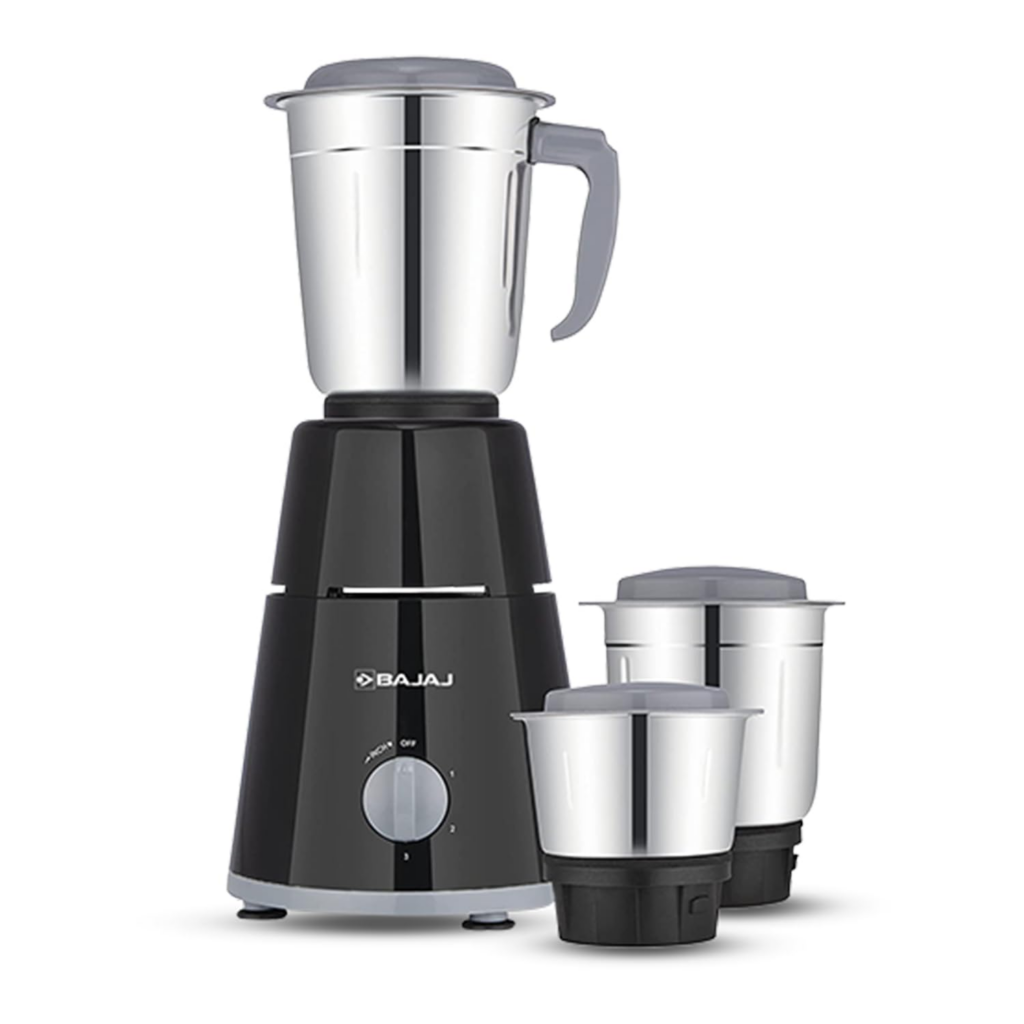
The Bajaj GX-1 is one of the best-selling budget mixer grinders in India. It runs on a 500W Titan motor at 20,000 RPM and comes in a sleek black ABS body. It’s simple, reliable, and does exactly what an everyday kitchen needs.
Best For: Budget buyers, bachelors, and small families of 2-3 members
Key Features:
- 500W Titan motor with 20,000 RPM
- 3 stainless steel jars (1.2L liquidizing jar, 0.8L dry grinding jar, 0.4L chutney jar)
- 3-speed control with pulse function
- Overload protection with auto-reset
- Lockable lids for safe grinding
- Shock-proof ABS body
- 2-year product warranty, 5-year motor warranty
| Pros | Cons |
|---|---|
| Very affordable (under ₹2,000) | Motor can overheat on long grinding sessions |
| Compact and lightweight | Opaque jar lids can’t see grinding progress |
| 20,000 RPM is good for its class | Not suitable for idli batter |
| Reliable Bajaj brand service network | Vibrates more than premium models |
| 5-year motor warranty at this price is great | Jars feel slightly thin |
Customer review:
- Positive:“For everyday chutney and simple masala, this is unbeatable at this price.”
- Negative: “The lids don’t have clamps I have to hold them while grinding, which is annoying.”
2. Prestige 500W Nexus Mixer Grinder with 3 Stainless Steel jars
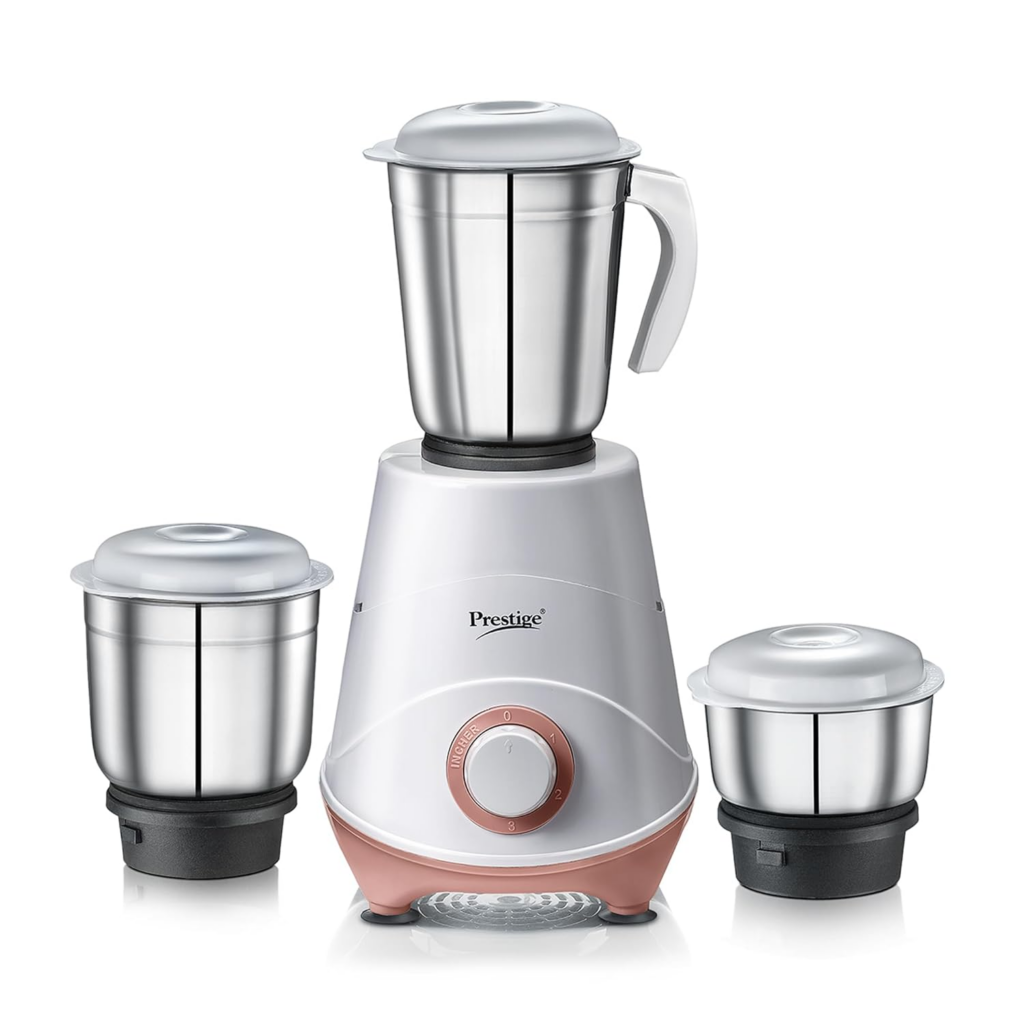
The Prestige Nexus is a solid mid-range 500W option from one of India’s most trusted kitchen brands. It features a powerful motor with super-efficient blades and comes with three stainless steel jars that cover your daily cooking needs comfortably.
Best For: Home cooks who want reliable performance without overspending
Key Features:
- 500W motor with 3 speed settings
- 3 stainless steel jars (1,200ml wet jar, 800ml dry jar, 400ml chutney jar)
- Super-efficient blade design for faster grinding
- Sturdy ABS body with anti-vibration feet
- Overload thermal protection
- 2-year product warranty, 5-year motor warranty
- Available in White and Rose Gold finish
| Pros | Cons |
|---|---|
| Prestige brand reliability | Slightly pricier than Bajaj at same wattage |
| Good blade design for wet grinding | Average performance on hard dry spices |
| Attractive design | Motor noise is noticeable |
| Stable, anti-vibration base | Jars can feel slightly small for bigger families |
| Strong after-sales service network | No juicer jar included |
Customer review:
- Positive: “Grinds coconut chutney smooth in under a minute exactly what I needed.”
- Negative: “Wish it came with a larger jar 1.2L fills up fast when cooking for guests.”
3. Lifelong LLMG23 Power Pro 500-Watt Mixer Grinder with 3 Jars
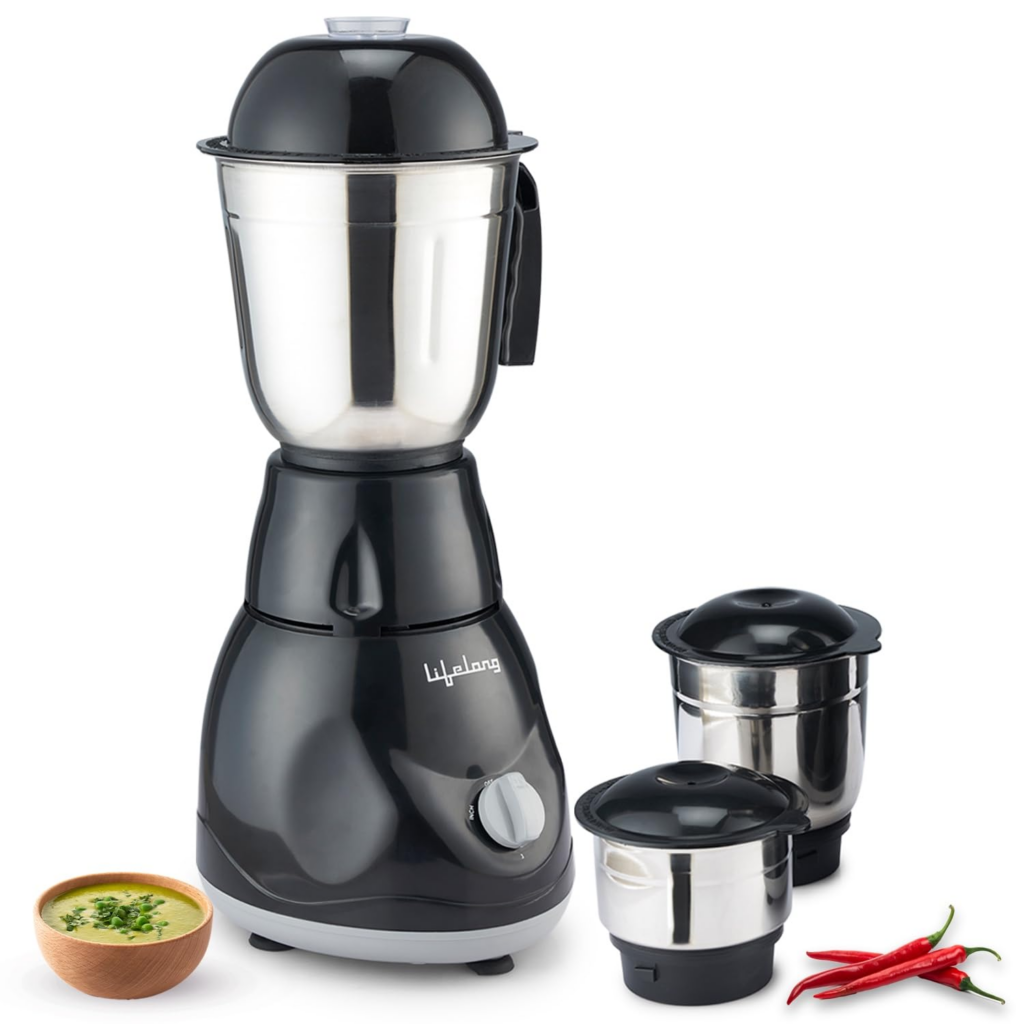
Lifelong’s Power Mix is one of the best value-for-money 500W mixer grinders on the market. It’s designed for simplicity and affordability, making it a popular choice for those who don’t want to spend big but still want a functional kitchen appliance from a known brand.
Best For: Single-person households and couples who need a light, affordable daily grinder
Key Features:
- 500W motor with 18,500 RPM
- 3 stainless steel jars (1L, 0.6L, 0.3L)
- 3-speed control with pulse function
- Overload protection
- Easy-clean stainless steel blades
- ABS plastic body with non-slip feet
- 1-year product warranty, 2-year motor warranty
| Pros | Cons |
|---|---|
| Very budget-friendly (under ₹1,500) | Shorter warranty than competitors |
| Lightweight and easy to store | Smaller jars limit batch size |
| Good for daily single-serving tasks | Motor not as robust under continuous use |
| Reliable for basic chutney and blending | Fewer safety features |
| Easy to clean | Limited brand service centers in smaller cities |
Customer review:
- Positive: “Perfect for just the two of us does what we need without wasting electricity.”
- Negative: “The warranty is only 1 year on the product, which feels a little short for the price.”
3 Best 1000W Mixer Grinders in India
1. BOSCH TrueMixx Pro 1000 W Mixer Grinder 4 Jar
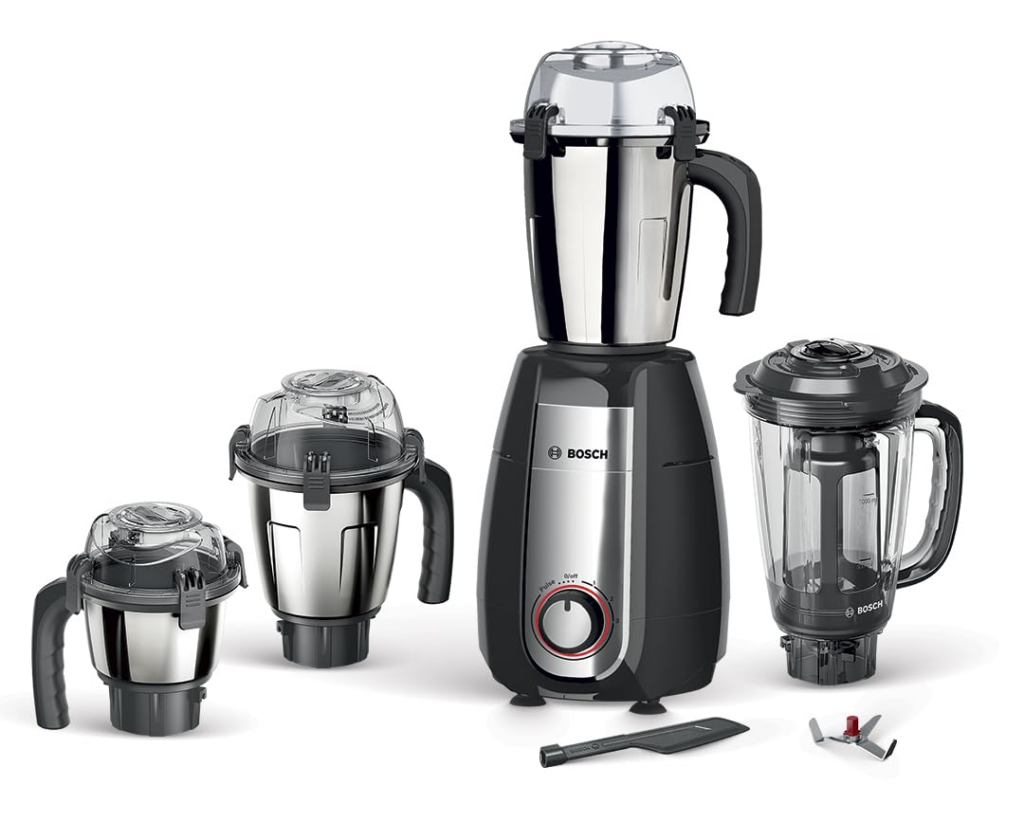
The Bosch TrueMixx Pro is widely considered the gold standard among 1000W mixer grinders in India. It features a powerful HighFlux motor, unique Stone Pounding Technology in its blade design for authentic spice flavor, and a robust build that handles the toughest kitchen tasks with ease.
Best For: Large families, serious cooks, and those who want the best wet-grinding performance
Key Features:
- 1000W 3-C series HighFlux motor
- Stone Pounding Technology for traditional texture in masalas
- Active Flow Breaker for fine, even grinding
- 4 jars: 1.5L blender jar, 1L dry grinding jar, 0.4L chutney jar, plus sauce jar (model-dependent)
- Stainless steel jars with sturdy polycarbonate lids
- Overload protection with auto-reset
- Anti-skid feet and shock-proof ABS body
- 5-year motor warranty
| Pros | Cons |
|---|---|
| Best wet grinding performance in class | One of the most expensive 1000W mixers |
| Stone Pounding Technology gives authentic flavor | Heavier than comparable models |
| Extremely durable build quality | Louder than 750W competitors |
| 5-year motor warranty | Spare parts can be harder to find in smaller towns |
| Handles turmeric, coconut, tough spices effortlessly | Higher electricity consumption |
Customer review:
- Positive: “The batter for my idlis comes out smoother than with my old wet grinder absolutely worth the price.“
- Negative: “It’s quite loud during operation and the weight makes it hard to move around on the counter.“
2. Sujata MG03 1000W Mixer Grinder
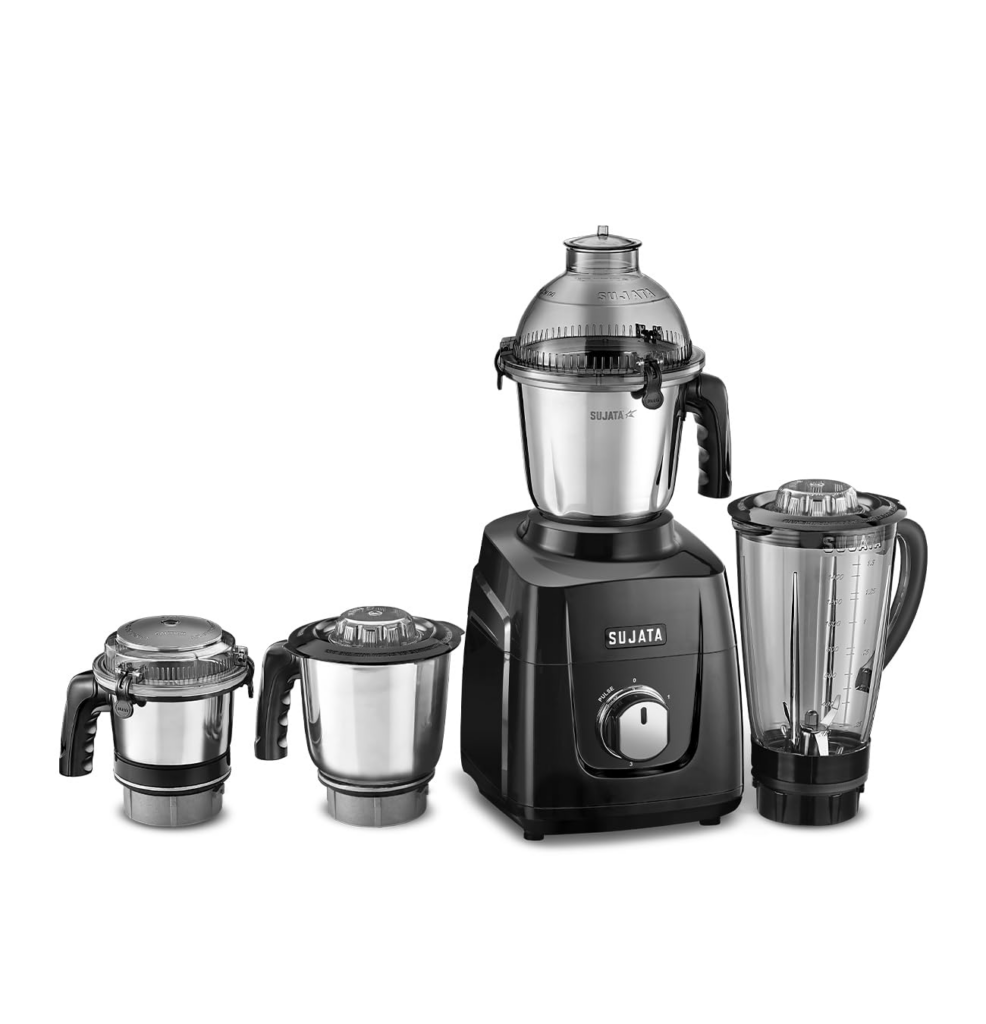
Sujata has a legendary reputation in Indian kitchens for making rugged, powerful mixer grinders. The Sujata MG03 is their flagship 1000W model with a double ball bearing motor running at an impressive 24,000 RPM. It can run non-stop for 90 minutes something almost no other mixer grinder in India can claim.
Best For: Heavy-duty users, large families cooking South Indian food regularly, and those grinding tough ingredients daily
Key Features:
- 1000W double ball bearing motor at 24,000 RPM
- Non-stop 90-minute continuous running capability
- 4 jars: 1,750ml blender jar with coconut milk extractor, 1,500ml, 1,000ml, and 500ml jars
- Self-aligning jar and motor coupling for easy use
- Self-drainage system to protect motor from water exposure
- Safety lock on dome jar prevents loosening during thick batter work
- Made in India
- 5-year motor warranty
| Pros | Cons |
|---|---|
| 90-minute continuous running — best in class | Higher price point |
| 24,000 RPM for outstanding grinding speed | Bulky and takes up significant counter space |
| Best for idli/dosa batter in large quantities | Less stylish design compared to Bosch |
| Coconut milk extractor jar is a practical bonus | Heavier than most competitors |
| Extremely durable for daily heavy use | Vibrates noticeably at maximum speed |
Customer review:
- Positive: “I’ve been using this for 4 years daily grinding batter, spices, everything and it hasn’t skipped a beat.”
- Negative: “It’s big and takes up a lot of counter space, which is a problem in my small kitchen.”
3. Bajaj Military Series Glamore 1000 W Mixer Grinder
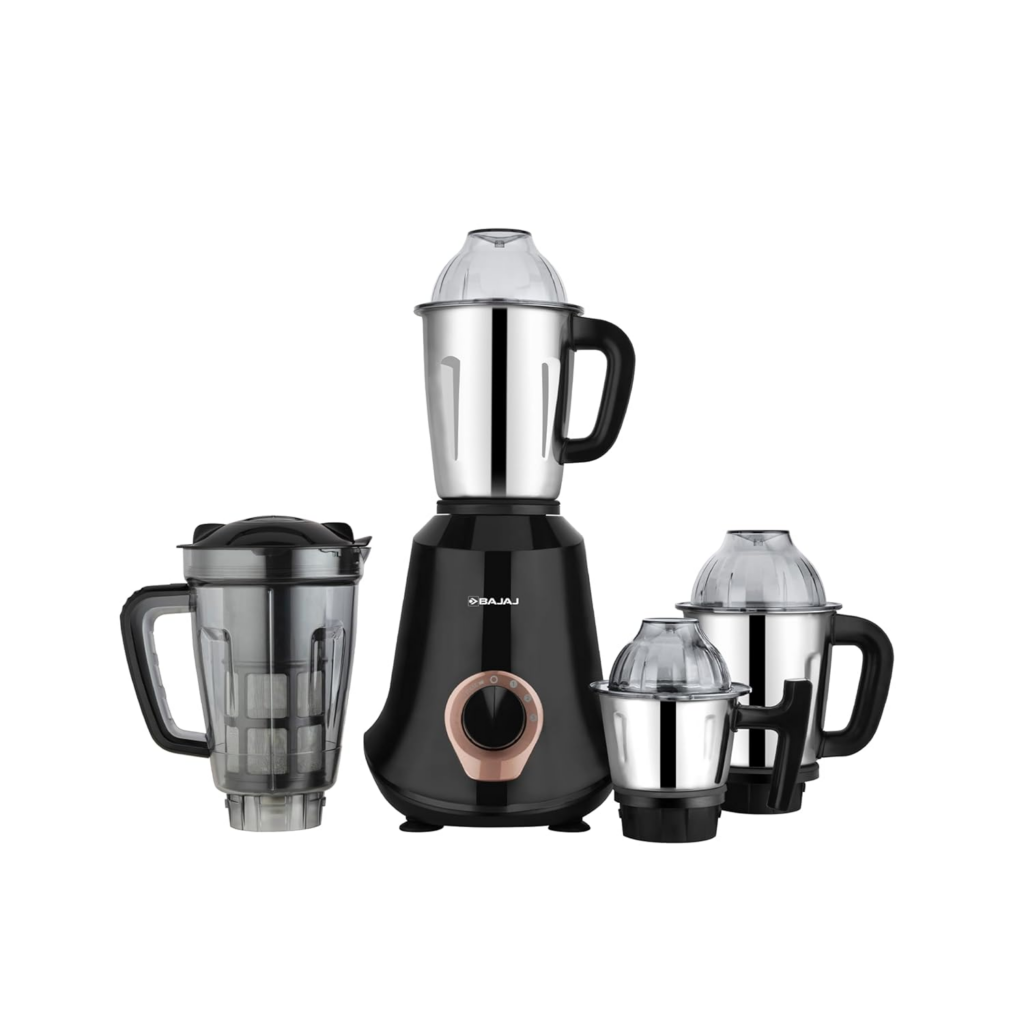
The Bajaj Military Series Glamore 1000W Mixer Grinder is designed for powerful and heavy duty kitchen performance. It comes with a strong motor that can handle tough grinding tasks easily. The stylish design, durable jars, and high speed grinding make it suitable for modern Indian kitchens.
Best For: Heavy grinding, Indian masala preparation, Large families, Idli and dosa batter and tough ingredients like turmeric and coconut
Features
- 1000W powerful motor
- Heavy duty stainless steel jars
- Strong copper motor technology
- Suitable for wet and dry grinding
- Durable build quality
- High speed grinding performance
- Multi purpose jars
- Overload protection feature
- Elegant modern design
- Ideal for tough Indian cooking needs
Pros & Cons
| Pros | Cons |
|---|---|
| Powerful 1000W motor | Slightly noisy during use |
| Excellent for hard grinding | Consumes more electricity |
| Good for large families | Heavy body |
| Durable jar quality | Takes more kitchen space |
| Fast grinding performance | Premium pricing |
| Handles batter grinding well | Can vibrate at high speed |
| Stylish design | Not ideal for basic light use |
- Positive: “Powerful mixer grinder that easily handles masalas and batter grinding.”
- Negative: “Motor is powerful but the noise level is quite high.”
Final Verdict: Difference between 500W or 1000W Mixer Grinder?
Go with a 500W mixer grinder if you’re a small family doing light, everyday grinding. The Bajaj GX-1 or Prestige Nexus will serve you well for years, save you money upfront, and keep your electricity bill lower. There’s no point paying double for power you’ll never use.
Go with a 1000W mixer grinder if you’re a large family, you cook Indian meals daily, or you grind hard ingredients like turmeric, batter, or bulk spices regularly.
The Bosch TrueMixx Pro and Sujata MG03 are both exceptional the Bosch wins on grinding quality and pounding texture, while the Sujata wins on raw endurance and running time.
If you want a balanced option, a quality 750W mixer grinder often gives the best mix of performance and affordability.
Related Posts:
- Mixer Grinder or Juicer Mixer Grinder
- Mixer Grinder vs Food Processor
- Mixer Grinder vs Wet Grinder
- Difference between 500w and 750w mixer grinder
- Difference Between 750W and 1000W Mixer Grinder
Sourabh researches and writes about home appliances, kitchen appliances, and common appliance problems to help readers make informed buying decisions. He covers mixer grinders, refrigerators, air conditioners, washing machines, and appliance troubleshooting.
At ReviewSpot, Sourabh compares manufacturer specifications, product features, warranty information, pricing, and customer feedback to turn technical appliance information into practical buying advice. His goal is to help readers understand their options, avoid costly mistakes, and choose products that fit their needs and budget.
ReviewSpot distinguishes manufacturer information, customer feedback, and editorial analysis, and does not describe products as hands-on tested unless they have actually been tested.