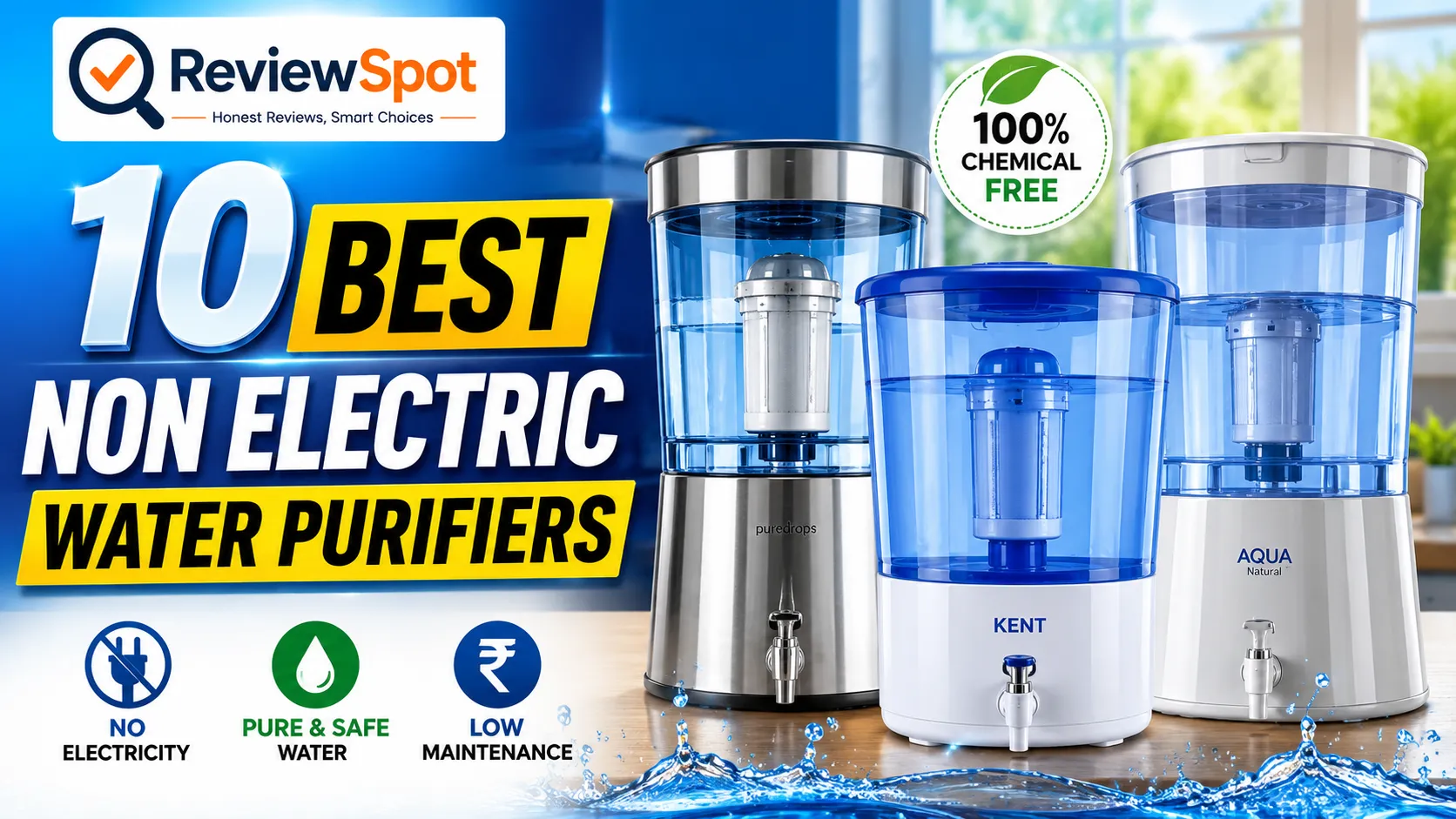
10 Best Non electric Water Purifier in India with Price 2026: Top Picks for Home

A non-electric water purifier can be useful when you need basic filtration without electricity, especially during power cuts or in homes where an RO system isn’t necessary. But a gravity or non-electric purifier is not automatically suitable for every water source. Check your water quality and the purifier’s filtration technology before buying.
We’ve done the deep dive for you. This is your ultimate guide to the 10 Best Non-Electric Water Purifiers in India, complete with prices, key features, and honest pros and cons. If your water does not require RO treatment, a non-electric purifier can be a simpler alternative.
Affiliate Disclosure: ReviewSpot may earn a commission when you buy through links in this article, at no extra cost to you. This helps support our work and product research.
Our Top Picks
- Best Overall: KENT Gold 20-Litres UF Gravity Water Purifier
- Best Budget: Home-Pro – Gravity Water Filter and Purifier
- Best for Family: KENT Gold+ 20-Litres Gravity-Based Water Purifier
- Best Multi-Stage Filter: Aquaguard Amrit+ 6000
Best Non-Electric Water Purifiers Comparison
| Product | Capacity | Main filtration | Price* | Buy |
|---|---|---|---|---|
| KENT Gold | 20 L | UF | ₹3,299 | Buy Now |
| KENT Gold+ | 20 L | UF | ₹3,449 | Buy Now |
| Home-Pro | 16 L | Ceramic candle | ₹1,414 | Buy Now |
| Aquaguard Amrit+ 6000 | 21 L | 4-stage Active Charge | ₹3,399 | Buy Now |
| Pureit Classic | 23 L | 4-stage | ₹2,999 | Buy Now |
| KENT Gold Optima | 10 L | UF | ₹1,899 | Buy Now |
| KENT Gold Star | 22 L | UF | ₹2,899 | Buy Now |
| Pureplus Water Purifier | 20 L | 4-stage | ₹1,994 | Buy Now |
| PRISTINE Stainless Steel | 20 L | Ceramic/gravity | ₹1,747 | Buy Now |
| RAMA Gravity Water Filter | Varies | Ceramic/carbon | ₹5,939 | Buy Now |

You can use the gravity-based non-electric water purifier, which is far cheaper than an electric water purifier. Apart from the lower price, these water purifiers clean the water properly and provide fresh drinking water.
Benefits of a Best Non electric Water Purifier
- Electricity is not required to run this water purifier.
- Less water is wasted while filtering.
- You are not required to connect directly to the running water tap.
- It can be used anywhere as electricity is optional, such as in a rural area or remote location.
- Maintenance cost is very low.
- Water can be supplied with low TDS.
- Comparatively, the price is lower than that of other water purifiers.
- It can be placed anywhere at home, even on a tabletop or kitchen slab.
Note: Check the water TDS before buying the gravity-based non-electric water purifier. Non-electric water purifiers are good only for low TDS water. If TDS is high, then it is recommended that the RO water purifier be used.
Who Should Buy a Non-Electric Water Purifier?
- Homes with suitable water quality
- People wanting electricity-free filtration
- Backup use during power cuts
- Buyers who want simple operation
- Users who don’t need RO treatment
Who Should NOT Buy One?
- Homes with water-quality problems requiring RO
- Users dealing with known contamination
- Buyers expecting RO-level dissolved-solid reduction
- Anyone who has not checked whether the product’s filtration technology suits their water
How We Evaluated Non-Electric Water Purifiers
Our product evaluation process
At ReviewSpot, we evaluate non-electric water purifiers based on filtration technology, purification claims, storage capacity, maintenance requirements and value for money. We compare product specifications and manufacturer information to help you choose a suitable purifier for your household.
Filtration Technology
We check the filtration method, such as activated carbon, ceramic or UF, and review the contaminants the manufacturer claims it can reduce.
Capacity and Ease of Use
We compare storage capacity, dispensing convenience, installation requirements and suitability for everyday household use.
Maintenance and Value
We review filter replacement requirements, maintenance costs, build quality, warranty terms and price to assess overall value.
Our approach: We base our recommendations on product research, available specifications and manufacturer information unless hands-on testing is explicitly identified. Filtration effectiveness depends on the technology, water quality and product performance. We do not claim verified purification results without supporting test evidence.
Why Trust ReviewSpot?
Honest Reviews, Smart Choices
Our goal is to help you make informed buying decisions with clear, practical product information.
Careful Product Research
We compare product features, compatibility, included accessories and manufacturer instructions.
Honest Testing and Reviews
We distinguish hands-on testing from research-based evaluations and never claim tests we haven’t performed.
Practical Comparisons
We explain product differences, limitations and intended uses to help you compare options.
Reader-First Recommendations
We focus on usefulness and value. We may earn a commission from qualifying purchases at no extra cost to you.
Our commitment: Clear information, transparent disclosures and recommendations that help readers choose products suited to their needs.
10 Best Non Electric Water Purifier in India
Here is the list of 10 best gravity-based water purifiers:
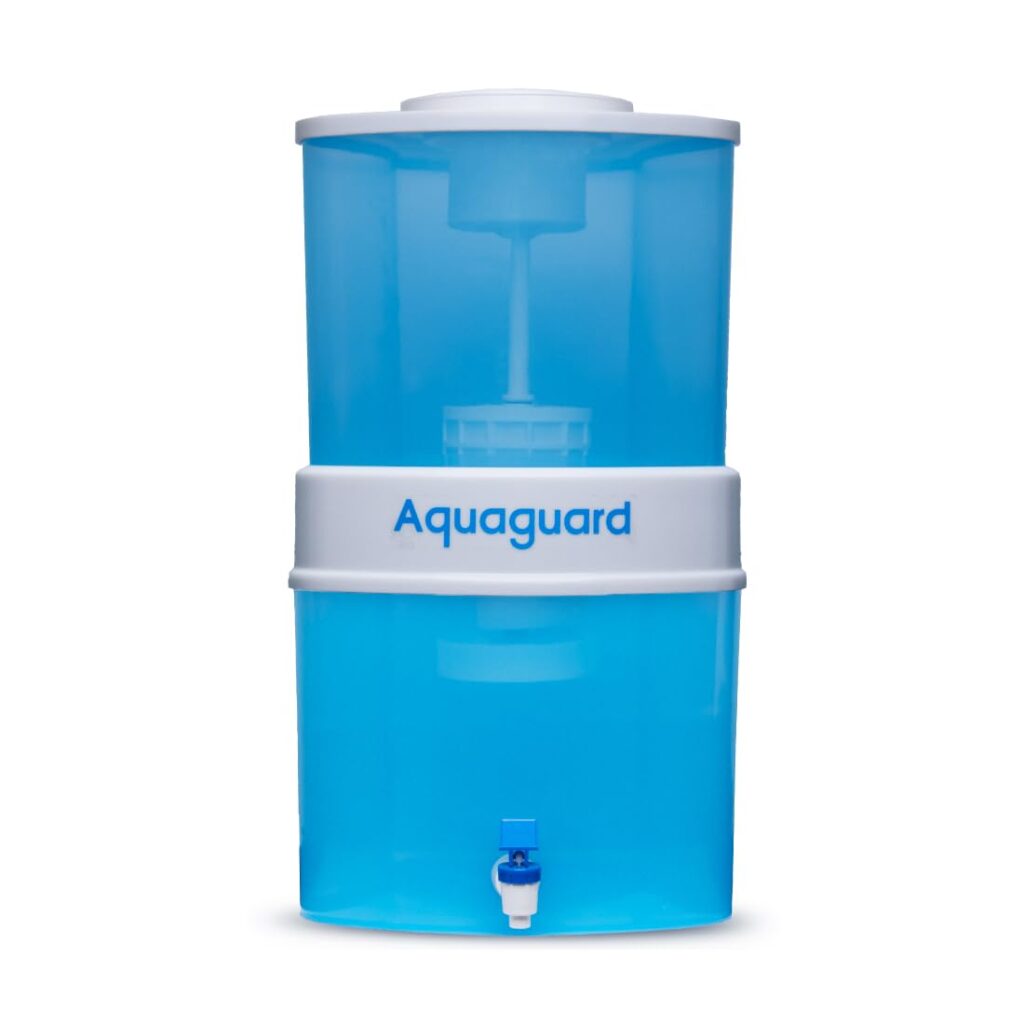
1. Aquaguard Amrit+ 6000 Non-Electric Water Purifier
⭐⭐⭐⭐⭐ 4.1/5
Aquaguard Amrit+ 6000 takes a different approach from the UF-only KENT models. Eureka Forbes lists a four-stage filtration system combining particulate and sediment filtration, activated carbon and Active Charge Technology for microbial protection. It has 21 litres of total storage, including 10 litres of purified water and 11 litres of raw water.
The manufacturer also specifies a cartridge life of up to 6,000 litres or about 15 months under stated test conditions. Its auto-shut-off feature is useful because it stops water flow when the cartridge reaches the end of its specified life.
Price: ₹3,399
| What We Liked | What We Didn’t Like |
|---|---|
| Four-stage filtration | Higher filter replacement cost |
| 21L capacity | Not an RO purifier |
| No electricity | Manufacturer’s claims depend on test conditions |
| Auto shut-off | 6-month warranty currently listed |
| 6,000L cartridge claim | Availability can vary |
Key Features
- 21L total storage
- 10L purified-water storage
- Four-stage filtration
- Activated carbon
- Active Charge Technology
- Auto shut-off
- No electricity required
Who Should Buy This?
Buyers who prefer a multi-stage branded non-electric purifier.
Who Should Avoid It?
People who specifically need TDS or hardness reduction.
Value for Money: Strong if you prefer multi-stage filtration over a basic gravity candle.
Editor’s Verdict: One of the more feature-rich non-electric choices in this list.
2. KENT Gold 20-Litres UF technology

⭐⭐⭐⭐☆ 3.9/5
KENT Gold is a 20-litre gravity-based purifier using a 0.1-micron hollow-fibre UF membrane. It is aimed at homes receiving low-TDS tap or municipal water and doesn’t require electricity or chemical dosing. The 20-litre capacity gives it enough storage for a typical family, while the UF membrane targets bacteria and cysts without removing naturally occurring minerals.
The main advantage is the combination of a recognised brand, relatively large storage and simple operation. The limitation is equally important: it isn’t designed to reduce TDS or hardness. KENT lists a 1-year warranty for the model.
Price: ₹3,299
| What We Liked | What We Didn’t Like |
|---|---|
| 20L storage | Not for high-TDS water |
| UF membrane | No RO/UV |
| No electricity required | Higher price than basic candle filters |
| Retains natural minerals | Needs filter maintenance |
| 1-year warranty | Source-water suitability matters |
Key Features
- 20L total storage
- 0.1-micron UF membrane
- Gravity-based operation
- No electricity required
- No chlorine, bromine or iodine used for purification
- Designed for low-TDS municipal water
- 1-year warranty
Who Should Buy This?
Families using low-TDS municipal or tap water who want a branded, electricity-free purifier.
Who Should Avoid It?
People using borewell or high-TDS water should look at an appropriate RO system instead.
Value for Money: Good if your water source matches its low-TDS use case.
Editor’s Verdict: The strongest all-round choice when you specifically need a non-electric UF purifier.
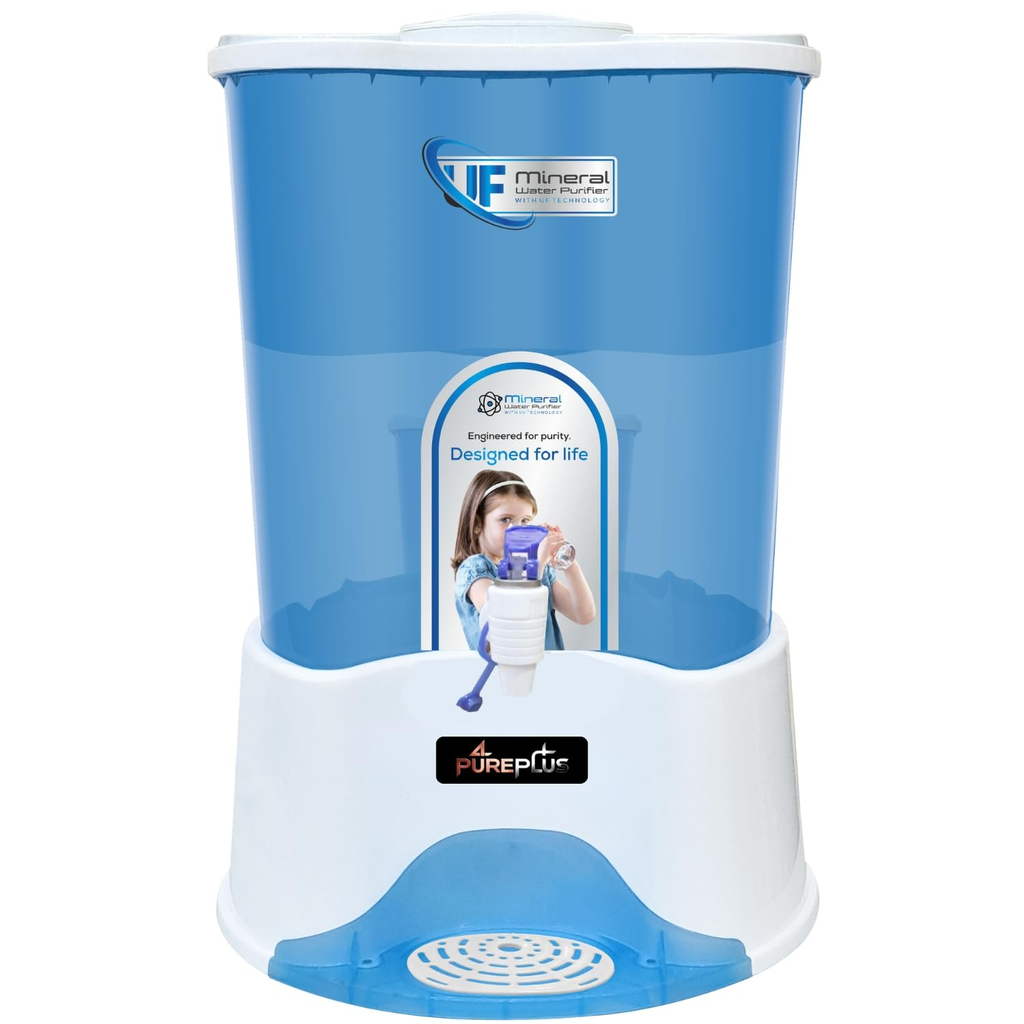
3. Pureplus 20 L Gravity Water Purifier
⭐⭐⭐⭐☆ 3.7/5
The Pureplus 20 L Gravity Water Purifier is a non-electric, UF-based water filtration system designed for homes that want basic filtration without electricity or chemical treatment. Its 20-litre capacity makes it suitable for small and medium-sized families, while the gravity-based design keeps operation simple. It can be a practical option for low-TDS municipal or tap water where RO-level purification is not required.
The main advantage is its simple operation and low running cost. You don’t need a power connection, and water can be filtered even during power cuts. However, buyers should check the exact filter specifications and replacement availability before purchasing. Like other gravity purifiers, it should not be treated as a substitute for an RO purifier when the source water has high TDS or dissolved contaminants.
Price: ₹1,994
| What We Liked | What We Didn’t Like |
|---|---|
| No electricity required | Not suitable for high-TDS water |
| UF-based filtration | Filter replacement cost should be checked |
| 20L capacity | Filtration is slower than powered purifiers |
| Chemical-free operation | Exact purification performance depends on the filter |
| Simple countertop design | May not suit homes needing RO purification |
Key Features
- 20-litre storage capacity
- Gravity-based filtration
- UF filtration technology
- Non-electric operation
- Chemical-free filtration
- Countertop design
- Suitable for low-TDS tap or municipal water
Who Should Buy This?
- Families looking for a non-electric water purifier
- People living in areas with low-TDS municipal water
- Tenants who don’t want plumbing or electrical installation
- Homes that need a purifier that works during power cuts
- Buyers looking for a lower-cost alternative to an electric purifier
Who Should Avoid It?
Avoid the Pureplus 20L if your water has high TDS, excessive hardness or other dissolved contaminants. A gravity UF purifier cannot provide the same type of dissolved-salt reduction as an RO purifier.
It may also not be the right choice if you need very fast purification for a large family.
Value for Money
A reasonable budget option if you have low-TDS water and specifically want a simple, electricity-free purifier.
Editor’s Verdict
The Pureplus 20 L is worth considering for basic filtration of low-TDS water, but check the actual filter specifications and replacement availability before buying.
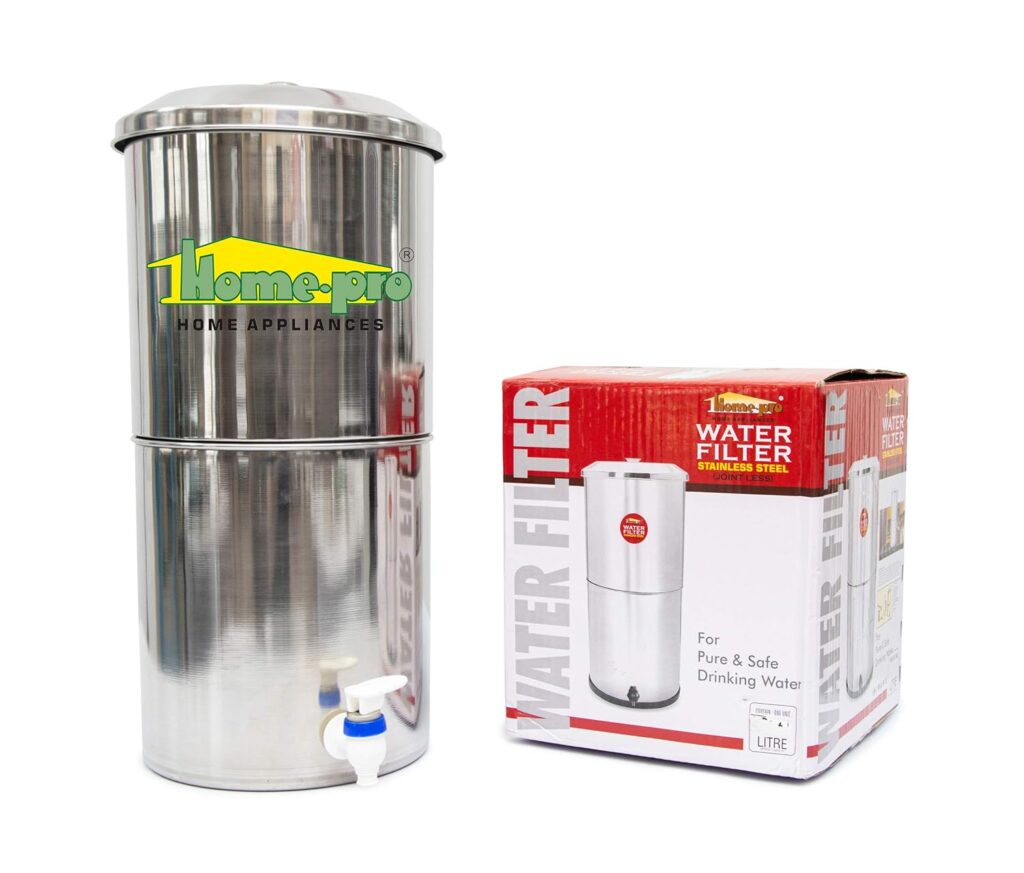
4. Home-Pro – Gravity Water Filter and Purifier
⭐⭐⭐⭐☆ 3.7/5
Home-Pro is a simple stainless-steel gravity water filter aimed at buyers who don’t want to spend several thousand rupees on a branded electric purifier. The commonly listed 16-litre version has an 8-litre upper and 8-litre lower chamber and includes a ceramic candle. It needs no electricity and can work as a straightforward household filtration system.
Its biggest advantage is its low purchase price and stainless-steel construction. However, customer-review data shows mixed ratings across variants, and some listings have different capacities and candle configurations. That makes it important to check the exact variant before ordering.
Price: Around ₹1,414
| What We Liked | What We Didn’t Like |
|---|---|
| Low price | Quality varies by variant |
| Stainless-steel body | Limited brand documentation |
| No electricity | Ceramic candles need maintenance |
| Simple operation | Not an RO replacement |
| Easy setup | Review ratings are mixed |
Key Features
- 16L variant available
- Stainless-steel body
- Ceramic filtration candle
- Gravity operation
- No electricity
- Counter-top design
Who Should Buy This?
Budget-conscious buyers looking for basic gravity filtration.
Who Should Avoid It?
Buyers who want a clearly documented filtration system, strong after-sales support or high-TDS treatment.
Value for Money: One of the cheapest options if your expectations are limited to basic filtration.
Editor’s Verdict: A practical budget option, but verify the exact capacity and candle configuration.
5. PRISTINE Stainless Steel Gravity Water Purifier
⭐⭐⭐⭐☆ 3.0/5
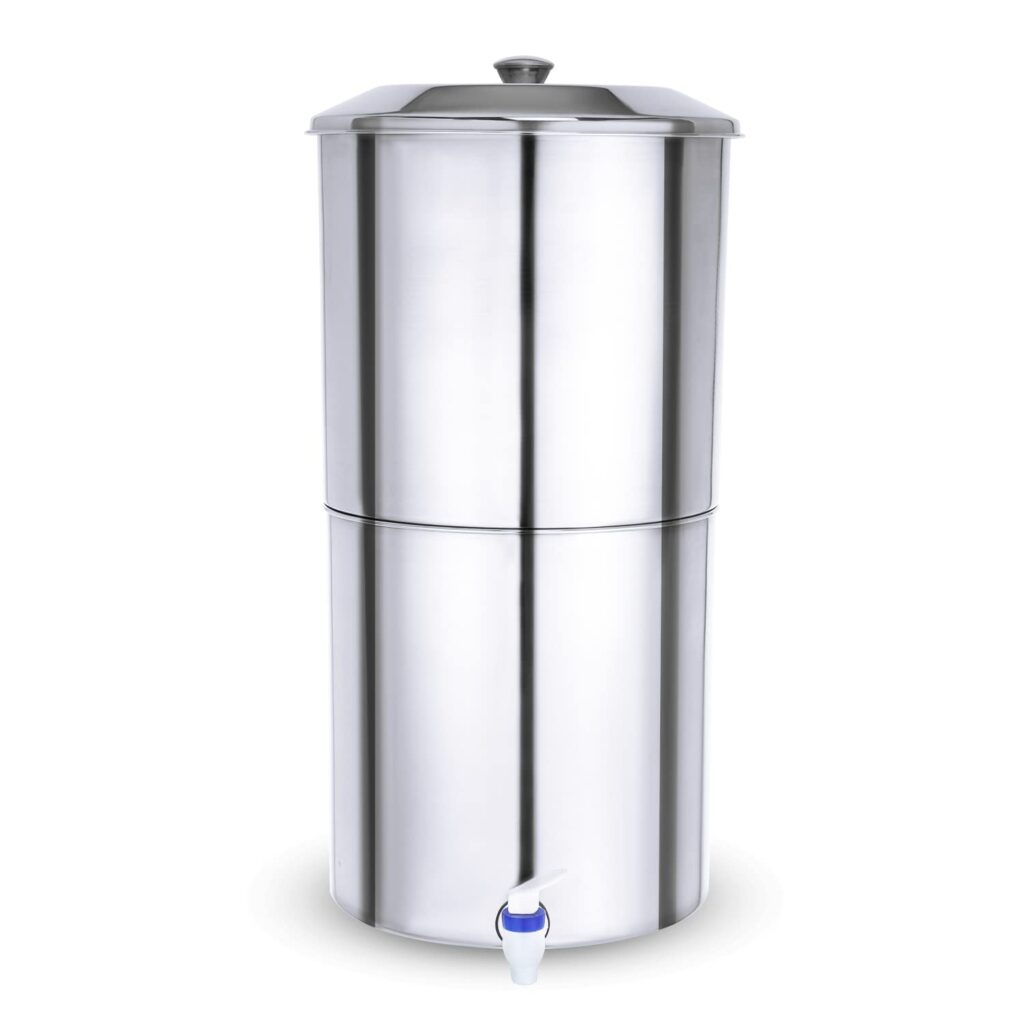
PRISTINE’s stainless-steel gravity purifier is aimed at buyers who prefer a metal body instead of plastic. The commonly listed WF20 version has 20 litres of capacity and uses ceramic candles for gravity filtration. Available listings describe the unit as non-electric, with a stainless-steel body, tap and filter candle.
The steel construction is its biggest practical attraction because it is easy to wipe and doesn’t rely on a large plastic reservoir. However, product information is less consistently documented than KENT or Aquaguard, and different listings can show different candle configurations. Buyers should therefore verify the exact model and included components before ordering.
Price: Around ₹1,747
| What We Liked | What We Didn’t Like |
|---|---|
| Stainless-steel body | Limited manufacturer information |
| 20L capacity | Ceramic candles require cleaning/replacement |
| No electricity | Filtration claims vary by listing |
| Simple construction | After-sales support may be less predictable |
| Budget-friendly | Not a TDS-reduction system |
Key Features
- 20L capacity
- Stainless-steel body
- Gravity filtration
- Ceramic filter candles
- No electricity
- Counter-top design
Who Should Buy This?
Buyers who prefer a simple stainless-steel gravity filter at a lower price.
Who Should Avoid It?
Those who want extensive manufacturer documentation or advanced purification technology.
Value for Money: Good for basic filtration and stainless-steel construction.
Editor’s Verdict: A straightforward option, but verify the exact listing carefully.
6. KENT Gold Optima Gravity Water Purifier

⭐⭐⭐⭐☆ 3.5/5
KENT Gold Optima is the compact member of KENT’s gravity purifier range. It has 10 litres of total storage, split into 5 litres of raw and 5 litres of purified water. It uses a 0.1-micron UF membrane and is designed for low-TDS tap or municipal water.
The compact format is particularly useful for small kitchens, tenants and smaller households. KENT also lists a high-base stand, which makes filling a glass easier without placing the unit directly at the edge of a counter. The biggest limitation is its small purified-water capacity compared with the 20L and 22L models.
Price: ₹1,899
| What We Liked | What We Didn’t Like |
|---|---|
| Compact size | Only 10L total capacity |
| UF membrane | Not for high-TDS water |
| No electricity | Smaller purified-water reserve |
| 1-year warranty | UF doesn’t reduce hardness |
| High-base stand | Not ideal for large families |
Key Features
- 10L total capacity
- 5L purified-water storage
- 0.1-micron UF membrane
- No electricity
- No chemical purification
- High-base stand
- 1-year warranty
Who Should Buy This?
Singles, couples, tenants and small families using low-TDS municipal water.
Who Should Avoid It?
Large families that need a bigger ready-to-use water reserve.
Value for Money: Good for small households that don’t need 20L storage.
Editor’s Verdict: The most practical compact KENT gravity purifier.
7. Pureit Classic 23 L Gravity-Based Water Purifier
⭐⭐⭐⭐⭐ 4.0/5
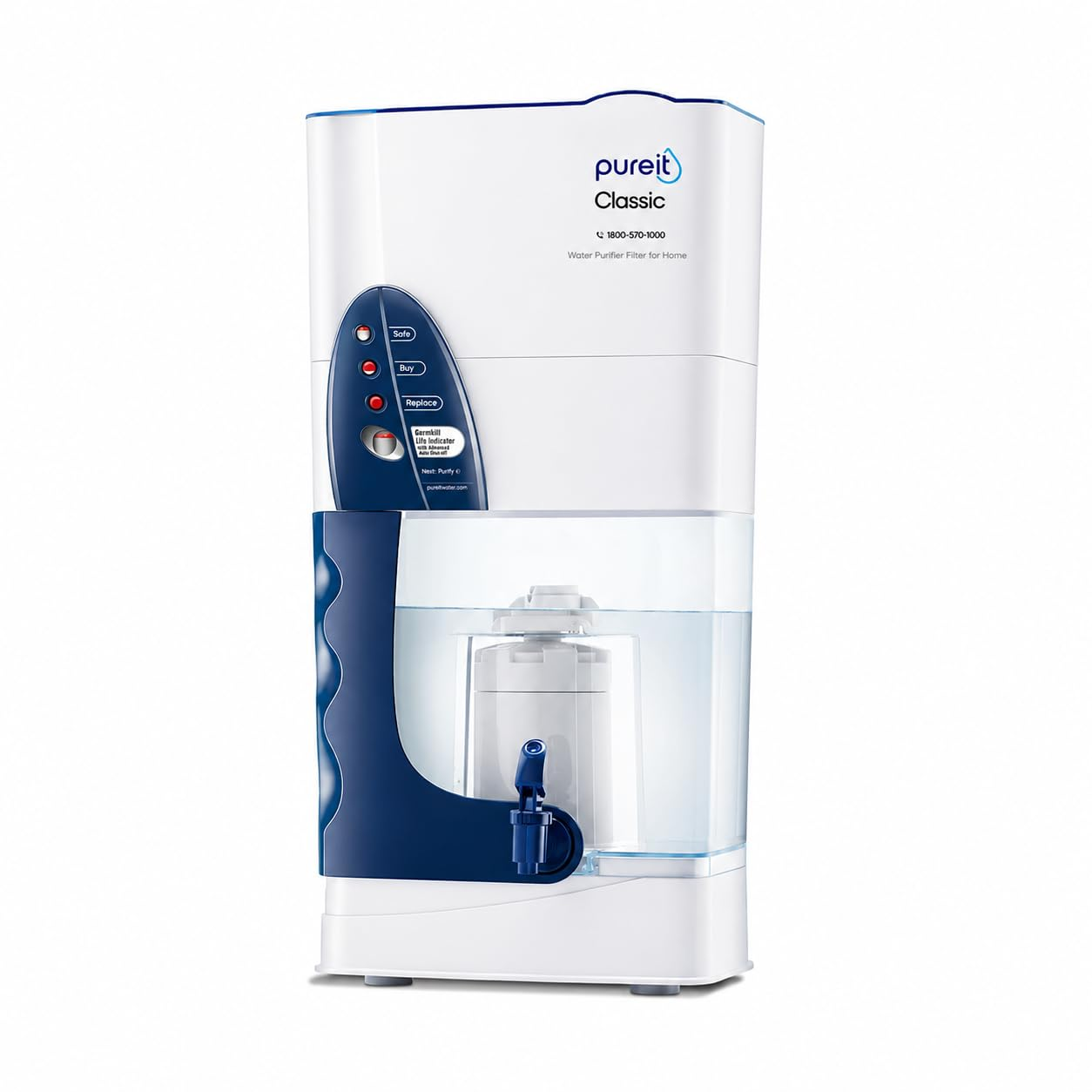
Pureit Classic offers one of the largest storage capacities in this group at 23 litres. The manufacturer describes four-stage purification, a long-lasting filter of up to 3,000 litres under stated test conditions, automatic shut-off and operation without electricity or a continuous tap-water connection.
Its large capacity suits families that prefer filling the purifier in batches rather than relying on a small reservoir. However, customer feedback isn’t uniformly positive. Recent marketplace reviews mention concerns about plastic quality and occasional leakage, so buyers should check the current product version and return policy.
Price: Around ₹2,999
| What We Liked | What We Didn’t Like |
|---|---|
| 23L capacity | Bulky |
| Four-stage purification | Plastic-quality complaints appear in reviews |
| No electricity | Filter kit replacement needed |
| Auto shut-off | 6-month warranty |
| Established product line | Not intended as a high-TDS RO replacement |
Key Features
- 23L storage
- Four-stage purification
- No electricity required
- Auto shut-off
- Up to 3,000L filter life under stated conditions
- Food-safe engineering-grade plastic
- 6-month warranty
Who Should Buy This?
Families wanting large storage and a well-established gravity purifier.
Who Should Avoid It?
Those wanting stainless steel construction or RO-level TDS reduction.
Value for Money: Good when large capacity is the priority.
Editor’s Verdict: A sensible choice for buyers who want storage and multi-stage filtration.
8. KENT Gold+ 20-litres Gravity Based Water Purifier

⭐⭐⭐⭐☆ 3.7/5
KENT Gold+ is a larger table-top gravity purifier with 20 litres of total storage, split into 10 litres for unfiltered water and 10 litres for purified water. It uses a 0.1-micron hollow-fibre UF membrane and is designed for low-TDS municipal or tap water.
Compared with compact gravity purifiers, its 20-litre capacity makes it more practical for families who consume a lot of drinking water during the day. It doesn’t use electricity or chemical disinfectants. Its main limitation remains the same as other UF-only purifiers: it doesn’t reduce dissolved salts or hardness. KENT specifies a 1-year warranty.
Price: ₹3,449
| What We Liked | What We Didn’t Like |
|---|---|
| 20L capacity | Not suitable for high-TDS water |
| 10L purified storage | No RO |
| UF filtration | Takes more counter space |
| No electricity | Higher cost than basic filters |
| 1-year warranty | Filter replacement required |
Key Features
- 20L total capacity
- 10L purified-water storage
- UF membrane
- 20L/hr purification capacity claimed by KENT
- Gravity-based operation
- Table-top design
- 1-year warranty
Who Should Buy This?
Families that need more ready-to-use filtered water and have low-TDS municipal water.
Who Should Avoid It?
Homes dependent on borewell or hard water.
Value for Money: Worth considering when storage capacity matters more than a low purchase price.
Editor’s Verdict: A better family-oriented choice than a small gravity purifier.
9. KENT Gold Star 22-litre Gravity-Based Water Purifier
⭐⭐⭐⭐☆ 3.7/5
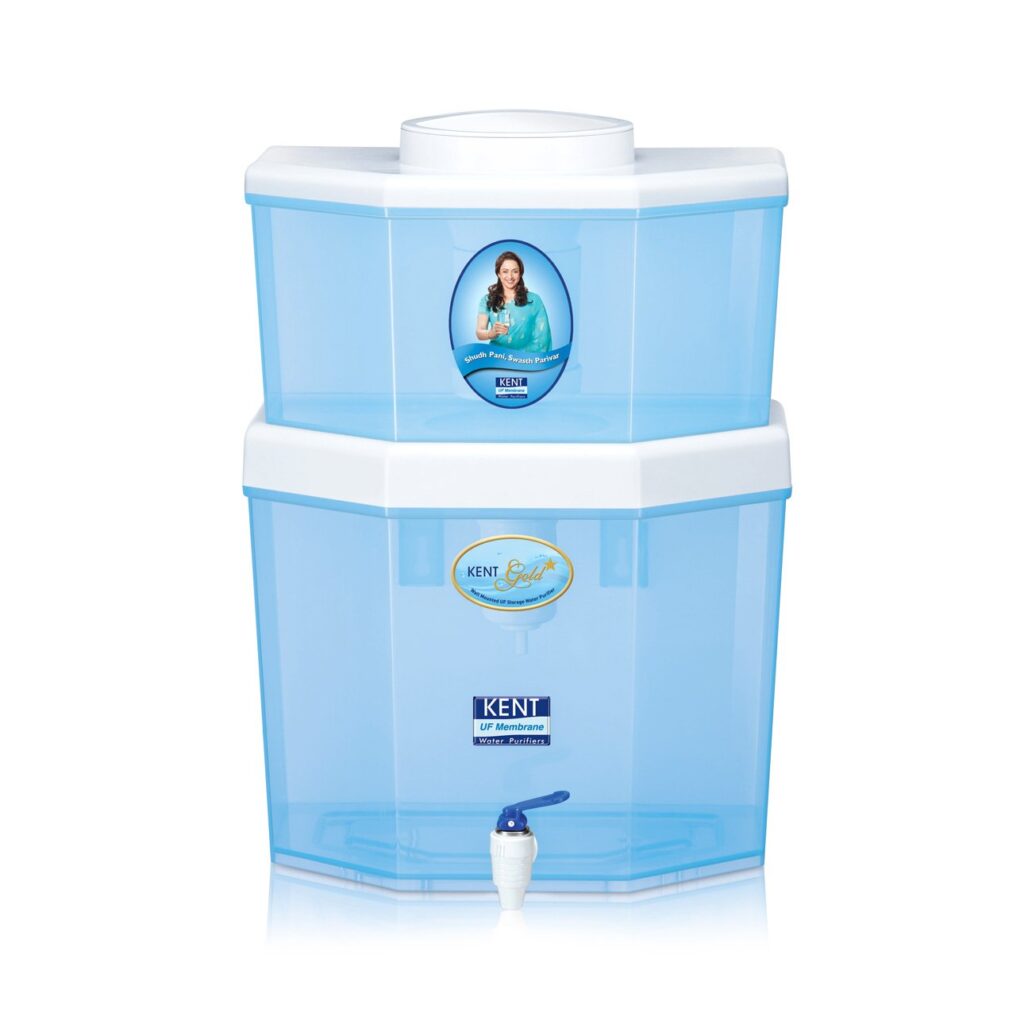
KENT Gold Star is the larger premium model in KENT’s gravity range, with 22 litres of total storage. KENT specifies 8 litres in the upper raw-water tank and 14 litres in the lower purified-water tank. It uses the same 0.1-micron hollow-fibre UF approach used across the Gold range and is designed for low-TDS municipal water.
The 22-litre capacity is useful for families because more filtered water remains available after the upper chamber has been emptied. The main limitation is not capacity but water-source compatibility: UF cannot remove dissolved salts or hardness.
Price: ₹2,899
| What We Liked | What We Didn’t Like |
|---|---|
| 22L capacity | Not for high-TDS water |
| 14L purified storage | No RO |
| UF membrane | Larger footprint |
| No electricity | Replacement filters add cost |
| 1-year warranty | Currently listed as sold out on KENT’s site |
Key Features
- 22L total capacity
- 14L purified storage
- 8L raw-water storage
- 0.1-micron UF membrane
- No electricity
- Chemical-free purification
- 1-year warranty
Who Should Buy This?
Families that want a large purified-water reserve from a non-electric purifier.
Who Should Avoid It?
People with high-TDS or hard water.
Value for Money: Good when storage is more important than compactness.
Editor’s Verdict: A strong family-size alternative to KENT Gold+.
10. RAMA Gravity Water Filter

⭐⭐⭐⭐☆ 3.9/5
RAMA Gravity Water Filter is the premium stainless-steel option in this list. Its current range includes different capacities and candle configurations, including 24-litre systems with stainless-steel housing, stand and carbon or ceramic candles. RAMA states that its carbon-candle systems use activated carbon and can reduce bacteria and other contaminants while retaining minerals.
The manufacturer also offers a 10-year warranty on the stainless-steel housing for specified systems. This is a very different proposition from a ₹1,500 plastic gravity purifier: you’re paying considerably more for stainless-steel construction, candle options and the warranty.
Price: Around ₹5,939
| What We Liked | What We Didn’t Like |
|---|---|
| Stainless-steel construction | Expensive |
| Multiple candle options | Limited marketplace review volume |
| Large capacity options | Takes more space |
| 10-year housing warranty on specified systems | Replacement candles add cost |
| No electricity | Exact performance depends on candle configuration |
Key Features
- Stainless-steel housing
- Multiple capacity options
- Carbon and ceramic candle options
- Gravity-based operation
- No electricity
- Stainless-steel stand options
- 10-year housing warranty on specified systems
Who Should Buy This?
Buyers willing to spend more for a stainless-steel gravity filtration system.
Who Should Avoid It?
Budget buyers who simply need basic filtered water.
Value for Money: Expensive upfront, but more appealing if long-term stainless-steel construction is important.
Editor’s Verdict: The premium choice for buyers who specifically want a stainless-steel gravity system.
Non Electric Water Purifier Buyer’s Guide
What is a Non-Electric Water Purifier?
A non-electric or gravity-based water purifier filters water using gravity, without electricity. Water is poured into the upper tank, passes through a filter and collects in the lower tank.
Depending on the model, filtration may use UF, activated carbon or other filter media to reduce impurities, bacteria and cysts. These purifiers are generally suitable for low-TDS water and are useful during power cuts.
Non-electric purifiers are one type of water filtration system. Before buying, compare them with other water purifier types, such as RO, UV, UF and activated-carbon purifiers.
What is the UF water purifier?
UF stands for ultrafiltration. It is a non-electric water purifier and works on gravity. Unfiltered water was poured into the top chamber, and using a UF filter, water was purified and collected in the bottom chamber.
The UF membrane restricts the bacteria, germs, and other impurities during the manual filtration process. This is a chemical-free purification and requires weekly cleaning. UF water purifiers are suitable for water purifiers with low TDS (total dissolved solids). These kinds of water purifiers are inexpensive as they do not require electricity to work.
Source https://crystalquest.com/pages/what-is-ultrafiltration
Advantages of Ultrafiltration Water Purifier
- It works without electricity
- For filtration, Chemical is not used.
- It removes germs, bacteria, and other impurities using the UF membrane
- It has a long life and can be used for 3 to 5 years.
How does a gravity-based water purifier work?
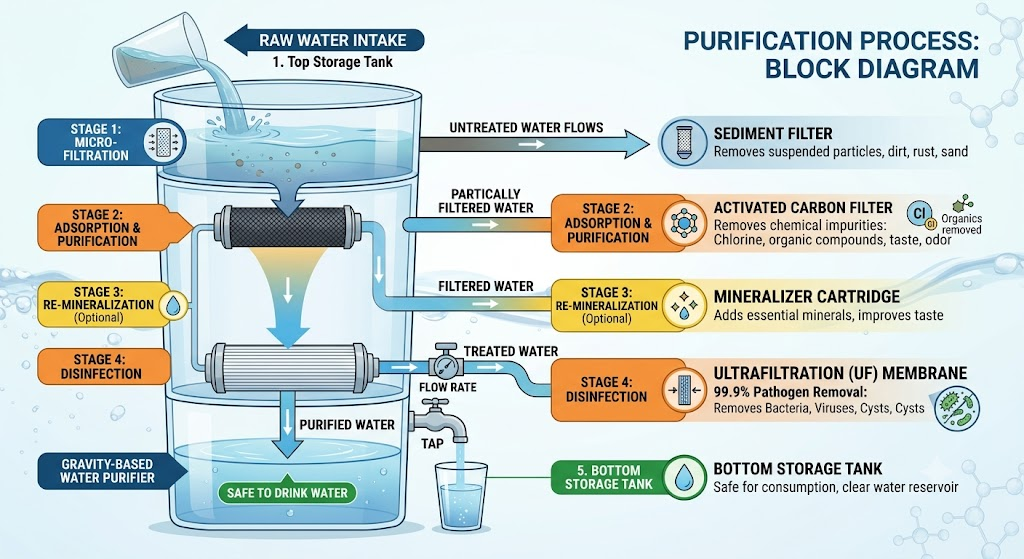
Gravity-based water purifiers are non-electric water purifiers. It filters water using a normal gravity process. Water flows from the top container to the bottom using gravity.
The filtration is done using activated carbon or Ultrafiltration. Activated carbon absorbs the impurities. It’s small-sized carbon granules, whereas in UF, water passes through the hollow fibers, and impurities stick in membranes.
In the filtration process, water flows from the top to the bottom container. The filter placed in the middle of the two containers filters the water. In the filter process, water flows through different parts of the filter to remove dirt particles, bacteria, germs, and other impurities. First, water flows through the microfiber mesh, then the activated carbon filter, and then the UF membrane for the last stage of the filter. Finally, water reaches the bottom container after the filtration process.
Things to consider while buying a water purifier
Before choosing a model, first understand the different types of water purifier for home and what each technology does.
Please go through the below points and, based on your requirements, buy the best non-electric water filter for your home.
1. Check your TDS before buying
This is the most important step.
A gravity purifier with UF or a ceramic candle is not an automatic replacement for RO. KENT explicitly states that its UF models are intended for low-TDS water and don’t reduce dissolved salts or hardness.
If your home uses:
- Low-TDS municipal water: A gravity purifier can make sense.
- High-TDS borewell water: Consider an appropriate RO purifier.
- Hard water: Don’t assume a UF or ceramic filter will soften it.
- Tanker water: Test the water before choosing the filtration technology.
2. Don’t choose only by storage capacity
A 30L purifier isn’t automatically better than a 10L purifier.
A large tank is useful for a family, but it also occupies more counter space. A 10L purifier may be perfectly adequate for one or two people.
3. UF vs ceramic vs activated carbon
UF: Useful for removing suspended particles and certain microorganisms while retaining dissolved minerals. It doesn’t reduce TDS.
Activated carbon: Mainly useful for improving taste, odour and reducing certain chemicals such as chlorine.
Ceramic candle: Provides physical filtration through the candle material. Actual performance depends heavily on the candle design and maintenance.
Multi-stage filtration: Combines different media, potentially addressing more than one type of contaminant.
Don’t assume that “4-stage” automatically means better than “UF”. The actual filter media matter more than the number printed on the box.
4. Consider purified-water storage
For a family of four, 10 litres of purified storage may feel small if everyone drinks filtered water throughout the day.
A 20L or 23L model can reduce the need to refill the upper chamber repeatedly.
5. Look at filter replacement cost
The purchase price is only the beginning.
Before buying, check:
- Replacement filter price
- Filter availability
- Replacement frequency
- Whether you can replace it yourself
- Whether branded replacement cartridges are easily available
A ₹1,500 purifier can become less attractive if replacement candles are difficult to source.
6. Check the warranty
Warranty varies considerably.
For example, KENT lists a 1-year warranty on several of its gravity models, while the current Eureka Forbes listing for Amrit+ 6000 shows a 6-month warranty. Pureit Classic’s current manufacturer page also lists a 0.5-year warranty.
Always check the current product page because warranty terms can change.
7. Don’t confuse filtration with water disinfection
A purifier can remove certain particles or microorganisms without addressing every possible contaminant.
If you’re unsure about your water quality, get it tested rather than selecting a purifier based only on marketing claims.
Which Non-Electric Water Purifier Should You Buy?
| Buying Need | Recommended Product | Why |
|---|---|---|
| For a family using municipal water | KENT Gold or KENT Gold+ | Both offer 20L capacity and UF filtration, making them practical choices for daily use when the water has low TDS. |
| For a small family or rented home | KENT Gold Optima | Its 10L capacity takes up less space and is better suited to smaller households and kitchens. |
| For the lowest budget | Home-Pro | A budget-friendly option if you want stainless-steel construction and simple gravity-based filtration. |
| For multi-stage filtration | Aquaguard Amrit+ 6000 | Offers four-stage filtration and 21L total capacity, making it the more feature-rich option. |
| For maximum storage | Pureit Classic 23L | Its 23L capacity provides more storage than the other mainstream plastic models in this comparison. |
| For stainless-steel construction | PRISTINE or RAMA | PRISTINE is the more budget-oriented choice, while RAMA is the premium option for buyers willing to spend more. |
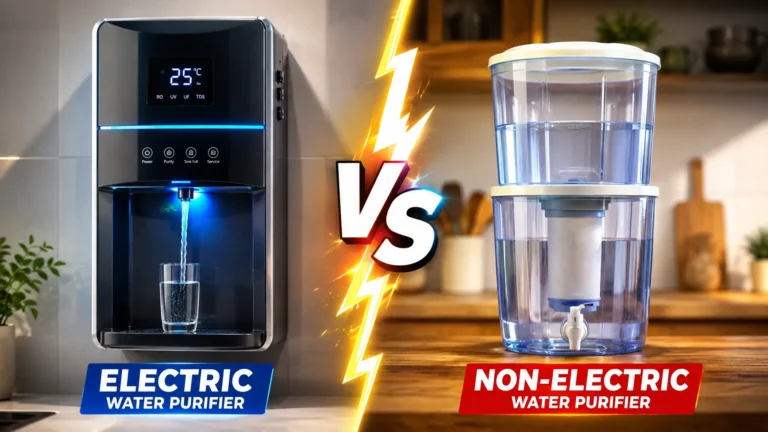
Non-electric vs Electric purifier
| Factor | Non-Electric | Electric |
|---|---|---|
| Electricity | No | Required |
| Purification | Basic filtration | RO/UV/UF options |
| Best for | Low-TDS water | High-TDS water |
| Running Cost | Low | Higher |
| Power Cuts | Works | Doesn’t work |
| Choose If | Simple, low-cost purification | Water quality is a bigger concern |
You can read our guide on Difference between electric and non-electric water purifier for complete details.
Conclusion:
Healthy drinking water is essential in everyone’s life. With Contaminated water, a lot of unwanted material enters our bodies and makes us unhealthy. Pollution levels have increased in the last few years, and it is affecting our natural resources such as plants and water. Now, it has become essential to use a water purifier to clean the water.
A gravity-based water purifier is the best economical solution for rural places. In India, where there is a power shortage and a lot of power cuts, this non-electric water purifier is best to use. Based on our review, the KENT Gold Optima 10-Litres Gravity Non-electric Water Purifier is the best. In the above list, there are water purifiers in different capacities and designs. Choose the water purifier according to your needs.
If you’re not limited to non-electric models, compare these options with our guide to the best water purifier in India.
FAQs:
Is a non-electric water purifier good for home use?
Yes, if your source water is suitable for the filtration method. They are particularly useful for low-TDS municipal water and homes that experience power cuts.
Which is the best non-electric water purifier in India?
For low-TDS municipal water, KENT Gold is our overall pick because it combines 20L storage, UF filtration, gravity operation and a 1-year warranty.
Which is the best non-electric water purifier for a family?
KENT Gold+ is a strong choice because it provides 20L total storage with 10L purified-water storage.
Does a non-electric purifier remove TDS?
Usually, no. UF and many gravity-based filters do not reduce dissolved salts. If TDS reduction is required, an appropriate RO system may be necessary.
Is KENT Gold suitable for borewell water?
KENT says its Gold purifier is designed for low-TDS tap and municipal water and isn’t suitable for high-TDS or hard water.
Does Pureit Classic require electricity?
No. Pureit Classic is a gravity-based purifier that operates without electricity.
Which is better, KENT Gold or KENT Gold Optima?
Choose KENT Gold for higher storage and a family. Choose Gold Optima when space and lower capacity are more important. Gold has 20L storage, while Gold Optima has 10L.
Is Aquaguard Amrit+ 6000 non-electric?
Yes. Eureka Forbes lists it as a gravity-based purifier that doesn’t require electricity.
How often should a gravity purifier filter be changed?
It depends on the purifier and filter type. Follow the manufacturer’s stated replacement interval rather than using a universal schedule.
Is stainless steel better than plastic for a water purifier?
Not automatically. Stainless steel can appeal to buyers looking for a metal body and easy cleaning, but filtration performance depends on the filter media, not simply the outer material.
Feel free to write in the comment section if you have any queries related to the non-electric water purifier.
Related Posts:
- 10 Best Non electric Water Purifier in India with Price
- Alkaline Water Purifiers Explained
- Difference between electric and non-electric water purifier
- 10 Best Water Purifier For Home in India 2026
Sourabh researches and writes about home appliances, kitchen appliances, and common appliance problems to help readers make informed buying decisions. He covers mixer grinders, refrigerators, air conditioners, washing machines, and appliance troubleshooting.
At ReviewSpot, Sourabh compares manufacturer specifications, product features, warranty information, pricing, and customer feedback to turn technical appliance information into practical buying advice. His goal is to help readers understand their options, avoid costly mistakes, and choose products that fit their needs and budget.
ReviewSpot distinguishes manufacturer information, customer feedback, and editorial analysis, and does not describe products as hands-on tested unless they have actually been tested.