
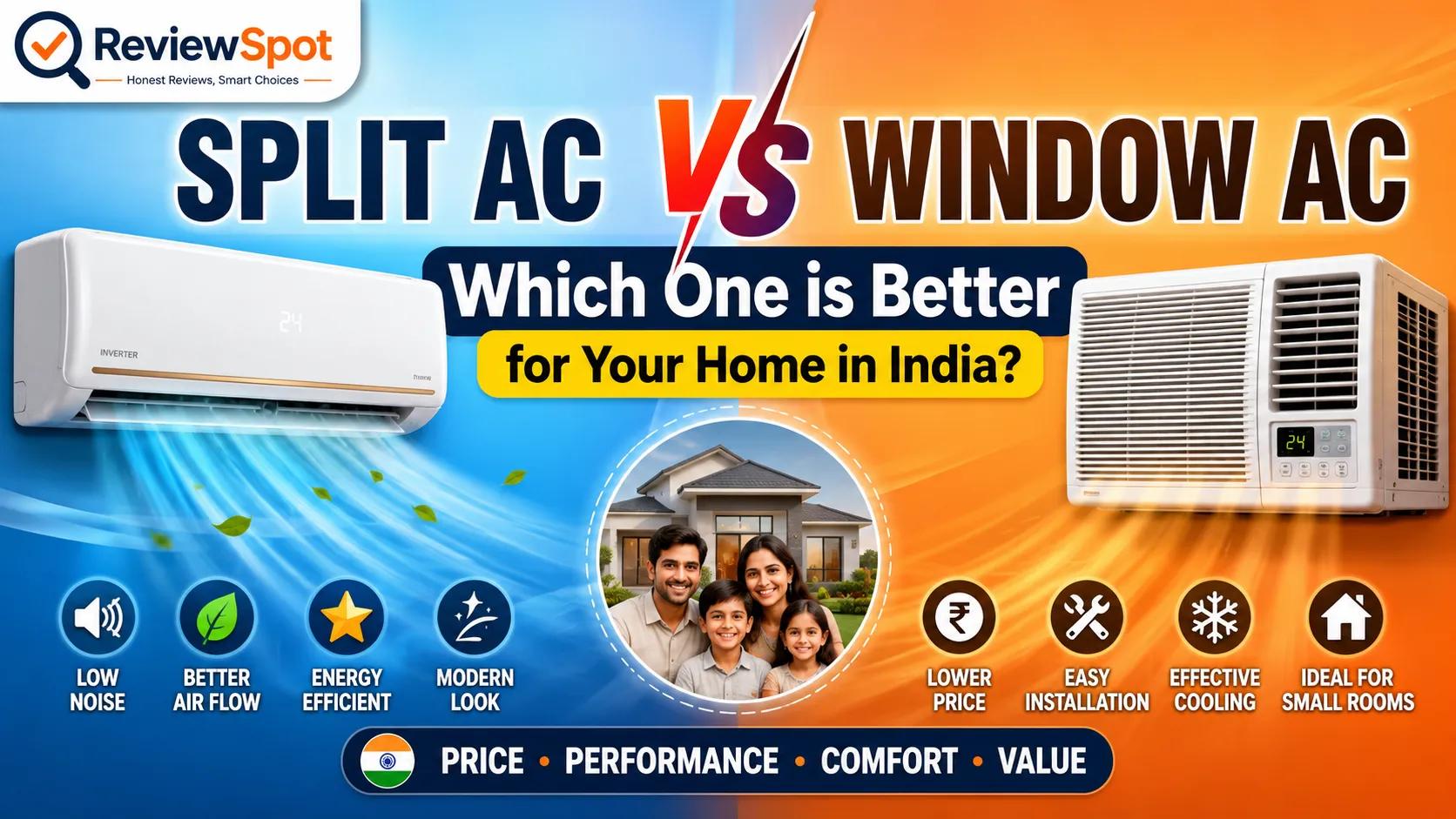
Split AC vs Window AC: Which One is Better for Your Home in India? (2026 Complete Buying Guide)

Buying a new air conditioner looks simple until you visit an electronics store or browse online. Suddenly, you have two popular options Split AC and Window AC. Both can cool your room, but they differ in installation, electricity consumption, noise level, maintenance, price, and long-term value.
Many Indian buyers make the mistake of choosing an AC based only on price. A cheaper AC may cost you more in electricity bills over the next 8–10 years. Likewise, spending extra on a premium Split AC isn’t always the right decision if your room or budget doesn’t justify it.
This guide compares Split AC vs Window AC in detail using practical Indian examples. By the end, you’ll know exactly which AC is right for your home, apartment, office, rental property, or small room.
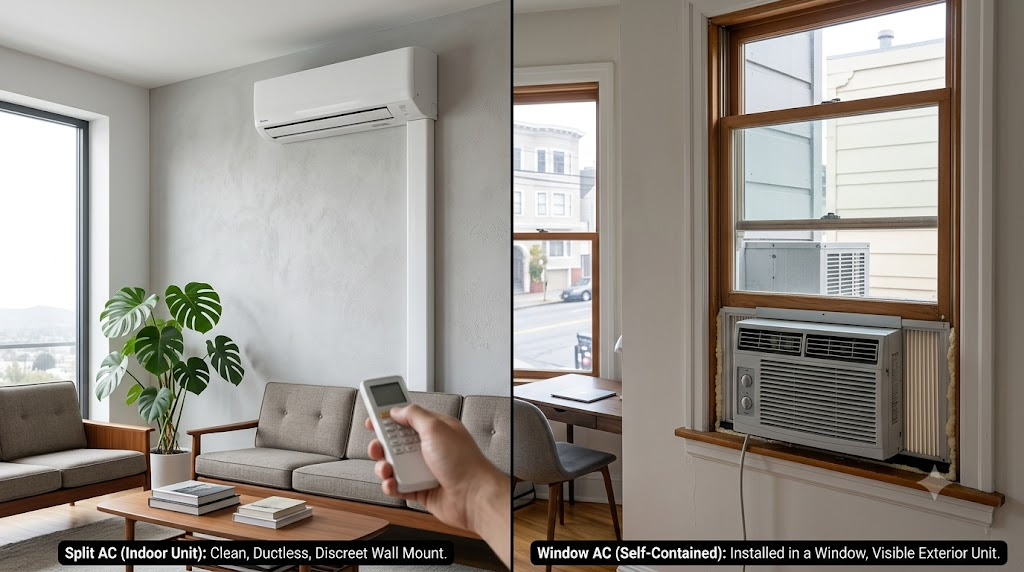
Split AC vs Window AC
Choose a Split AC if you want quieter cooling, better energy efficiency, modern features, and superior looks.
Choose a Window AC if you have a limited budget, need easy installation, live in a rented house, or want lower maintenance costs.
For most Indian families purchasing an AC for long-term use, a 5-Star Inverter Split AC is usually the better investment. However, a Window AC still offers excellent value for small rooms and rental homes.
Split AC vs Window AC at a Glance
| Feature | Split AC | Window AC | Winner |
|---|---|---|---|
| Cooling | Excellent | Good | Split AC |
| Electricity Saving | Excellent | Good | Split AC |
| Noise | Very Low | Moderate to High | Split AC |
| Purchase Price | Higher | Lower | Window AC |
| Installation | Complex | Easy | Window AC |
| Maintenance | Moderate | Easy | Window AC |
| Appearance | Premium | Basic | Split AC |
| Air Distribution | Excellent | Good | Split AC |
| Smart Features | Many | Limited | Split AC |
| Rental Homes | Moderate | Excellent | Window AC |
| Long-Term Value | Excellent | Good | Split AC |
What is a Split AC?
A Split AC has two separate units.
- Indoor unit installed inside the room
- Outdoor compressor unit installed outside the house
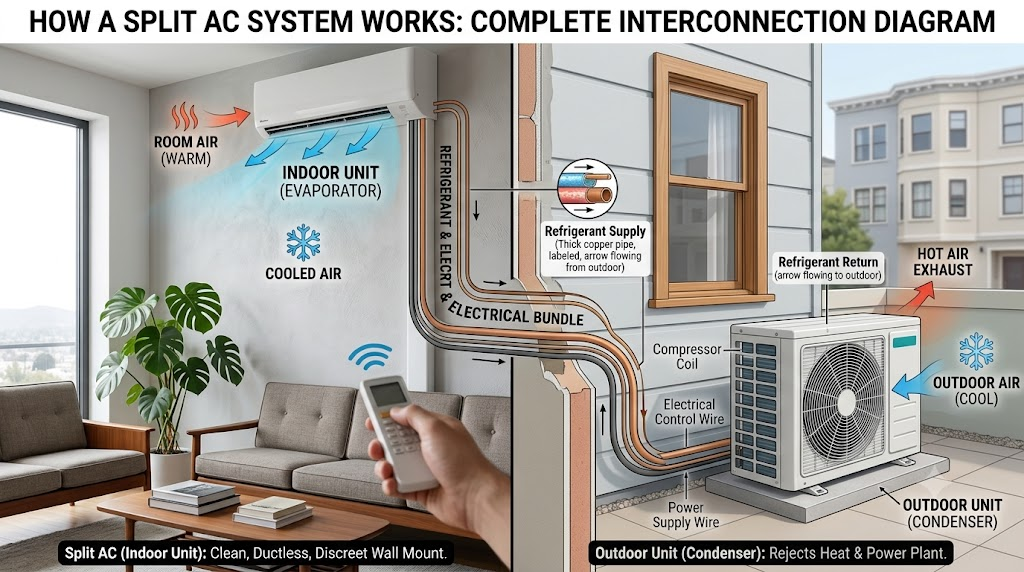
Copper pipes connect both units. Since the compressor remains outside, the indoor room stays much quieter. Today’s Split ACs also include several modern features like:
- Inverter compressor
- Wi-Fi connectivity
- AI cooling
- Convertible modes
- Air purification filters
- Self-cleaning function
These features make Split ACs the preferred choice in most modern Indian homes.
What is a Window AC?
A Window AC contains all components inside one compact box. The compressor, condenser, evaporator and cooling fan are fitted into a single unit.
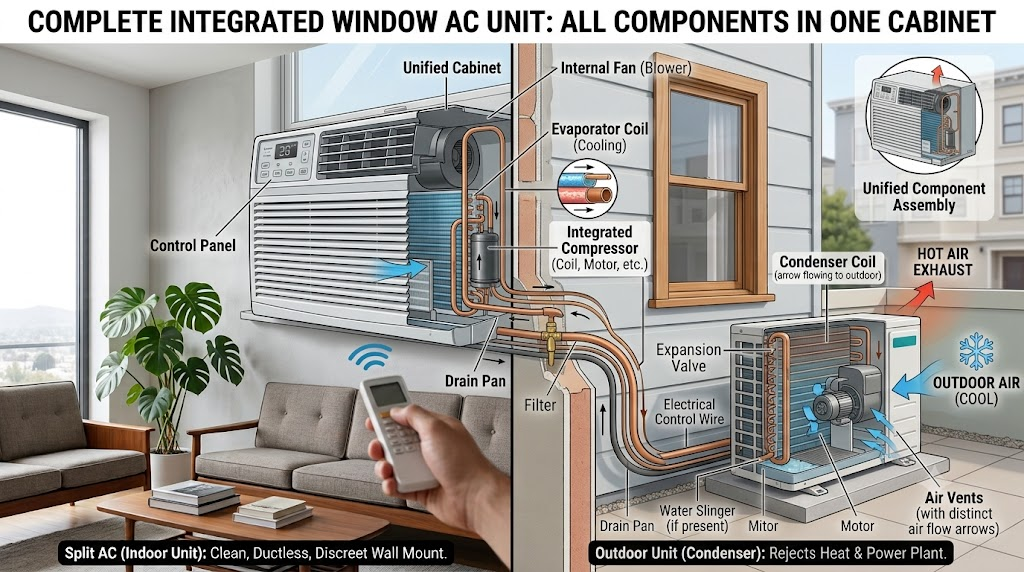
The AC is installed in a window or a wall opening because the compressor remains inside the same unit, Window ACs produce more noise compared to Split ACs.
However, they are Less expensive, easier to install and easier to remove when shifting houses. This makes them popular among tenants and budget-conscious buyers.
Split AC vs Window AC: Detailed Comparison
1. Cooling Performance
Cooling performance depends on several factors:
- Room size
- Insulation
- Sunlight exposure
- Ceiling height
- Outdoor temperature
| Feature | Split AC | Window AC |
|---|---|---|
| Cooling Distribution | Distributes cool air evenly across the entire room. | Cools the area directly in front of the unit first. |
| Air Throw | Larger air throw covers a wider area. | Shorter air throw with limited reach. |
| Airflow | Better airflow ensures uniform cooling. | Airflow is concentrated near the AC unit. |
| Swing Movement | Wider horizontal and vertical swing for even cooling. | Limited air swing compared to Split AC. |
| Compressor Technology | Inverter models continuously adjust compressor speed instead of switching ON and OFF repeatedly. | Standard models usually cycle the compressor ON and OFF, although inverter Window ACs are also available. |
| Cooling Speed | Cools the room faster and reaches the desired temperature quickly. | Takes slightly longer to cool, especially in larger rooms. |
| Temperature Stability | Maintains a consistent room temperature with fewer fluctuations. | Temperature may fluctuate more due to compressor cycling. |
| Comfort Level | Offers better comfort with uniform cooling across the room. | Provides good comfort in small rooms but may cool unevenly in larger or irregular-shaped rooms. |
| Best Room Size | Suitable for medium to large rooms and open spaces. | Performs well in square rooms up to 150 sq. ft. |
| Performance in Irregular Rooms | Delivers even cooling in most room layouts. | May struggle to cool rooms with awkward layouts evenly. |
| Overall Cooling Performance | ⭐⭐⭐⭐⭐ Excellent | ⭐⭐⭐⭐☆ Good (Best for small rooms) |
| Winner | ✅ Split AC | — |
2. Electricity Consumption
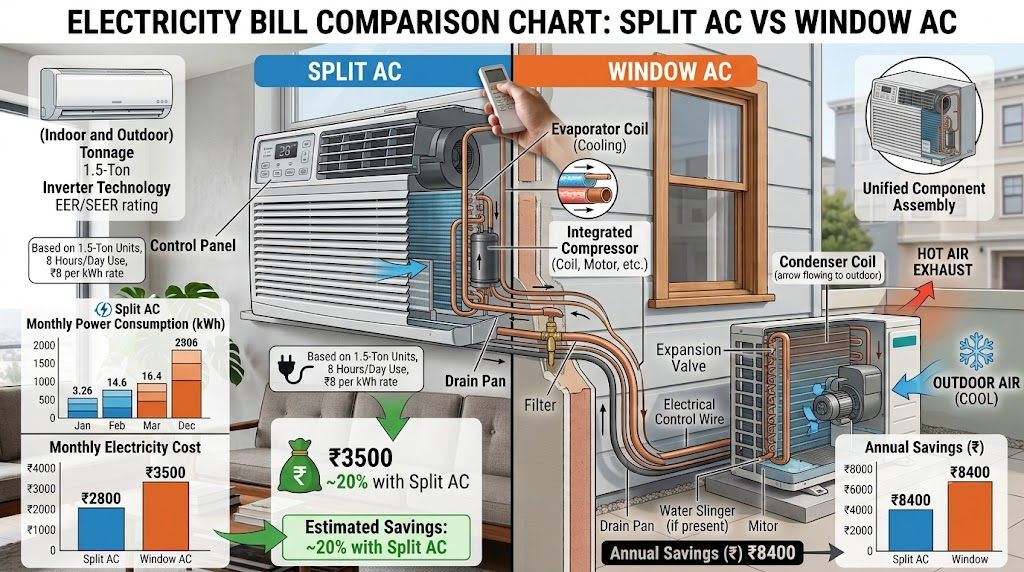
Electricity bills are one of the biggest concerns for Indian families. Many people assume Window AC always consumes more electricity. That isn’t completely true. Electricity usage depends on:
- Star rating
- Inverter technology
- Room insulation
- Outdoor temperature
- Usage hours
- Temperature setting
For example,
A 5-Star Inverter Split AC can consume significantly less electricity than an older 3-Star Window AC. Approximate monthly consumption (8 hours/day)
| AC Type | Monthly Units |
|---|---|
| 5-Star Inverter Split AC | 130–180 units |
| 3-Star Split AC | 170–230 units |
| 3-Star Window AC | 180–250 units |
Tips to Reduce Electricity Bills
Regardless of which AC you buy:
- Set temperature between 24°C and 26°C.
- Keep doors and windows closed.
- Clean air filters every 15–30 days.
- Use ceiling fans along with AC.
- Seal air leaks around doors.
- Avoid direct sunlight with curtains.
- Service your AC annually.
You should also learn Which Mode is Best for AC to Save Electricity because using Eco Mode or Auto Mode correctly can reduce power consumption without affecting comfort.
Winner
Split AC (especially Inverter models)
3. Noise Level
Noise becomes important if:
- You work from home.
- You attend online meetings.
- You have babies.
- You’re a light sleeper.
| Feature | Split AC | Window AC |
|---|---|---|
| Compressor Location | Compressor is installed outside the room. | Compressor is built inside the same unit. |
| Indoor Operation | Only the indoor fan operates inside the room. | Both the fan and compressor operate in the same unit. |
| Typical Noise Level | 20–40 dB | 45–60 dB |
| Noise Comparison | Similar to a quiet library or soft whisper. | Comparable to a normal conversation or moderate background noise. |
| Compressor Noise | Minimal compressor noise is heard inside the room. | Compressor noise is clearly audible indoors. |
| Startup Noise | Smooth and quieter startup, especially in inverter models. | Compressor startup may produce a noticeable increase in noise. |
| Comfort During Sleep | Excellent for uninterrupted sleep due to quiet operation. | Noise may disturb light sleepers. |
| Best for Work from Home | Ideal for online meetings, video calls, and focused work. | Background noise may be noticeable during meetings. |
| Best for Babies and Elderly | Better choice because of low operating noise. | Less suitable due to higher noise levels. |
| Overall Noise Performance | ⭐⭐⭐⭐⭐ Very Quiet | ⭐⭐⭐☆☆ Moderate Noise |
| Winner | ✅ Split AC | — |
4. Installation
Installation is where many buyers underestimate the total cost.
| Feature | Split AC | Window AC |
|---|---|---|
| Installation Complexity | More complex and time-consuming. | Simple and quick to install. |
| Required Components | Copper pipes, drain pipe, outdoor unit stand, electrical wiring, and insulation. | Single unit with minimal additional components. |
| Wall Drilling | Required for copper pipes and drainage. | Usually not required if a suitable window opening already exists. |
| Outdoor Unit | Required and installed outside the building. | Not required. |
| Vacuuming & Gas Pressure Check | Necessary to ensure proper installation and cooling efficiency. | Generally not required. |
| Installation Time | Usually 3–5 hours. | Usually 1–2 hours. |
| Labour Charges | Higher due to complex installation. | Lower because installation is simpler. |
| Additional Costs | Extra charges may apply for longer copper pipes, brackets, wiring, or drain pipe extensions. | Additional costs are usually minimal if a suitable window opening is available. |
| Suitable for New Apartments | Yes, as most modern apartments are designed for Split ACs. | May not be suitable because many new apartments do not have Window AC openings. |
| Overall Installation Cost | Higher | Lower |
| Winner | — | ✅ Window AC |
5. Purchase Cost
Price matters for every buyer. Approximate price range in India:
| Feature | Split AC | Window AC |
|---|---|---|
| Approximate Price Range (India) | ₹30,000–₹60,000+ | ₹22,000–₹38,000 |
| Premium Models | Premium inverter and smart models can cost ₹70,000 or more. | Premium Window ACs are generally more affordable than Split ACs. |
| Initial Investment | Higher upfront cost. | Lower upfront cost, making it budget-friendly. |
| Long-Term Running Cost | Lower electricity consumption (especially 5-Star Inverter models) can reduce monthly power bills. | May have slightly higher running costs depending on the model and star rating. |
| Value for Money | Better for long-term ownership due to energy savings and advanced features. | Best for buyers looking for an affordable cooling solution. |
| Overall Cost | Higher initial cost but lower long-term operating cost. | Lower initial cost but may have higher electricity costs over time. |
| Winner | — | ✅ Window AC (Lower Purchase Cost) |
6. Appearance: Split AC vs Window AC
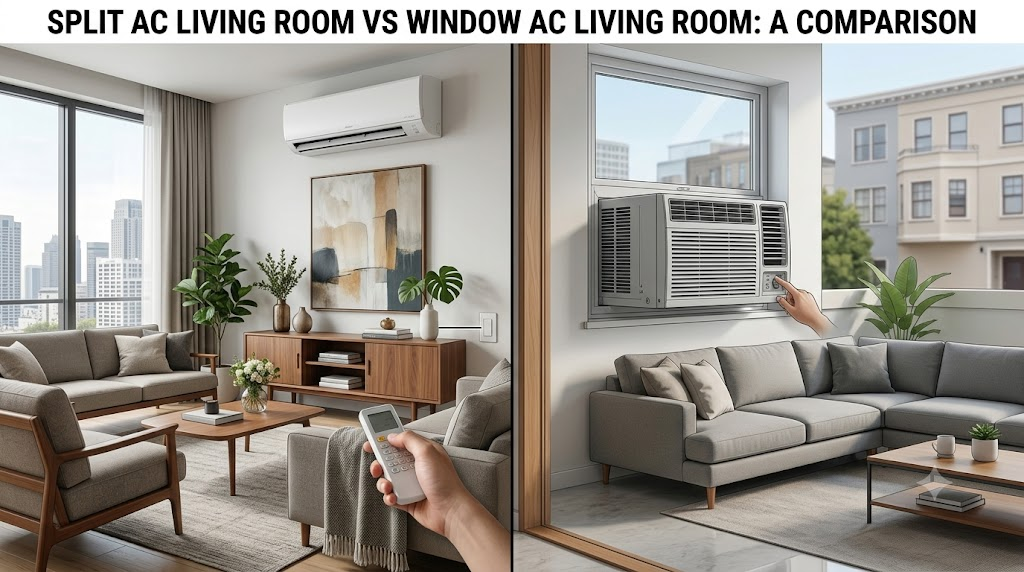
Modern homes increasingly focus on interior design.
| Feature | Split AC | Window AC |
|---|---|---|
| Design | Slim, sleek, and modern design. | Bulky and box-shaped design. |
| Appearance | Premium and stylish look. | Basic and functional appearance. |
| Space Occupied | Mounted on the wall without blocking windows. | Occupies window or wall opening space. |
| Suitable For | Modern homes, apartments, and premium interiors. | Budget homes, rental properties, and older buildings. |
| Overall Visual Appeal | ⭐⭐⭐⭐⭐ Excellent | ⭐⭐⭐☆☆ Average |
| Winner | ✅ Split AC | — |
7. Air Distribution
Cooling is not only about temperature. It is also about how evenly the air reaches different parts of the room.
Split AC
The indoor unit is mounted high on the wall. Even large bedrooms receive more balanced cooling.
Advantages include:
- Longer air throw
- Better vertical swing
- Better horizontal swing
- Uniform cooling
Window AC
Airflow remains concentrated near the unit. People sitting farther away may feel less cooling, especially in rectangular rooms.
Winner
Split AC
8. Suitable Room Size
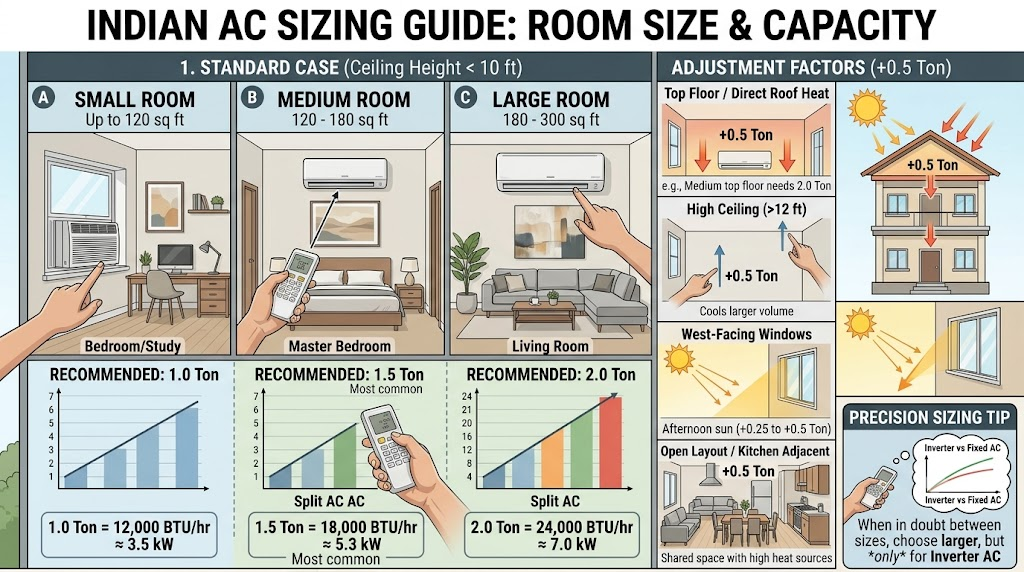
Choosing the right AC capacity is just as important as choosing the type.
Window AC is Ideal For
- Small bedrooms
- Study rooms
- Guest rooms
- Rental homes
- Shops
- Small offices
Generally suitable for rooms up to 150 sq. ft., depending on capacity.
Split AC is Ideal For
- Bedrooms
- Living rooms
- Large halls
- Villas
- Modern apartments
- Offices
It handles medium to large rooms more efficiently and maintains consistent cooling over longer periods.
Quick Recommendation
| Room Size | Recommended AC |
|---|---|
| Up to 120 sq. ft. | 1 Ton Window AC or Split AC |
| 120–180 sq. ft. | 1.5 Ton Split AC |
| 180–250 sq. ft. | 2 Ton Split AC |
9. Flexibility for Rental Homes
If you frequently change houses, portability becomes an important factor.
Window AC
A Window AC is generally easier to uninstall and reinstall. Since it’s a single unit, shifting it to another home is less complicated and often costs less.
Split AC
Moving a Split AC involves removing both indoor and outdoor units, disconnecting copper piping, and reinstalling the system at the new location. This process usually requires professional technicians and may involve additional expenses for new copper pipes or gas refilling if needed.
For tenants who expect to relocate every few years, this difference can significantly affect the overall ownership cost.
Winner
Window AC
Split AC vs Window AC: Which One Should You Choose?
The right choice depends on your budget, home type, and long-term plans—not just the purchase price.
Choose a Split AC if you:
- Plan to stay in the same home for several years.
- Want lower electricity bills with an inverter model.
- Prefer quiet operation.
- Care about modern interiors.
- Need even cooling in medium or large rooms.
Choose a Window AC if you:
- Have a tight budget.
- Live in a rented house.
- Already have a suitable window opening.
- Need a simple installation.
- Want lower maintenance costs.
10. Maintenance and Cleaning
Many buyers compare only the purchase price, but maintenance is equally important. A well-maintained AC cools better, consumes less electricity, and lasts longer.
Split AC Maintenance
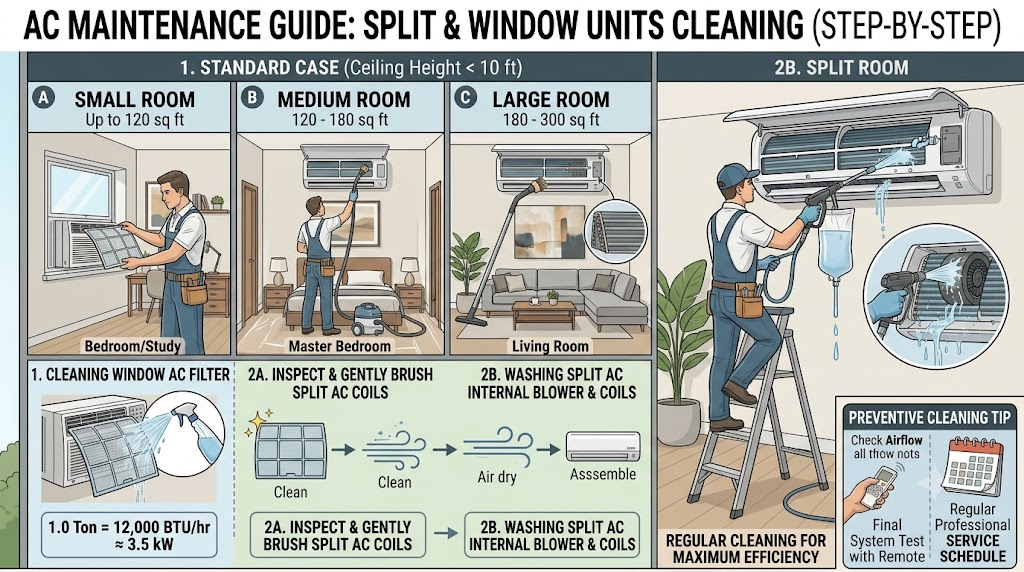
A Split AC has two separate units, so servicing is slightly more detailed.
Routine maintenance includes:
- Cleaning indoor air filters every 15–30 days
- Cleaning the evaporator coil
- Washing the outdoor condenser
- Checking refrigerant pressure
- Inspecting copper pipe insulation
- Cleaning the drain pipe
Professional servicing is generally recommended once or twice a year.
Pros
- Cleaner indoor air
- Better cooling performance
- Longer compressor life
Cons
- Service charges are usually higher
- Outdoor unit may be difficult to access in high-rise apartments
Window AC Maintenance
Window ACs are simpler because everything is inside one unit.
Cleaning usually involves:
- Removing and washing the filter
- Cleaning condenser fins
- Removing dust from the cooling coil
- Checking drainage
Servicing is generally quicker and less expensive than a Split AC.
Winner
Window AC
11. Lifespan and Durability
Both AC types can last a long time if maintained properly. Average lifespan:
| AC Type | Expected Life |
|---|---|
| Split AC | 10–15 years |
| Window AC | 8–12 years |
- Frequency of servicing
- Dust levels
- Voltage fluctuations
- Quality of installation
- Brand quality
- Usage hours
Using a voltage stabilizer in areas with frequent voltage fluctuations can also improve compressor life.
Winner
Split AC (slightly longer lifespan with proper maintenance)
12. Repair Costs
Unexpected repairs are part of owning any appliance.
Split AC
Repairs can include:
- PCB replacement
- Indoor fan motor
- Outdoor fan motor
- Refrigerant leakage
- Copper pipe repairs
- Compressor replacement
Because of separate indoor and outdoor units, labour costs may be higher.
Window AC
Most repairs are easier because all components are in one cabinet. Replacement parts are generally easier to access.
Winner
Window AC
13. Which AC is Better During Indian Summers?
Indian summers vary greatly across the country.
| Region / Climate | Recommended AC | Reason |
|---|---|---|
| North India (Delhi, Jaipur, Lucknow) | Split AC | Temperatures often exceed 45°C. A high-quality inverter Split AC provides faster and more stable cooling during extreme heat. |
| Coastal Areas (Mumbai, Chennai, Kochi, Visakhapatnam) | Split AC | High humidity levels require better moisture control. Split ACs offer improved humidity removal, making rooms feel more comfortable. |
| Moderate Climate (Bengaluru, Pune) | Split AC or Window AC | Both AC types perform well if the correct capacity is chosen for the room size. |
| Dry Heat Areas (Rajasthan and Central India) | Split AC | Split ACs recover room temperature more quickly after doors are opened and maintain consistent cooling during prolonged hot weather. |
14. Hidden Costs Buyers Often Ignore
Many comparison articles stop at the purchase price. However, the real ownership cost includes much more. Consider these expenses:
- Installation charges
- Copper pipe extension
- Outdoor unit stand
- Drain pipe extension
- Annual servicing
- Electricity bills
- Stabilizer (if required)
- Relocation costs
- Repair expenses after warranty
For example:
A Split AC may cost ₹10,000–₹15,000 more initially, but lower electricity consumption can recover much of that difference over several years if you use the AC daily. This is why looking only at the sticker price can be misleading.
15. Which AC is Better for Different Users?
| Room / Usage | Best Choice | Reason |
|---|---|---|
| Small Bedrooms | Window AC | Lower purchase price, sufficient cooling for small rooms, and easy installation. |
| Master Bedrooms | Split AC | Quiet operation, better comfort during sleep, and modern appearance. |
| Living Rooms | Split AC | Better air throw, uniform cooling, and efficiently cools larger spaces. |
| Rental Homes | Window AC | Easier to uninstall and shift when relocating, with lower installation costs. |
| Home Offices | Split AC | Minimal noise during video meetings and maintains a consistent room temperature. |
| Shops | Split AC or Window AC | Choose based on room size, available installation space, and daily operating hours. |
16. Tips to Save Electricity Regardless of AC Type
Whether you buy a Split AC or a Window AC, these habits can noticeably reduce your electricity bill:
- Set the temperature to 24°C–26°C instead of 18°C.
- Use Eco Mode or Auto Mode whenever possible.
- Keep doors and windows closed while the AC is running.
- Clean filters every 15–30 days.
- Use ceiling fans to circulate cool air.
- Close curtains during the afternoon to reduce heat gain.
- Avoid placing heat-generating appliances near the thermostat.
- Get professional servicing before every summer season.
If you’re unsure about cooling modes, read our detailed guide on Which Mode is Best for AC to Save Electricity to understand when to use Cool Mode, Eco Mode, Auto Mode, Dry Mode, and Fan Mode for maximum efficiency.
Split AC vs Window AC: Pros and Cons
| Split AC Pros | Split AC Cons |
|---|---|
| Quiet operation | Higher purchase price |
| Better cooling | Costly installation |
| Energy-efficient inverter models | Higher servicing cost |
| Modern design | More difficult to relocate |
| Better air distribution | Outdoor unit requires space |
| Window AC Pros | Window AC Cons |
|---|---|
| Budget-friendly | Noisier operation |
| Easy installation | Basic appearance |
| Lower maintenance cost | Less uniform cooling |
| Easy to relocate | Occupies window space |
| Simpler repairs | Fewer premium features |
FAQs
Q. Which AC is better, Split AC or Window AC?
For most Indian households, a Split AC is the better choice because it offers quieter operation, better cooling, improved energy efficiency, and modern features. A Window AC is ideal if you have a tighter budget or live in a rented home.
Q. Which AC consumes less electricity?
A 5-Star Inverter Split AC usually consumes less electricity than a standard Window AC. However, actual consumption depends on star rating, usage habits, room insulation, and maintenance.
Q. Is a Window AC easier to maintain?
Yes. Since all components are housed in a single unit, Window ACs are generally easier and cheaper to service.
Q. Is Split AC worth the extra money?
Yes, if you plan to use the AC for many years. The higher initial cost is often offset by lower electricity bills, quieter operation, and better comfort.
Q. Can I install a Window AC in any apartment?
Not always. Many modern apartments are designed only for Split AC installations and do not provide a dedicated window opening for a Window AC.
Q. Which AC is better for a rented house?
A Window AC is usually the better option because it is easier and less expensive to uninstall and reinstall when you move.
Q. Which AC is quieter?
Split ACs are significantly quieter because the compressor is installed outside the room.
Q. Does inverter technology matter?
Yes. Inverter ACs adjust compressor speed based on cooling demand, resulting in lower electricity consumption, more consistent temperatures, and quieter operation.
Final Verdict
When comparing Split AC vs Window AC, there is no one-size-fits-all answer. The best option depends on your budget, room size, and how long you plan to stay in your home.
Choose a Split AC if:
- You want the best overall cooling experience.
- Low noise is important.
- You prefer a modern look.
- You use the AC frequently and want lower long-term electricity costs.
- You are buying for your own home.
Choose a Window AC if:
- You have a limited budget.
- You live in a rented house.
- You already have a suitable window opening.
- You want easy installation and lower maintenance costs.
For most Indian homeowners, a 5-Star Inverter Split AC offers the best balance of comfort, efficiency, and long-term value. However, a quality Window AC remains a practical and economical choice for small rooms, rental properties, and buyers looking for a lower upfront investment.
Recommended Reading:
- 10 Best AC for Bedroom in India 2026
- 10 Best AC Under ₹40000 in India 2026
- Which Mode is Best for AC to Save Electricity?
- 7 Best Stabilizer for 1.5 Ton AC in India (2026)
Sourabh researches and writes about home appliances, kitchen gadgets, and common appliance problems to help readers make smarter buying decisions. He specializes in mixer grinders, refrigerators, air conditioners, washing machines, and appliance troubleshooting guides.
At ReviewSpot, Sourabh focuses on creating easy-to-understand content that simplifies technical appliance issues into practical solutions. His goal is to help users save time, avoid costly mistakes, and choose the right appliances with confidence.