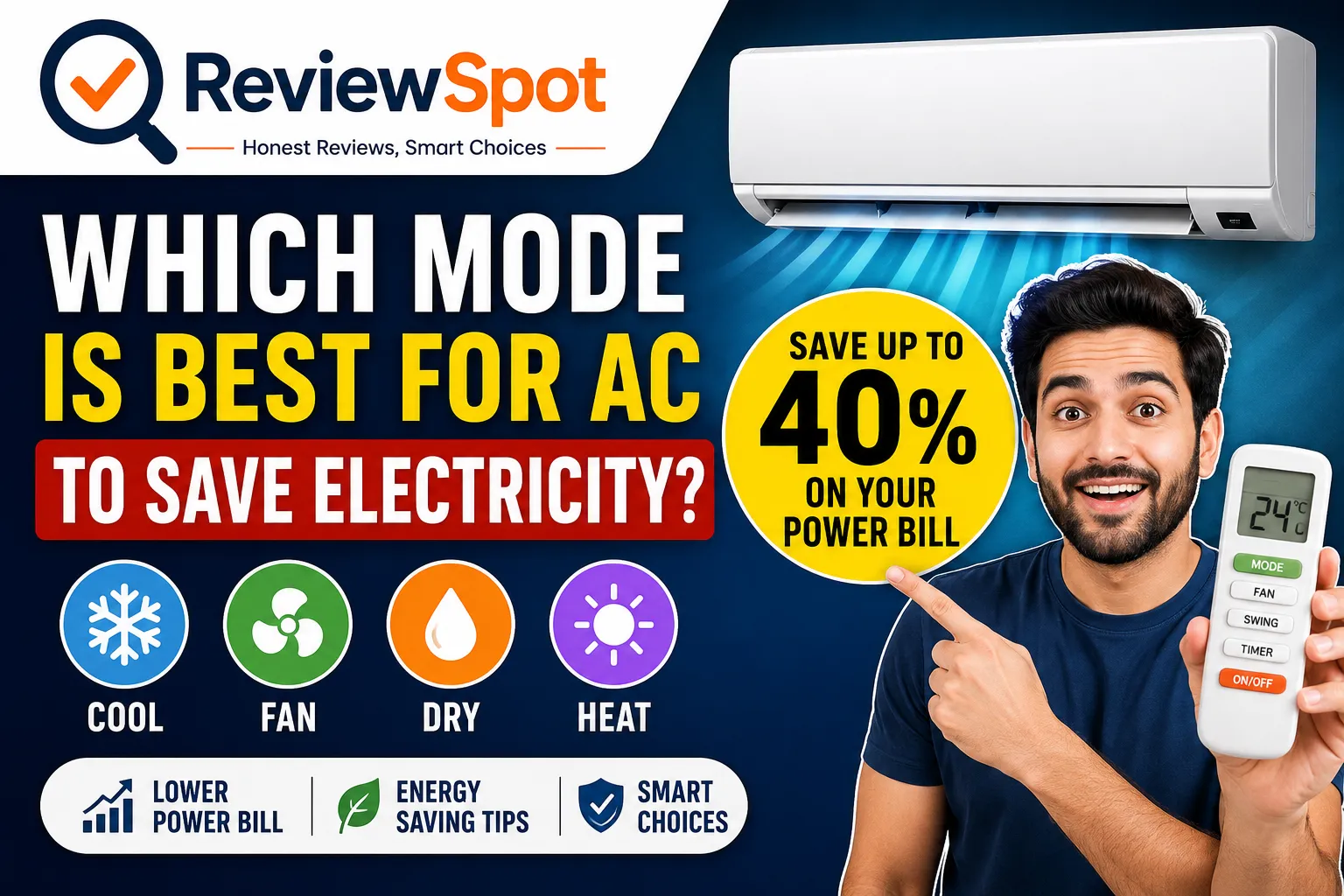
Which Mode is Best for AC to Save Electricity? Save Up to 40% on Your Power Bill

Summer electricity bills can be shocking, especially if your air conditioner runs for several hours every day. Many people think buying a 5-star AC is enough to save electricity. In reality, how you use your AC matters just as much as the star rating.
Modern air conditioners come with different operating modes like Cool, Auto, Eco, Dry, Fan, Sleep, and Turbo. Each mode is designed for a different purpose, but not every mode helps reduce electricity consumption. If you’ve ever wondered:
Which Mode is Best for AC to Save Electricity?
Eco Mode is generally the best mode for saving electricity because it limits compressor operation and optimizes cooling according to room conditions.
| Situation | Best AC Mode |
|---|---|
| Daytime summer | Eco Mode |
| Regular daily use | Auto Mode |
| Night sleeping | Sleep Mode |
| High humidity during monsoon | Dry Mode |
| Quick cooling after coming home | Turbo Mode (only for 10–15 minutes) |
| Extremely hot afternoons | Cool Mode at 24–26°C |
If your AC doesn’t have Eco Mode, use Auto Mode with the temperature set between 24°C and 26°C. This combination provides an excellent balance between comfort and electricity savings.
Looking for an energy-efficient AC? Check the latest prices on Amazon →
AC Mode Comparision Table
| AC Mode | What It Does | Best For | Energy Use |
|---|---|---|---|
| Cool Mode | Cools the room to the set temperature | Normal summer cooling | Medium to High |
| Dry Mode | Removes excess moisture from the air | Humid or rainy weather | Low to Medium |
| Fan Mode | Circulates indoor air without active cooling | Mild weather when cooling isn’t needed | Low |
| Auto Mode | Automatically adjusts cooling/fan operation based on room conditions | Hands-free everyday use | Medium |
| Sleep Mode | Gradually adjusts temperature and operation during the night | Sleeping comfortably while reducing unnecessary cooling | Low to Medium |
| Turbo/Powerful Mode | Runs the AC at higher capacity for faster cooling | Quickly cooling a hot room | High |
| Eco/Energy-Saving Mode | Reduces compressor or operating load to lower electricity consumption | Longer usage when maximum cooling isn’t required | Low |
| Heat Mode | Produces warm air instead of cooling | Winter use on hot-and-cold/heat-pump ACs | Medium to High |
Best AC Settings to Reduce Electricity Consumption
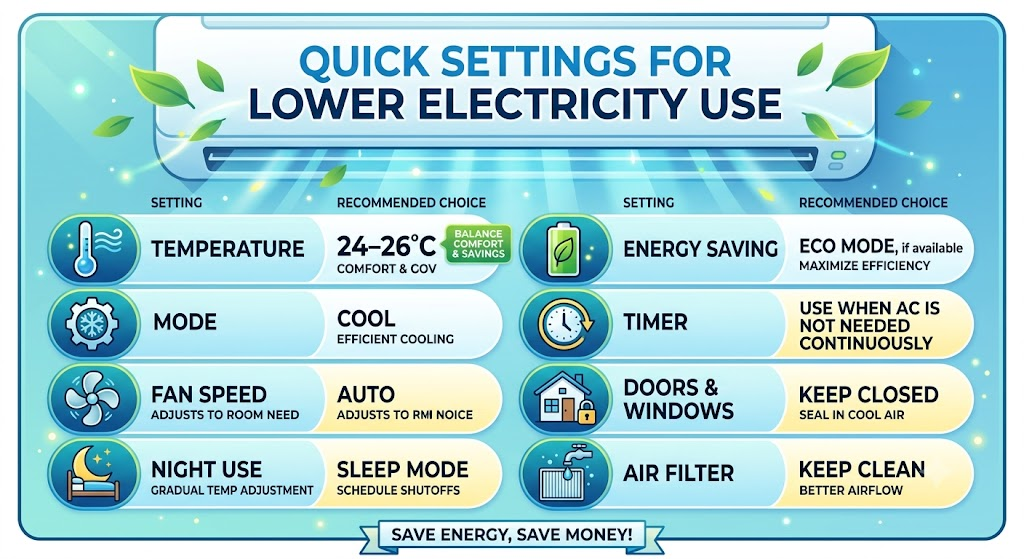
You can reduce your AC electricity consumption without sacrificing too much comfort by using the right temperature, mode, fan speed, and timer settings. The goal is to avoid making the AC work harder than necessary.
| Setting | Recommended Choice |
|---|---|
| Temperature | 24–26°C |
| Mode | Cool |
| Fan Speed | Auto |
| Night Use | Sleep Mode |
| Energy Saving | Eco Mode, if available |
| Timer | Use when AC is not needed continuously |
| Doors & Windows | Keep closed |
| Air Filter | Keep clean |
Why Choosing the Right AC Mode Matters
Most people focus only on the temperature setting. But the operating mode controls how often the compressor runs.
Since the compressor consumes nearly 80–90% of an air conditioner’s electricity, reducing unnecessary compressor operation can significantly lower your monthly electricity bill.
For example: Imagine two people using the same 1.5 Ton inverter AC for eight hours every day.
Person A
- Cool Mode
- Temperature: 20°C
Person B
- Eco Mode
- Temperature: 25°C
Even though both use the AC for the same duration, Person B may consume 20–40% less electricity, depending on outdoor temperature and room insulation.
That’s why understanding AC modes is more important than many people realize.
How Does an Air Conditioner Consume Electricity?
Before comparing AC modes, let’s understand where electricity actually goes. An air conditioner mainly has three power-consuming parts.
1. Compressor
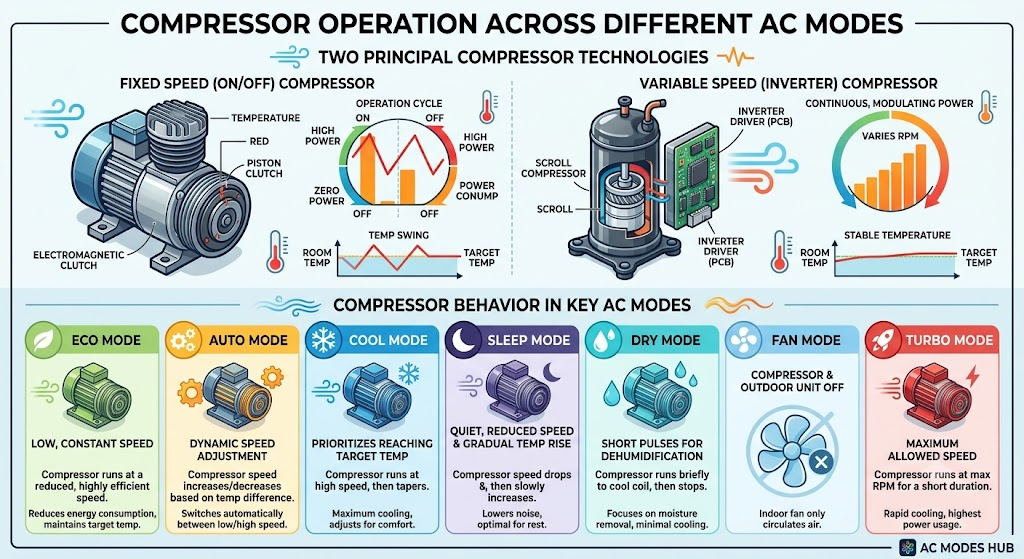
This is the biggest electricity consumer. It compresses refrigerant and removes heat from your room. Whenever the compressor runs continuously, electricity consumption increases.
2. Indoor Fan
The indoor blower circulates cool air. It consumes very little electricity compared to the compressor.
3. Outdoor Fan
This fan removes heat from the outdoor unit. Its electricity consumption is also relatively low. The real goal of every energy-saving mode is simple:
Reduce compressor running time without making the room uncomfortable. That’s exactly what Eco Mode, Auto Mode and Sleep Mode try to achieve.
Understanding Every AC Mode
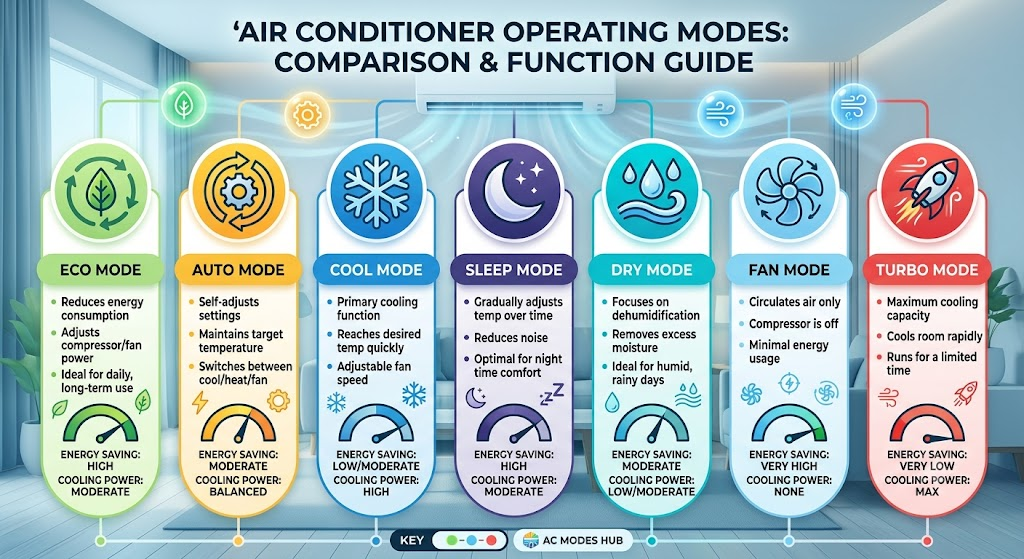
Let’s understand what each mode actually does.
1. Cool Mode
| Feature | Details |
|---|---|
| Mode Name | Cool Mode |
| Purpose | Provides continuous cooling by maintaining the temperature set by the user. |
| How It Works | • The compressor cools the room to the selected temperature.• The indoor fan runs at the chosen speed.• The compressor automatically turns ON and OFF to maintain the set temperature. |
| Best For | • Peak summer afternoons• Rooms with direct sunlight• Fast and consistent cooling |
| Electricity Consumption | Medium to High |
| Energy Saving Tip | Avoid setting the temperature between 18°C and 21°C, as the compressor has to work much harder, increasing electricity consumption. |
| Recommended Temperature | 24°C to 26°C |
| Why This Temperature? | This temperature range offers comfortable cooling while keeping electricity consumption under control and reducing compressor workload. |
2. Auto Mode
Many people ignore Auto Mode because they don’t understand how it works. Actually, it’s one of the smartest features in modern inverter ACs.
| Feature | Details |
|---|---|
| Mode Name | Auto Mode |
| Purpose | Automatically balances cooling and energy efficiency by adjusting AC operation based on the room temperature. |
| How It Works | • Automatically adjusts the fan speed.• Controls compressor operation as needed.• Changes the cooling intensity according to the room temperature.• Reduces cooling once the room reaches the desired comfort level instead of running at maximum power continuously. |
| Advantages | • Better energy efficiency• Less manual adjustment• Comfortable and consistent cooling• Maintains a stable room temperature automatically |
| Best For | • Daily home use• Offices• Living rooms• Families using the AC for several hours every day |
| Electricity Consumption | Low to Medium |
| Energy Saving Tip | Use Auto Mode with the temperature set between 24°C and 26°C for the best balance of comfort and electricity savings. |
| Recommended Usage | Ideal for everyday use when you want the AC to automatically maintain a comfortable temperature without frequent manual adjustments. |
If you want better energy efficiency and more consistent cooling, see our detailed guide to Best Inverter AC before choosing a model.
Which Mode is Best for AC Cool or Auto?
This is one of the most searched questions online. Here’s the simple answer.
| Feature | Cool Mode | Auto Mode |
|---|---|---|
| Cooling speed | Faster | Moderate |
| Electricity saving | Average | Better |
| Compressor operation | More frequent | Optimized |
| User comfort | Good | Excellent |
| Best for | Very hot weather | Daily use |
Verdict
If your room is already comfortable, Auto Mode is better than Cool Mode for saving electricity. Use Cool Mode only when you need quick cooling or when outdoor temperatures are extremely high.
3. Eco Mode
Now let’s discuss the most important mode.
Does Eco Mode in AC Save Electricity?
Yes. Eco Mode is specifically designed to reduce electricity consumption. In Eco Mode:
- Compressor runs at optimized capacity.
- Cooling becomes gradual instead of aggressive.
- The AC avoids unnecessary compressor cycles.
- Indoor temperature remains comfortable without excessive cooling.
Many inverter AC brands claim electricity savings of around 20–40% compared to regular cooling under suitable conditions. Actual savings depend on:
- Outdoor temperature
- Room size
- Insulation
- Number of people
- AC capacity
Benefits
- Lower electricity bill
- Less compressor stress
- Comfortable cooling
- Better efficiency during long usage
Best for
- Night use
- Work from home
- Daily summer usage
- Long operating hours
When Not to Use Eco Mode
Avoid Eco Mode if:
- Room temperature is above 40°C
- You have just returned home
- You need instant cooling
In these situations, first cool the room using Cool Mode or Turbo Mode, then switch to Eco Mode.
Eco Mode vs Auto Mode
Many users confuse these two modes. Here’s the difference.
| Feature | Eco Mode | Auto Mode |
|---|---|---|
| Main goal | Save electricity | Maintain comfort |
| Compressor | Restricted | Automatic |
| Cooling | Slightly slower | Balanced |
| Energy saving | Highest | Moderate |
| Best use | Long hours | Everyday use |
If saving electricity is your highest priority, Eco Mode wins. If comfort is more important, choose Auto Mode.
4. Sleep Mode
Most people use Sleep Mode without knowing how it works.
Does Sleep Mode in AC Save Electricity?
Yes. Sleep Mode gradually increases the temperature by around 1–2°C every hour (depending on the AC brand). Because your body naturally requires less cooling while sleeping.
Instead of keeping the room at 24°C throughout the night, the AC slowly raises the temperature to around 26–28°C. This reduces compressor operation.
As a result:
- Electricity consumption decreases.
- The room doesn’t become too cold.
- You sleep more comfortably.
Many users wake up feeling fresher because excessive cooling often causes dry throat and body stiffness.
Best for
- Nighttime
- Elderly people
- Children
- Daily sleeping
Electricity Saving
Moderate to High
A person sleeping for eight hours every night can notice meaningful savings over an entire summer.
Dry Mode vs Cool Mode: Which One Saves More Electricity?
Many people assume that Dry Mode is simply a weaker version of Cool Mode. That’s not true.
Both modes work differently.
| Feature | Dry Mode | Cool Mode |
|---|---|---|
| Main purpose | Remove humidity | Reduce room temperature |
| Compressor operation | Runs intermittently | Runs based on cooling demand |
| Fan speed | Usually low | User adjustable |
| Best season | Monsoon | Summer |
| Electricity consumption | Lower | Medium to High |
What is Dry Mode?
Dry Mode removes excess moisture from the air without trying to cool the room aggressively.
The compressor turns ON for short periods, removes humidity, and then switches OFF. Because of this, it generally uses less electricity than Cool Mode.
When Should You Use Dry Mode?
Dry Mode works best during:
- Monsoon season
- Humid evenings
- Coastal cities
- Rooms that feel sticky rather than hot
For example:
- Mumbai
- Chennai
- Kochi
- Kolkata
- Goa
If the temperature is around 28°C but humidity is 80%, the room feels much hotter than it actually is.
In this case, Dry Mode makes the room feel comfortable while using less electricity.
When Shouldn’t You Use Dry Mode?
Avoid Dry Mode when:
- Outdoor temperature is above 35°C.
- The room is genuinely hot.
- You want fast cooling.
Dry Mode removes moisture, not heat.
Fan Mode
Many people think Fan Mode can cool a room. In Fan Mode:
- Compressor remains OFF.
- Only the indoor fan operates.
- Air circulates inside the room.
Electricity consumption is very low because only the blower motor runs.
Best Uses
- Pleasant evenings
- Mild weather
- After switching OFF cooling
- Air circulation
Electricity Consumption
Very Low
If the room is already cool, switching to Fan Mode for some time can reduce electricity usage.
Turbo Mode
Turbo Mode is designed for one purpose:
Cool the room as quickly as possible. In Turbo Mode:
- Compressor runs at maximum capacity.
- Fan operates at the highest speed.
- Cooling happens much faster.
Does Turbo Mode Save Electricity?
No. Turbo Mode consumes more electricity because the compressor works continuously at full capacity. However, there is one smart way to use it.
Best Practice
Instead of keeping Turbo Mode ON for hours:
- Use Turbo Mode for 10–15 minutes.
- Once the room becomes comfortable, switch to Eco Mode or Auto Mode.
This provides both comfort and energy savings.
Which Temperature Saves the Most Electricity?
Many people lower the AC temperature to 18°C thinking the room will cool faster. This is one of the biggest myths. Your AC cools at almost the same speed regardless of whether you set it to 18°C or 24°C. The difference is that at 18°C, the compressor keeps running much longer.
Recommended Temperature
Experts generally recommend:
24°C to 26°C
Why?
- Comfortable for most people
- Lower compressor workload
- Better electricity savings
- Reduced wear on the AC
Every 1°C increase in the thermostat setting can reduce electricity consumption by approximately 3–6%, depending on room conditions and AC type.
Suggested Temperature Guide
| Situation | Temperature |
|---|---|
| Peak summer afternoon | 24°C |
| Daily use | 25°C |
| Night | 26°C |
| Elderly people | 26°C |
| Children | 25–26°C |
| Work from home | 25°C |
How to Use AC Efficiently to Save Electricity
Buying an inverter AC isn’t enough. The way you use it every day makes a much bigger difference.
1. Keep Temperature Between 24°C and 26°C
Avoid setting your AC below 22°C unless absolutely necessary. This single habit can save a noticeable amount on your monthly electricity bill.
2. Use Eco Mode Whenever Possible
Eco Mode is ideal if you’re using the AC for more than two hours. It optimizes compressor operation without making the room uncomfortable.
3. Switch to Sleep Mode at Night
Instead of cooling the room all night at the same temperature, let Sleep Mode gradually adjust the temperature. You’ll sleep comfortably while using less electricity.
4. Close Doors and Windows
Cool air escaping from the room forces the compressor to work harder. This simple habit can improve cooling significantly.
Always keep:
- Doors closed
- Windows shut
- Curtains drawn during the afternoon
5. Clean AC Filters Regularly
Dirty filters restrict airflow. When airflow decreases:
- Cooling becomes slower.
- Compressor runs longer.
- Electricity consumption increases.
Clean the filters every 2–4 weeks during summer. Keeping the AC filter clean is an important part of regular maintenance because dust can restrict airflow. For suitable DIY cleaning beyond the basic filter, an AC cleaning kit can be considered according to the manufacturer’s instructions.
6. Keep the Outdoor Unit Clean
The outdoor unit releases heat. If it’s blocked by dust, leaves, or clutter, the AC loses efficiency. Leave enough space around the outdoor unit for proper airflow.
7. Use Ceiling Fans Along with AC
This is one of the easiest ways to reduce AC electricity consumption. A ceiling fan helps circulate cool air faster. As a result, you can comfortably increase the AC temperature from 23°C to 25°C without feeling warmer.
8. Avoid Frequent ON/OFF Switching
Many people switch the AC OFF for five minutes and then ON again. This isn’t an effective way to save electricity. Modern inverter ACs are designed to run continuously at lower power rather than restarting repeatedly. Frequent restarting can actually reduce efficiency.
9. Reduce Heat Inside the Room
Simple habits can lower the cooling load:
- Switch OFF unused lights.
- Turn OFF unnecessary appliances.
- Avoid cooking near the cooled room.
- Use curtains or blinds to block direct sunlight.
10. Service Your AC Before Summer
A professionally serviced AC:
- Cools faster
- Uses less electricity
- Lasts longer
- Maintains better airflow
Annual servicing is a small investment that often pays for itself through improved efficiency.
5 Tips to Reduce AC Electricity Bill
If you’re looking for quick ways to cut your electricity bill, start with these proven habits.
Tip 1: Use Eco Mode for Long Hours
Eco Mode is the easiest way to reduce electricity consumption without sacrificing much comfort.
Tip 2: Set the Temperature to 24–26°C
Avoid extremely low settings.
A moderate temperature keeps the compressor from running unnecessarily.
Tip 3: Turn ON Sleep Mode Before Bed
This prevents overcooling and reduces overnight power consumption.
Tip 4: Clean Filters Every Month
Clean filters improve airflow and reduce the workload on the compressor.
Tip 5: Use Curtains During Daytime
Blocking sunlight keeps the room cooler naturally, allowing the AC to work less.
Estimated Monthly Electricity Consumption by AC Mode
The actual electricity used depends on:
- AC capacity
- Inverter or non-inverter model
- Outdoor temperature
- Room insulation
- Daily usage
The table below shows a general estimate for a 1.5 Ton inverter AC used for 8 hours per day.
| Mode | Estimated Monthly Electricity Usage |
|---|---|
| Turbo Mode | Highest |
| Cool Mode (20°C) | Very High |
| Cool Mode (24°C) | Medium |
| Auto Mode | Medium-Low |
| Sleep Mode | Low |
| Eco Mode | Lowest |
| Fan Mode | Minimal |
This comparison shows why choosing the right mode has a noticeable impact on your electricity bill over an entire summer season.
Real-Life Example: How Much Can You Save?
Let’s compare two households using the same 1.5 Ton inverter AC for 8 hours daily during summer.
Family A
- Temperature: 20°C
- Mode: Cool
- Dirty filters
- Curtains kept open
- No annual servicing
Family B
- Temperature: 25°C
- Mode: Eco during the day
- Sleep Mode at night
- Filters cleaned every month
- Curtains closed during the afternoon
- Annual AC servicing
| Comparison | Family A | Family B |
|---|---|---|
| AC Mode | Cool | Eco + Sleep |
| Temperature | 20°C | 25°C |
| Compressor Runtime | High | Optimized |
| Monthly Electricity Bill | Higher | Lower |
| Comfort | Good | Good |
| Long-Term AC Health | Average | Better |
Result: Family B can save 15–40% on electricity, depending on outdoor temperature, room insulation, and usage habits. Over one summer season, these savings can add up to a significant amount.
Common Mistakes That Increase Your AC Electricity Bill
Many households unknowingly waste electricity because of small habits. Avoid these common mistakes.
1. Setting the Temperature to 18°C
Lower temperatures don’t cool the room instantly. They simply make the compressor work for longer.
2. Keeping Doors or Windows Open
Cool air escapes, forcing the AC to run continuously.
3. Not Cleaning Air Filters
Dust blocks airflow, reducing cooling efficiency and increasing power consumption.
4. Ignoring AC Servicing
A poorly maintained AC has to work harder to deliver the same cooling.
5. Using Turbo Mode for Hours
Turbo Mode is only meant for quick cooling. Running it continuously wastes electricity.
6. Turning the AC On and Off Frequently
Modern inverter ACs are designed to adjust compressor speed automatically. Frequent restarting can reduce efficiency.
7. Blocking the Outdoor Unit
Keep the outdoor unit free from leaves, boxes, and other obstructions so heat can escape easily.
AC Electricity Saving Myths vs Facts
Many myths about air conditioners continue to circulate. Here’s what actually happens.
| Myth | Fact |
|---|---|
| Lower temperature cools the room faster | The cooling speed remains almost the same; the compressor simply runs longer. |
| Fan Mode cools the room | Fan Mode only circulates air. It doesn’t lower the room temperature. |
| Turbo Mode is the best daily mode | Turbo Mode is designed only for short-term cooling. |
| Switching the AC off every 10 minutes saves electricity | Frequent restarting can reduce efficiency, especially with inverter ACs. |
| Bigger AC always uses more electricity | A correctly sized inverter AC may use less power than an undersized unit struggling to cool the room. |
| Only a 5-star rating matters | Star rating helps, but correct temperature settings and AC mode have an equally important impact. |
Which AC Mode Should You Use in Different Seasons?
Choosing the right mode according to the weather improves comfort and reduces electricity usage.
| Season | Recommended Mode | Why? |
|---|---|---|
| Summer | Eco Mode or Auto Mode | Balanced cooling with lower electricity consumption |
| Peak Afternoon Heat | Cool Mode | Faster cooling during extreme temperatures |
| Monsoon | Dry Mode | Removes excess humidity efficiently |
| Winter (if cooling isn’t needed) | Fan Mode | Air circulation with minimal electricity use |
| Night | Sleep Mode | Gradually adjusts temperature and reduces compressor usage |
Expert Tips to Maximize AC Efficiency
Here are some practical tips that many homeowners overlook.
Use Ceiling Fans Alongside Your AC
A ceiling fan spreads cool air evenly across the room. This allows you to increase the AC temperature by 1–2°C without sacrificing comfort.
Seal Air Leaks
Small gaps around doors and windows let cool air escape. Weather stripping or door seals can improve efficiency.
Avoid Heat-Producing Appliances
Running ovens, irons, or clothes dryers near the cooled room increases the AC’s workload.
Don’t Block Indoor Vents
Furniture or curtains covering the indoor unit reduce airflow and cooling performance.
Choose the Right AC Capacity
An oversized or undersized AC both waste electricity.
General guideline:
| Room Size | Recommended AC Capacity |
|---|---|
| Up to 120 sq ft | 1 Ton |
| 120–180 sq ft | 1.5 Ton |
| 180–250 sq ft | 2 Ton |
Choosing the correct capacity is just as important as choosing the right operating mode.
Before worrying about which AC mode saves electricity, make sure you Choose the Right AC Capacity for your room size and heat load.
Frequently Asked Questions (FAQs)
Q. Which Mode is Best for AC to Save Electricity?
Eco Mode is generally the best choice for saving electricity because it reduces compressor workload while maintaining a comfortable temperature. If your AC doesn’t have Eco Mode, use Auto Mode with the temperature set between 24°C and 26°C.
Q. Does Eco Mode in AC Save Electricity?
Yes. Eco Mode is specifically designed to optimize compressor operation and can reduce electricity consumption during long hours of use.
Q. Does Sleep Mode in AC Save Electricity?
Yes. Sleep Mode gradually increases the temperature during the night, reducing compressor runtime while keeping you comfortable.
Q. Which Mode is Best for AC: Cool or Auto?
For everyday use, Auto Mode is the better option because it adjusts cooling automatically and usually consumes less electricity. Use Cool Mode when you need faster cooling.
Q. Is 18°C Better Than 24°C?
No. Setting the AC to 18°C doesn’t cool the room faster. It only makes the compressor run for longer, increasing electricity consumption.
Q. Is Dry Mode Good During Summer?
Only if the weather is humid. During dry, hot summer days, Cool Mode or Eco Mode works much better.
Q. Does an Inverter AC Always Save Electricity?
An inverter AC is more energy-efficient than a non-inverter model, but your usage habits still matter. Incorrect temperature settings and poor maintenance can reduce its efficiency.
Q. How Often Should I Service My AC?
At least once a year, preferably before the summer season. If you use your AC heavily, servicing every 6–8 months is even better.
Key Takeaways
- Eco Mode is the best mode for saving electricity during long hours of use.
- Auto Mode offers the best balance between comfort and energy efficiency for daily use.
- Sleep Mode is ideal at night because it gradually raises the temperature and reduces power consumption.
- Dry Mode works best during humid weather, especially in the monsoon season.
- Turbo Mode should only be used for 10–15 minutes to cool the room quickly.
- Keep your AC temperature between 24°C and 26°C for the best mix of comfort and energy savings.
- Clean filters regularly, service your AC annually, and keep doors and windows closed while the AC is running.
Final Verdict
If someone asks, “Which Mode is Best for AC to Save Electricity?”, the answer is straightforward:
- Eco Mode is the most electricity-efficient option for extended use.
- If Eco Mode isn’t available, Auto Mode is the next best choice.
- At night, switch to Sleep Mode to save additional electricity without compromising comfort.
- During humid weather, Dry Mode can reduce power consumption while making the room feel more comfortable.
Remember, the mode alone won’t guarantee lower electricity bills. The biggest savings come from combining the right mode with smart habits like maintaining a temperature of 24–26°C, cleaning filters regularly, using ceiling fans, blocking direct sunlight, and servicing your AC every year.
By following these simple practices, most Indian households can enjoy comfortable cooling while keeping electricity bills under control throughout the summer.
Recommended Reading:
- 7 Best Stabilizer for 1.5 Ton AC in India (2026)
- 7 Best AC for 10×10 Room in India (2026)
- How to Unlock AC Remote
- 8 Best AC Cleaning Kits in India (2026)
Sourabh researches and writes about home appliances, kitchen appliances, and common appliance problems to help readers make informed buying decisions. He covers mixer grinders, refrigerators, air conditioners, washing machines, and appliance troubleshooting.
At ReviewSpot, Sourabh compares manufacturer specifications, product features, warranty information, pricing, and customer feedback to turn technical appliance information into practical buying advice. His goal is to help readers understand their options, avoid costly mistakes, and choose products that fit their needs and budget.
ReviewSpot distinguishes manufacturer information, customer feedback, and editorial analysis, and does not describe products as hands-on tested unless they have actually been tested.