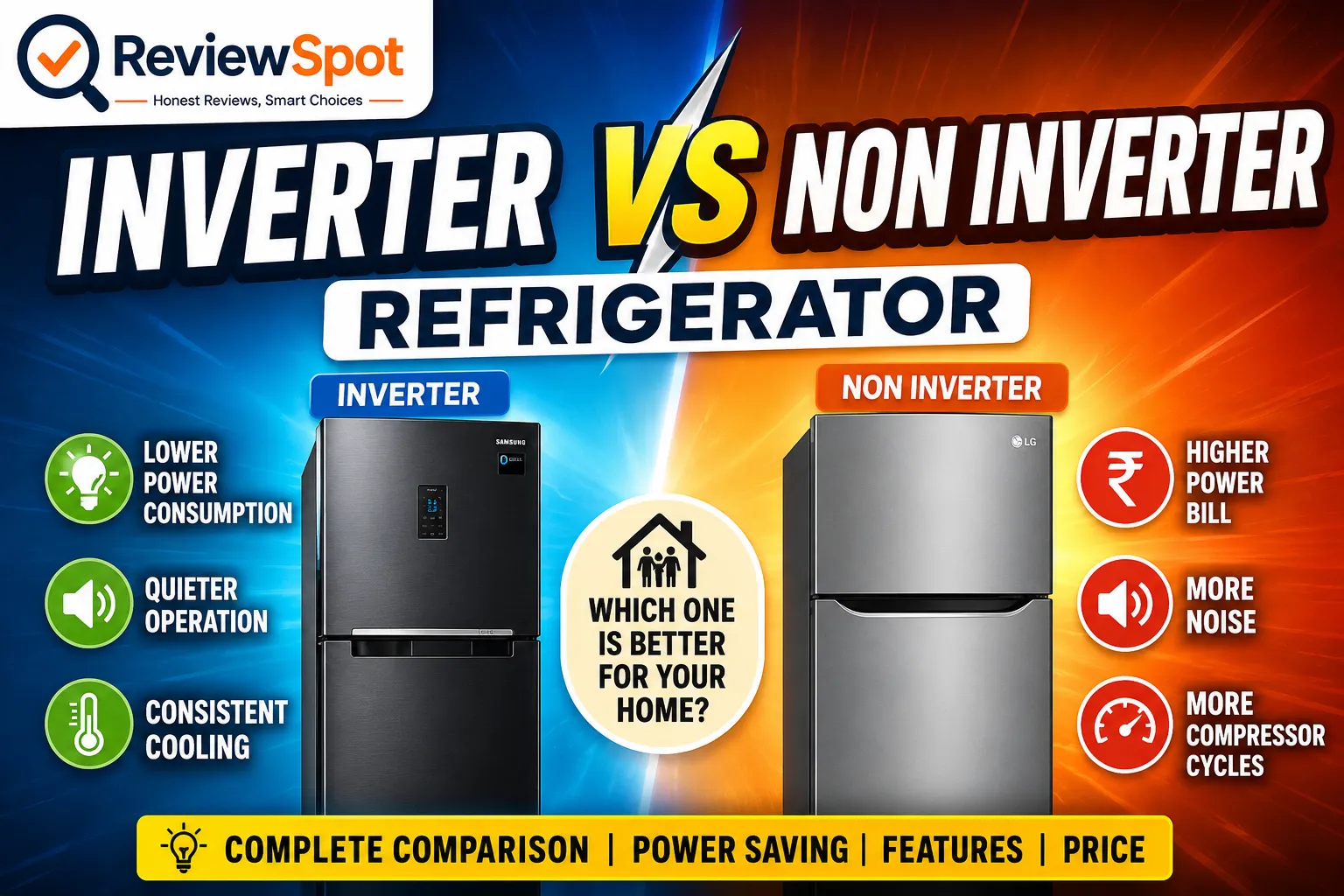
Inverter vs Non Inverter Refrigerator: Which One Is Better for Your Home?

Choosing between an inverter and non-inverter refrigerator can be confusing because both types can keep your food cold, but they use very different compressor technologies. The difference can affect electricity consumption, noise, cooling consistency, purchase price, and long-term operating costs.
One question that often confuses Indian buyers is inverter vs non inverter refrigerator. Both types can cool your food properly, but they use different types of compressors and behave differently when cooling demand changes.
Inverter vs Non Inverter Refrigerator
For most Indian households, an inverter refrigerator is the better choice because it can adjust compressor speed according to cooling demand, generally uses electricity more efficiently, operates more quietly and provides more consistent cooling.
However, a non-inverter refrigerator can still be a sensible choice if your budget is very tight, the refrigerator is used only occasionally, or you find a highly energy-efficient non-inverter model at a significantly lower price.
The most important point is this: don’t choose a refrigerator based on “inverter” alone. Check its BEE star rating, annual energy consumption, capacity, features, warranty and service availability as well.
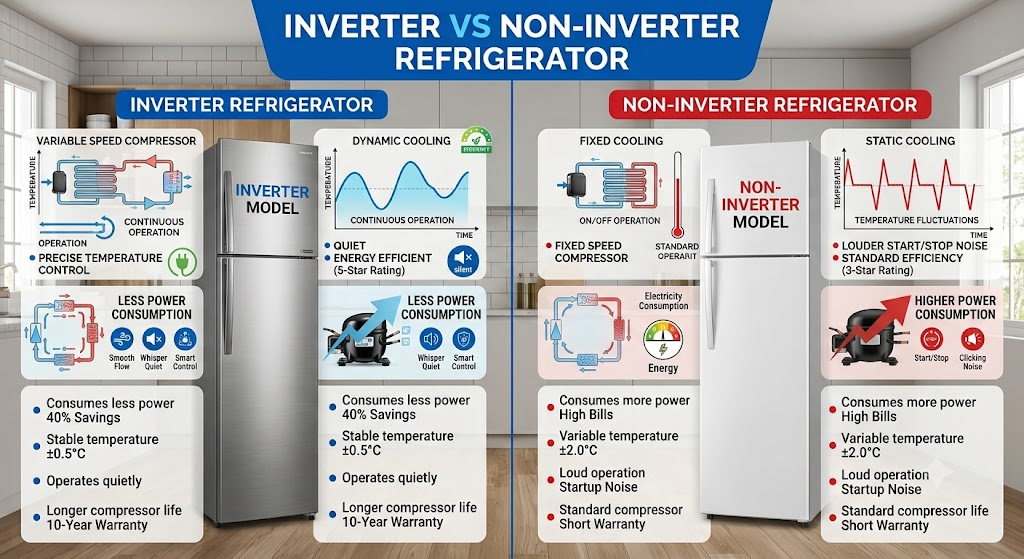
Inverter vs Non Inverter Refrigerator: Quick Comparison
| Feature | Inverter Refrigerator | Non-Inverter Refrigerator |
|---|---|---|
| Compressor type | Variable-speed compressor | Fixed-speed compressor |
| Compressor operation | Adjusts speed according to cooling demand | Runs at a fixed speed and switches on/off |
| Energy efficiency | Generally more efficient | Generally less efficient |
| Cooling consistency | More consistent | More temperature fluctuation |
| Noise | Usually quieter | Usually louder during compressor starts |
| Initial price | Usually higher | Usually lower |
| Electricity cost | Can be lower over time | Can be higher over time |
| Technology | More advanced | Simpler |
| Maintenance | Can be more complex | Generally simpler |
| Long-term suitability | Excellent for regular use | Suitable for budget-focused buyers |
| Best for | Energy-conscious households | Buyers focused on upfront cost |
What Is an Inverter Refrigerator?
An inverter refrigerator uses a variable-speed compressor. Instead of operating only at full speed and then shutting off, the compressor can adjust its speed according to the cooling requirement.
For example, when you open the refrigerator door frequently or place a large amount of food inside, the temperature may rise. The compressor can increase its speed to provide more cooling.
Once the desired temperature is reached, it can slow down rather than completely switching off.
This variable operation is one of the main reasons inverter refrigerators can deliver better energy efficiency and more consistent temperatures.
New to inverter technology? Read our detailed guide on What Is an Inverter Refrigerator? to understand how inverter compressors work and why they save electricity:
How an Inverter Compressor Works
The basic process is:
- It maintains a more consistent temperature.
- The refrigerator detects the cooling requirement.
- The compressor increases or decreases its speed.
- It provides more cooling when required.
- It slows down when less cooling is needed.
This variable operation is one of the biggest reasons inverter refrigerators can use less electricity than comparable conventional models.
What Is a Non-Inverter Refrigerator?
A non-inverter refrigerator normally uses a fixed-speed compressor. It essentially works in two states:
ON: The compressor runs at its fixed speed.
OFF: The compressor stops.
When the refrigerator becomes warmer than the desired temperature, the compressor starts again. Once the required temperature is reached, it switches off.
So the basic pattern is:
ON → OFF → ON → OFF
It is a proven and relatively simple technology that has been used in refrigerators for many years.
The main difference is that the compressor cannot continuously adjust its speed according to cooling demand in the same way an inverter compressor can.
Inverter vs Non Inverter Refrigerator: How Do They Work Differently?
The biggest difference is how the compressor responds to cooling demand. Imagine that your refrigerator needs only a small amount of cooling.
A non-inverter compressor may operate at its fixed speed until the required temperature is reached and then switch off.
An inverter compressor can reduce its speed and continue operating at a lower level.
When cooling demand increases, the inverter compressor can increase its speed. This makes the inverter system more adaptable to changing conditions.
1. Electricity Consumption
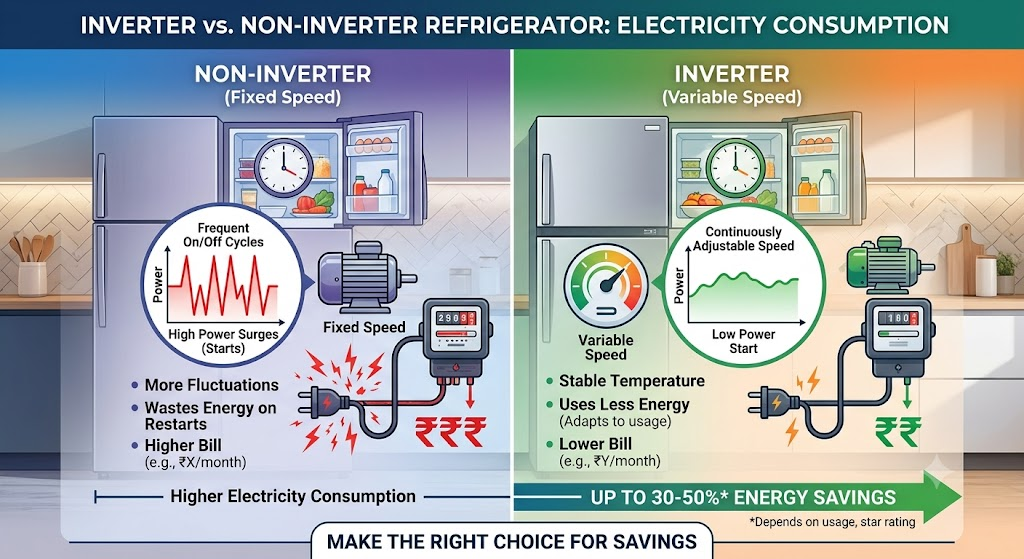
Electricity consumption is one of the biggest reasons consumers consider inverter refrigerators.
Because an inverter compressor can adjust its operating speed, it can avoid some of the repeated full-speed start/stop operation associated with conventional compressors.
This can improve efficiency, particularly when the refrigerator operates continuously under varying cooling loads.
However, it is incorrect to assume:
“Every inverter refrigerator consumes 30%, 40%, or 50% less electricity.”
There is no universal saving percentage that applies to every refrigerator. Actual electricity consumption depends on factors such as:
- Refrigerator capacity
- Energy efficiency rating
- Compressor design
- Ambient temperature
- Door-opening frequency
- Temperature setting
- Amount of food stored
- Frost-free or direct-cool design
- Usage pattern
How to Compare Electricity Consumption
The most useful figure is the annual energy consumption of the specific refrigerator, rather than simply whether it has an inverter compressor.
For example, suppose a refrigerator has an annual consumption of 250 kWh and your electricity tariff is ₹8 per kWh.
Annual electricity cost: 250 × ₹8 = ₹2,000 per year
Monthly electricity cost: ₹2,000 ÷ 12 ≈ ₹167 per month
The actual tariff and consumption will vary, so use the energy information provided for the specific refrigerator when making a purchase decision.
For Indian buyers, the applicable energy label and manufacturer specifications should be checked before comparing models.
Want to lower your electricity bill? Read our guide on household appliances that consume the most electricity and learn practical ways to save energy.
2. Cooling Consistency
Inverter refrigerators generally have an advantage in cooling consistency. Because the compressor can operate at different speeds, it can adjust cooling according to the current requirement.
This can help maintain a more stable temperature instead of allowing the temperature to rise and fall through repeated compressor cycles.
This is particularly useful when:
- The refrigerator is opened frequently
- The kitchen is warm
- A large amount of food is added
- The refrigerator is heavily used
However, cooling performance also depends on the refrigerator’s overall design, insulation, airflow, thermostat controls, and cooling system. Therefore, the compressor type is important, but it isn’t the only factor.
3. Noise Level

Inverter refrigerators are generally quieter because their compressors can operate at lower speeds once the required temperature has been reached.
A traditional fixed-speed compressor tends to operate at its set speed when running and can produce a more noticeable starting sound.
This doesn’t mean every non-inverter refrigerator is noisy or every inverter refrigerator is silent. Fan design, cabinet insulation, airflow, and overall refrigerator construction also influence noise.
Still, if quiet operation is important to you, an inverter model is generally worth considering.
4. Purchase Price
Non-inverter refrigerators can have an advantage when it comes to upfront price. The simpler compressor technology can make some conventional models more affordable.
Inverter refrigerators may cost more initially because they use variable-speed compressor technology and associated electronic components.
This creates an important buying question:
Should you pay more initially to potentially reduce operating costs over the refrigerator’s lifetime?
The answer depends on:
- Price difference
- Annual electricity consumption
- Electricity tariff
- Expected ownership period
- Refrigerator capacity
- Energy rating
Don’t assume the more expensive refrigerator is automatically the better financial decision.
5. Long-Term Electricity Cost
The initial price is only one part of refrigerator ownership cost.
Consider:
Purchase price + electricity cost + maintenance cost = overall ownership cost
For example, suppose an inverter refrigerator costs $100 more than a comparable non-inverter model.
If the inverter model saves ₹8,000 per year in electricity, the simple payback period would be:
₹8,000 ÷ ₹1,600 = 5 years
This is only an example. Actual savings depend on the energy consumption of the specific models and your electricity tariff.
The important point is that buyers should compare actual annual energy consumption, not rely solely on the inverter label.
6. Compressor Operation
This is the fundamental technological difference.
Inverter compressor
The compressor can operate at different speeds depending on cooling requirements.
Non-inverter compressor
The compressor normally operates at a fixed speed and switches on and off according to the cooling requirement.
The variable-speed operation of an inverter compressor can reduce unnecessary full-speed cycling and allow the refrigerator to respond more efficiently to changing cooling loads.
7. Temperature Fluctuation
Repeated compressor cycling can cause more variation around the refrigerator’s target temperature.
An inverter compressor can continuously adjust its operation to maintain the required cooling level. As a result, inverter refrigerators generally have an advantage when it comes to maintaining more consistent temperatures.
However, the actual temperature stability depends on the complete cooling system, not just the compressor.
8. Maintenance and Repair
An inverter refrigerator has more sophisticated electronics and variable-speed compressor controls. If an electronic component fails, the repair can potentially be more expensive than repairing a simpler system.
A non-inverter refrigerator may have a simpler compressor control system.
However, repair costs vary significantly by:
- Brand
- Model
- Component
- Warranty
- Availability of spare parts
- Service location
Therefore, it is inaccurate to say that inverter refrigerators are always expensive to repair or that non-inverter refrigerators are always cheaper to maintain.
Check the manufacturer’s warranty, particularly compressor and major-component coverage, before buying.
9. Lifespan and Reliability
Both inverter and non-inverter refrigerators can provide years of service when properly maintained. The compressor technology alone does not determine the overall lifespan.
Reliability also depends on:
- Compressor quality
- Electronics
- Refrigerant system
- Build quality
- Temperature conditions
- Maintenance
- Power quality
- Usage
Instead of asking only: “Is an inverter refrigerator more reliable?”
ask:
“Which specific model has better warranty coverage, service support, energy efficiency, and long-term reliability?”
Inverter vs Non Inverter Refrigerator: Pros and Cons
Inverter Refrigerator
| Pros of Inverter Refrigerator | Cons of Inverter Refrigerator |
|---|---|
| Generally better energy efficiency | Usually higher initial price |
| Variable-speed compressor operation | More complex electronics |
| More consistent cooling | Certain repairs may be more expensive |
| Usually quieter operation | Higher purchase price may not always be justified for every buyer |
| Better adaptation to changing cooling demand | — |
| Suitable for long-term regular use | — |
Non-Inverter Refrigerator
| Pros of Non-Inverter Refrigerator | Cons of Non-Inverter Refrigerator |
|---|---|
| Usually lower upfront price | Fixed-speed compressor |
| Simpler compressor operation | More frequent start/stop operation |
| Familiar technology | Generally less energy-efficient than comparable efficient inverter models |
| Suitable for budget-conscious buyers | More noticeable compressor cycling |
| Potentially simpler control system | Greater temperature variation may occur |
Which Refrigerator Saves More Electricity?
In many comparable situations, an efficient inverter refrigerator can consume less electricity than a comparable non-inverter refrigerator because the compressor can adjust its speed according to cooling demand.
But “inverter” should not be treated as a guarantee of low electricity consumption.
For example, a large inverter refrigerator with a mediocre efficiency rating could consume more electricity than a smaller, highly efficient non-inverter model.
When comparing two refrigerators, check:
- Annual energy consumption
- Energy efficiency rating
- Capacity
- Compressor type
- Cooling system
- Expected usage
- Purchase price
The annual energy-consumption figure is particularly useful because it gives you a model-specific basis for comparison.
Inverter vs Non Inverter: Total Cost of Ownership
A refrigerator is usually used for many years, so looking only at the purchase price can be misleading. Consider this simplified example:
| Cost factor | Inverter Refrigerator | Non-Inverter Refrigerator |
|---|---|---|
| Initial purchase price | Usually higher | Usually lower |
| Electricity consumption | Potentially lower | Potentially higher |
| Maintenance | Model-dependent | Model-dependent |
| Repair complexity | Can be higher | Generally simpler |
| Long-term cost | Potentially lower | Potentially higher |
The best choice depends on the actual models being compared. Paying substantially more for an inverter model may not make financial sense if the expected electricity savings are very small.
Which Is Better for Indian Homes?
There isn’t one answer for every household. Your usage pattern matters.
| Indian Household / Buyer Type | Recommended Choice | Why |
|---|---|---|
| Large family | Inverter Refrigerator | Frequent door opening and higher cooling demand can benefit from variable-speed compressor operation. |
| Small family | Either | Both can work well; compare capacity, energy consumption, price, and warranty. |
| Budget-conscious buyer | Non-Inverter Refrigerator | Usually has a lower upfront purchase price. |
| Energy-conscious buyer | Inverter Refrigerator | Variable-speed operation can improve energy efficiency compared with a comparable non-inverter model. |
| High electricity-cost household | Inverter Refrigerator | Lower energy consumption can help reduce long-term electricity costs, depending on the specific model. |
| Buyer seeking quiet operation | Inverter Refrigerator | The compressor can operate at lower speeds, generally resulting in quieter operation. |
| Heavy daily usage | Inverter Refrigerator | It can adjust compressor speed according to changing cooling requirements. |
| Occasional or light usage | Non-Inverter Refrigerator | Lower initial cost may be more important when the refrigerator has relatively light usage. |
| Long-term ownership | Inverter Refrigerator | Potential energy savings and quieter, more consistent operation can make it attractive over several years. |
| Buyer prioritizing simple technology | Non-Inverter Refrigerator | Fixed-speed compressor technology is simpler and familiar. |
| Buyers in hot climates | Inverter Refrigerator | Variable-speed operation can respond to increased cooling demand, although overall performance depends on the refrigerator’s design. |
| Best overall for most households | Inverter Refrigerator | It generally offers a stronger combination of efficiency, cooling consistency, and quieter operation, provided the model has good energy-consumption figures. |
Best for large families
An inverter refrigerator is generally worth considering because larger families tend to open the refrigerator more frequently and store more food.
The variable-speed compressor can respond to changing cooling demand. However, compare capacity and annual energy consumption before purchasing.
Looking for recommendations? Explore our list of the Best Double Door Refrigerators in India with expert reviews and buying advice.
Best for small families
Either type can work.
If your budget is tight and the refrigerator is relatively small, a good non-inverter model may be perfectly adequate.
If you plan to use the refrigerator for many years and want better energy efficiency, an inverter model may be the better long-term choice.
Best for budget buyers
A non-inverter refrigerator can make sense if the main priority is keeping the initial purchase price low.
But don’t ignore electricity consumption. A cheaper refrigerator isn’t necessarily cheaper to own.
Best for energy-conscious buyers
An efficient inverter refrigerator is generally the better starting point. Still, compare the actual annual energy consumption of competing models.
Best for quiet operation
An inverter refrigerator generally has an advantage because its compressor can operate at lower speeds.If noise is important, also consider customer reviews and manufacturer specifications rather than relying only on compressor type.
Is an Inverter Refrigerator Worth the Extra Money?
For many households, yes but not automatically.
An inverter refrigerator is more likely to be worth the additional investment if:
- You use the refrigerator continuously
- You plan to keep it for many years
- Electricity efficiency is important
- You prefer quieter operation
- You want more consistent cooling
- The difference in annual energy consumption is meaningful
A non-inverter refrigerator may be a better choice if:
- Your budget is limited
- The upfront price difference is substantial
- Electricity savings are not a major concern
- You need a basic refrigerator for limited use
Use the payback calculation
You can estimate the simple payback period with:
Extra purchase price ÷ estimated annual electricity savings
For example:
- Extra cost = ₹8,000
- Estimated annual savings = ₹1,600
- Payback period = 5 years
This doesn’t account for maintenance, financing, changing electricity rates, or other costs, so treat it as a simple comparison rather than a guaranteed financial outcome.
How to Choose Between Inverter and Non-Inverter Refrigerator
Use this simple decision guide.
Choose an inverter refrigerator if:
- You prioritize energy efficiency
- You use the refrigerator heavily
- You want quieter operation
- You prefer consistent cooling
- You plan to keep the refrigerator for many years
- The specific model has strong energy-efficiency figures
Consider a non-inverter refrigerator if:
- Your initial budget is the biggest concern
- You want a simpler compressor system
- Electricity consumption is less important
- You find a well-priced, efficient model that meets your needs
Most importantly:
Don’t compare only inverter vs non-inverter. Compare model vs model.
Look at:
Capacity + energy consumption + efficiency rating + price + warranty + features + service network
This will give you a much more accurate buying decision.
Inverter vs Non Inverter Refrigerator: Which One Should You Buy?
For most households that use a refrigerator every day and plan to keep it for several years, an inverter refrigerator is generally the better overall choice.
Its variable-speed compressor can adjust cooling according to demand, which can help improve energy efficiency, reduce compressor cycling, maintain more consistent temperatures, and provide quieter operation.
If your priority is a lower upfront price, a non-inverter model can still make sense—particularly when you select a model with good efficiency, appropriate capacity, and a reliable warranty.
The most important point is this:
Don’t buy a refrigerator simply because it says “inverter.” Compare the specific model’s annual energy consumption, efficiency rating, capacity, price, warranty, features, and service support.
Inverter vs Non-Inverter Refrigerator: During a Power Cut
One of the biggest misconceptions is that an inverter refrigerator keeps running during a power cut. This is not true.
The term “inverter refrigerator” refers to the compressor technology, not a built-in power backup.
| Feature | Inverter Refrigerator | Non-Inverter Refrigerator |
|---|---|---|
| Works during a power cut without backup? | ❌ No | ❌ No |
| Requires electricity to operate | Yes | Yes |
| Runs on a home inverter or UPS (if compatible) | Yes | Yes |
| Cooling retained during a power outage | Similar, depending on insulation and how often the door is opened | Similar, depending on insulation and how often the door is opened |
| Compressor restarts after power is restored | Resumes variable-speed operation | Restarts at fixed speed |
| Built-in battery backup | No | No |
Which Is Better During a Power Cut?
Neither refrigerator has an advantage if there is no backup power source. Once the electricity goes off, both stop cooling because the compressor cannot operate without power.
If your home has an inverter, UPS, or generator that can handle the refrigerator’s power requirements, both inverter and non-inverter refrigerators can continue running, subject to the capacity of the backup system.
If power cuts are common in your area, choosing the right backup is equally important. See our expert picks for the Best Inverters for Home Use in India.
Tips to Keep Food Cold During a Power Cut
- Keep the refrigerator door closed as much as possible.
- Avoid adding warm food during the outage.
- A full refrigerator generally stays cold longer than a nearly empty one.
- If power cuts are frequent in your area, consider using a properly sized home inverter or generator that supports refrigerator operation.
Bottom line: An inverter refrigerator does not provide backup power during a power cut.
FAQs
Q. Is an inverter refrigerator better than a non-inverter refrigerator?
For most regular household users, an inverter refrigerator offers advantages in energy efficiency, cooling consistency, and noise. However, a non-inverter refrigerator can be a sensible choice when upfront price is the main concern.
Q. Does an inverter refrigerator consume less electricity?
An efficient inverter refrigerator can consume less electricity than a comparable non-inverter model because its compressor can adjust its speed according to cooling demand. Actual consumption varies by model and usage, so compare the annual energy-consumption figure.
Q. Is an inverter refrigerator worth buying?
It can be worth buying if you use the refrigerator continuously, plan to keep it for several years, and value energy efficiency and quieter operation. Calculate the price difference against the expected electricity savings before deciding.
Q. Which refrigerator is better for a small family?
Both can work for a small family. Choose based on capacity, annual energy consumption, price, warranty, and features. An inverter model may be preferable for long-term energy efficiency, while a non-inverter model can offer a lower initial cost.
Q. Are inverter refrigerators more expensive to repair?
They can be, depending on the component that fails and the specific model. Inverter refrigerators use more sophisticated electronic controls, so some repairs may cost more. Warranty coverage and local service availability should be considered.
Q. Do inverter refrigerators cool better?
Inverter refrigerators can maintain more consistent cooling because the compressor can adjust its speed according to cooling demand. However, overall cooling performance also depends on the refrigerator’s design, insulation, airflow, and controls.
Q. Is an inverter compressor the same as a voltage stabilizer?
No. An inverter compressor and a voltage stabilizer serve different purposes. Inverter technology controls compressor operation and speed; it does not automatically mean the refrigerator has voltage-stabilization protection.
Final Verdict
Inverter vs non inverter refrigerator is not simply a choice between “new technology” and “old technology.”
An inverter refrigerator generally offers better efficiency potential, quieter operation, and more consistent cooling, making it a strong choice for households that use their refrigerator continuously and plan to keep it for years.
A non-inverter refrigerator can still be the right choice for buyers who prioritize a lower purchase price or prefer simpler technology.
Before buying, compare the actual annual energy consumption, efficiency rating, capacity, price, warranty, features, and service support of the models you are considering.
For most long-term household buyers, choose an efficient inverter refrigerator but choose the model based on its complete specifications, not the inverter label alone.
Still unsure which refrigerator to buy? Check our complete Refrigerator Buying Guide to compare capacity, cooling technology, star ratings, and essential buying tips
Recommended Reading:
- The Ultimate Refrigerator Buying Guide: What You Need to Know Before You Buy
- Direct Cool vs Frost Free Refrigerator: Which One Is Better for Your Home?
- 10 Best 5 Star Refrigerator in India (2026) – Top Energy-Efficient Refrigerators Reviewed
- Refrigerator Electricity Consumption in India: How Much Power Does Your Fridge Really Use?
Sourabh researches and writes about home appliances, kitchen appliances, and common appliance problems to help readers make informed buying decisions. He covers mixer grinders, refrigerators, air conditioners, washing machines, and appliance troubleshooting.
At ReviewSpot, Sourabh compares manufacturer specifications, product features, warranty information, pricing, and customer feedback to turn technical appliance information into practical buying advice. His goal is to help readers understand their options, avoid costly mistakes, and choose products that fit their needs and budget.
ReviewSpot distinguishes manufacturer information, customer feedback, and editorial analysis, and does not describe products as hands-on tested unless they have actually been tested.