Direct Cool vs Frost Free Refrigerator: Which One Is Better for Your Home?

Buying a refrigerator looks simple until you start comparing models. Then the confusion begins: Direct Cool, Frost Free, Inverter, Convertible, 3 Star, 5 Star, single door, double door and so on.
Among all these terms, one of the most important decisions is Direct Cool vs Frost Free Refrigerator.
The choice affects how your refrigerator cools food, how often you need to defrost it, how evenly it maintains temperature, how much convenience you get and, to some extent, how much electricity it uses.
Direct Cool vs Frost Free Refrigerator
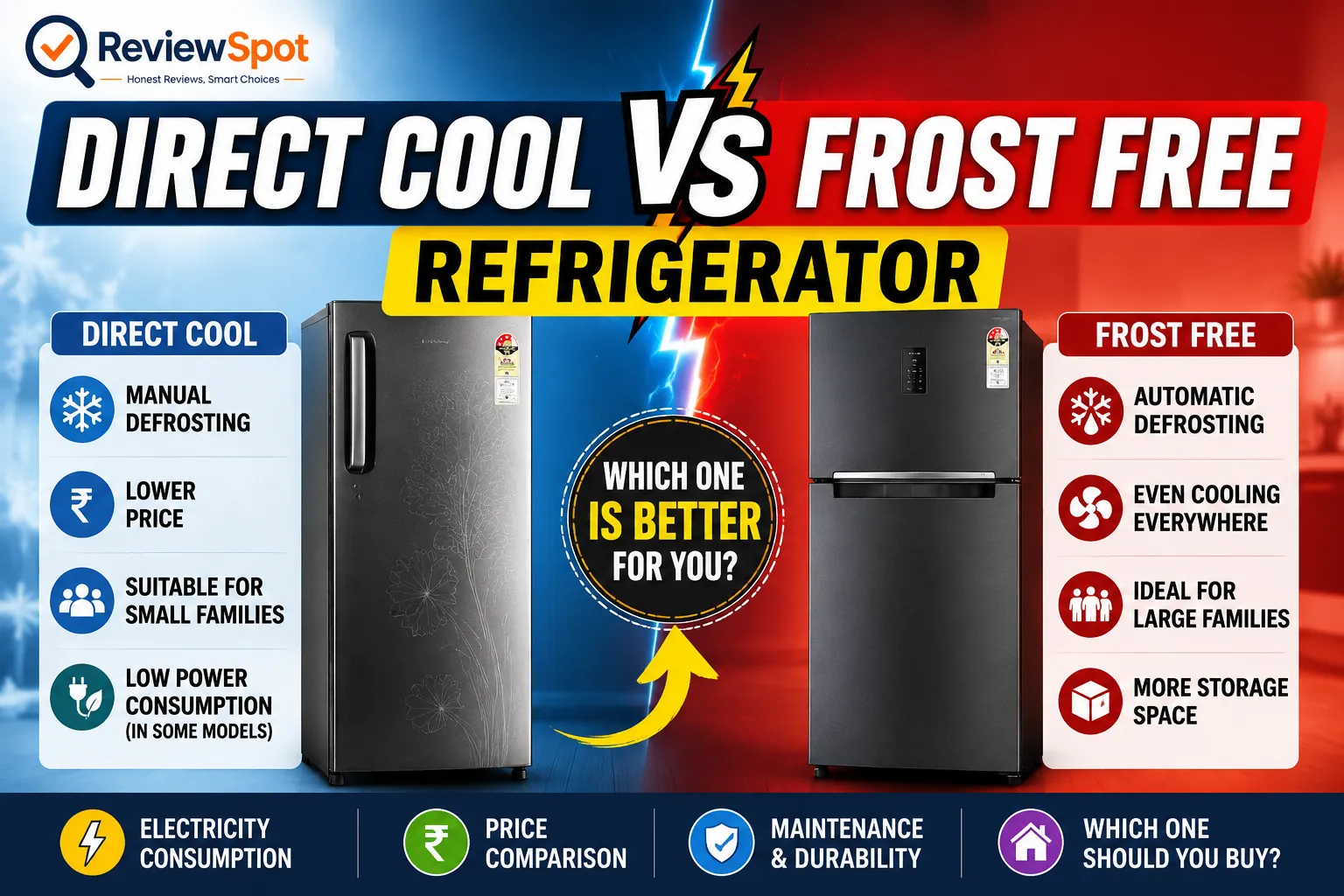
A Frost Free refrigerator is generally better for most Indian families because it offers automatic defrosting, more uniform cooling, better storage convenience and less day-to-day maintenance.
However, a Direct Cool refrigerator can be the smarter choice if you have a small family, limited budget, lower storage requirements or want a simpler refrigerator with potentially lower electricity consumption.
In simple terms:
- Choose Direct Cool if you want affordability, simplicity and lower running costs.
- Choose Frost Free if you want convenience, better cooling distribution and more storage flexibility.
- For a family of 3–5 people, Frost Free is usually the more practical long-term choice.
- For 1–3 people with modest storage needs, a Direct Cool refrigerator can offer excellent value.
The important point is that Frost Free doesn’t automatically mean better in every situation, and Direct Cool doesn’t automatically mean more energy efficient in every model. The actual BEE star rating and annual electricity consumption printed on the energy label matter.
Direct Cool vs Frost Free Refrigerator: Key Differences
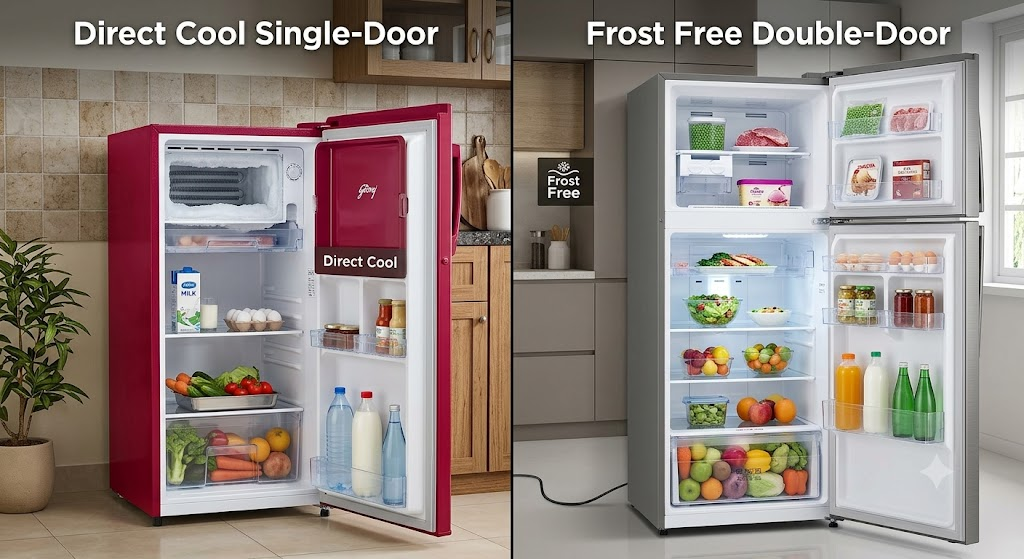
| Feature | Direct Cool | Frost Free |
|---|---|---|
| Cooling method | Natural circulation | Fan-assisted circulation |
| Defrosting | Manual | Automatic |
| Ice formation | Can occur | Managed automatically |
| Cooling distribution | Less uniform | More uniform |
| Initial price | Usually lower | Usually higher |
| Convenience | Moderate | High |
| Maintenance | Requires manual defrosting | Less manual work |
| Best for | Bachelors, couples, small families | Medium and large families |
| Large capacity options | Limited | Widely available |
| Freezer convenience | Basic | Better for frequent use |
| Electricity consumption | Can be lower in some models | Can be higher in some models |
| Food storage | Suitable for basic needs | Better for larger storage needs |
What Is a Direct Cool Refrigerator?
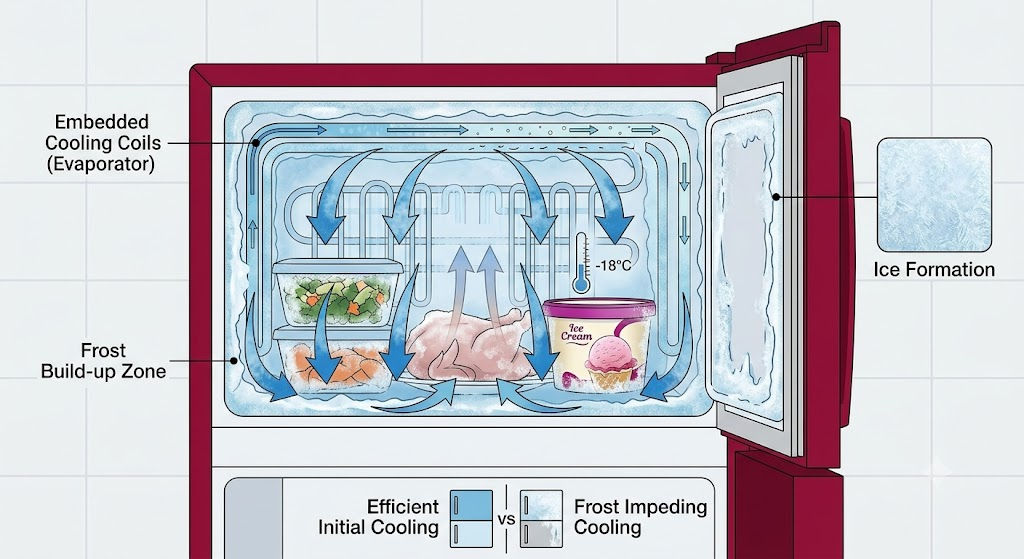
A Direct Cool refrigerator uses a relatively simple cooling method in which cold air circulates naturally inside the compartment.
Because it doesn’t use a fan to circulate cold air throughout the refrigerator, the temperature can vary slightly between different areas. You may notice that some parts are colder than others.
The biggest issue is ice formation.
When moisture inside the freezer comes into contact with cold surfaces, it can gradually turn into ice. Over time, this ice takes up useful freezer space and can affect cooling performance.
That’s why Direct Cool refrigerators generally require manual defrosting. You need to switch off the refrigerator, allow the ice to melt and clean the water before switching it back on. Direct Cool refrigerators remain popular in India because they are affordable and practical.
Key features of Direct Cool refrigerators
- Natural circulation of cool air
- Manual defrosting required
- Usually simpler cooling system
- Generally available in single-door models
- Often lower initial purchase price
- Good option for small households
- Usually easier to understand and operate
- Lower feature complexity
| Advantages of Direct Cool Refrigerators | Disadvantages of Direct Cool Refrigerators |
|---|---|
| Lower initial purchase price | Ice can build up inside the freezer |
| Simple cooling system | Manual defrosting is required |
| Usually available in compact sizes | Cooling may not be as evenly distributed |
| Suitable for small families and bachelors | Freezer space can reduce as ice builds up |
| Generally easier on the budget | Less convenient for storing large amounts of frozen food |
| Manual defrosting gives direct control over the process | Fewer large-capacity options compared with Frost Free models |
| Good choice for relatively low refrigerator usage | Requires periodic cleaning and defrosting |
What Is a Frost Free Refrigerator?
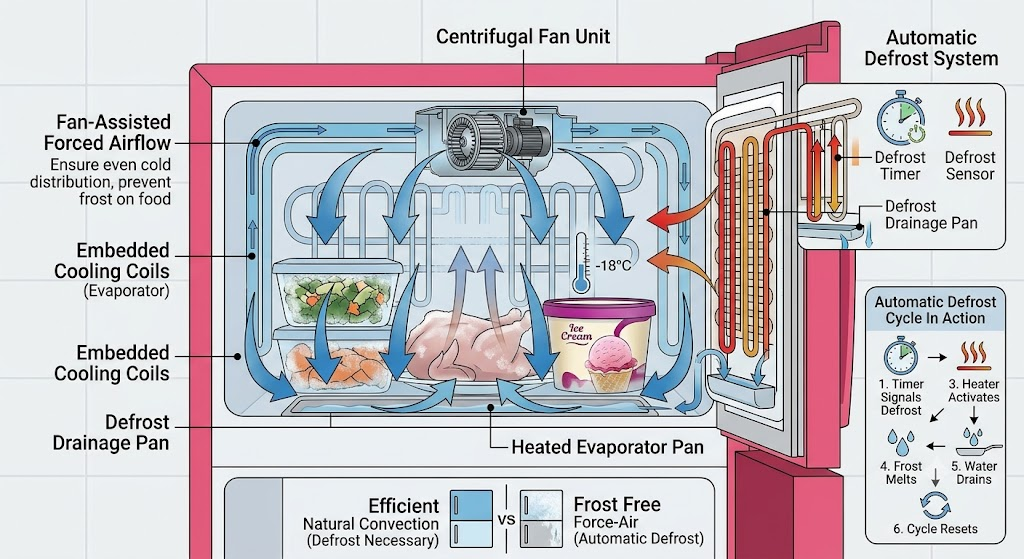
A Frost Free refrigerator uses a fan-assisted cooling system to circulate cold air more evenly throughout the refrigerator. It also has an automatic defrosting system.
This doesn’t mean frost never forms anywhere inside the cooling system. Instead, the refrigerator manages the frost automatically so you don’t have to periodically switch off the appliance and scrape away ice yourself.
That’s the biggest advantage. You simply use the refrigerator normally. The system takes care of the defrosting process automatically. This is one reason Frost Free refrigerators are particularly popular in double-door and larger-capacity refrigerators.
Key features of Frost Free refrigerators
- Automatic defrosting
- Fan-assisted air circulation
- More uniform cooling
- No regular manual defrosting
- Better suited to larger families
- Available in double-door and larger refrigerator formats
- More storage and organisation options
- Usually comes with more advanced features
| Advantages of Frost Free Refrigerators | Disadvantages of Frost Free Refrigerators |
|---|---|
| No regular manual defrosting | Usually cost more than basic Direct Cool models |
| More even distribution of cold air | Cooling system is more complex |
| More convenient for everyday use | Fans and automatic defrost components add complexity |
| Better suited to larger families | Some models may consume more electricity than similarly sized Direct Cool models |
| Good for storing food for several days | Larger refrigerators require more kitchen space |
| Widely available in larger storage capacities | Higher initial investment |
| Less chance of freezer space being lost to thick ice buildup | May require more expensive repairs if complex components fail |
| Better suited to frequent refrigerator use | Takes up more space than compact Direct Cool models |
Direct Cool vs Frost Free Refrigerator
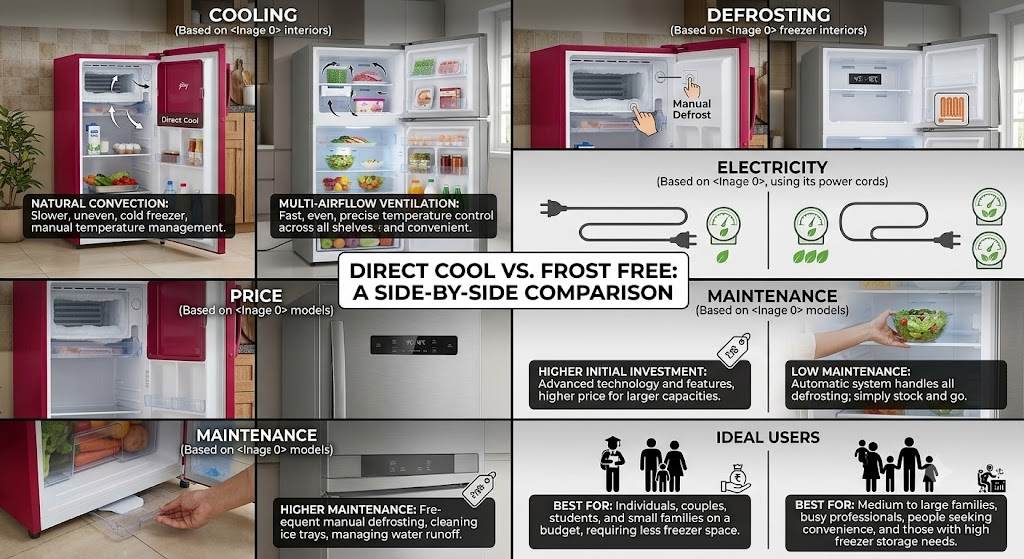
1. Cooling Performance: Which Is Better?
Frost Free refrigerators generally have an advantage when it comes to distributing cold air.
A fan circulates cold air through different sections of the refrigerator. This helps reduce temperature differences between areas.
Direct Cool refrigerators rely more heavily on natural circulation. Therefore, the temperature can vary more from one location to another.
For basic daily use, this difference may not bother you.
But if your refrigerator is packed with vegetables, milk packets, cooked food, fruits, dairy products and other items, more consistent cooling becomes useful.
Winner: Frost Free
For larger households and heavier usage, Frost Free is usually the more practical option.
2. Defrosting: The Biggest Difference
This is where the difference becomes painfully obvious. With a Direct Cool refrigerator, ice can gradually accumulate inside the freezer. At some point, you need to defrost it.
That means:
- Remove the stored food.
- Switch off the refrigerator.
- Wait for the ice to melt.
- Clean the water.
- Clean the freezer.
- Switch the refrigerator back on.
- Wait for it to return to the required temperature.
It isn’t difficult, but it’s a chore. With a Frost Free refrigerator, the appliance handles the defrosting automatically.
Winner: Frost Free
If you don’t want another household maintenance task, Frost Free wins easily.
3. Electricity Consumption: Which One Uses Less Power?
This is where many online articles oversimplify things.
You’ll often see the claim:
Direct Cool = low electricity consumption
and
Frost Free = high electricity consumption
That isn’t always true.
A Frost Free refrigerator uses additional components such as a fan and automatic defrost system. This can contribute to energy consumption.
However, modern refrigerators also use better compressors, improved insulation and more efficient control systems.
Therefore, you should not compare refrigerator types alone.
Instead, check:
- BEE star rating
- Annual electricity consumption shown on the energy label
- Refrigerator capacity
- Compressor technology
- Insulation
- Your usage pattern
- Ambient temperature
BEE regulations specify energy labelling requirements for household refrigerators, including electricity consumption information on the label.
A Better Way to Compare Electricity Usage
Suppose you are comparing:
Refrigerator A: Direct Cool, 5 Star, 190 litres
Refrigerator B: Frost Free, 3 Star, 250 litres
You shouldn’t automatically conclude that Refrigerator A is better simply because it is Direct Cool.
The second refrigerator is larger and has a different cooling system. The smarter approach is to compare the annual energy consumption printed on the BEE label, along with capacity and features.
Winner: Depends on the Model
Don’t buy a refrigerator solely because someone says Direct Cool always saves more electricity.
4. Which One Is Better for Indian Summers?
In many parts of the country, outdoor temperatures can cross 40°C. During summer, your refrigerator has to work harder to remove heat and maintain its internal temperature.
This makes refrigerator efficiency especially important.
A good-quality refrigerator with proper insulation and an efficient compressor can handle these conditions better than an inefficient older model.
Frost Free refrigerators can be particularly convenient during summer because you don’t have to deal with frequent manual defrosting while the refrigerator is working heavily.
However, Frost Free doesn’t automatically mean better cooling in every model.
Build quality, compressor performance, insulation and temperature control still matter.
Winner: Frost Free for Convenience
For Indian summer conditions, the bigger advantage is convenience rather than a guaranteed electricity saving.
6. Which Is Better for a Family of 4?
For a family of four, I would generally choose Frost Free.
A family of four typically needs more refrigerator space and tends to store more food.
You may have:
- Milk
- Vegetables
- Fruits
- Cooked food
- Water bottles
- Dairy products
- Leftovers
- Frozen food
- Ice cream
- Snacks
A larger Frost Free refrigerator makes this easier to organise. You also won’t have to deal with regular manual defrosting.
If your budget allows it, a good Frost Free refrigerator in the appropriate capacity is usually the more convenient long-term option.
Winner: Frost Free
6. Direct Cool vs Frost Free for a Small Family
For a couple or a small family, Direct Cool can make more sense.
If you don’t store much frozen food and don’t mind occasional manual defrosting, spending extra money on Frost Free technology may not provide enough benefit.
For example, someone living alone in a rented apartment doesn’t necessarily need a 300+ litre Frost Free refrigerator.
That’s simply paying for capacity and features they may never use.
7. Food Storage: Which Is Better?
Think about your weekly grocery shopping. If you buy only a few vegetables, milk, fruits and basic food items, a Direct Cool refrigerator may be perfectly adequate.
But if you buy groceries in bulk and store:
- Cooked food
- Vegetables
- Fruits
- Dairy products
- Frozen foods
- Ice cream
- Meat
- Ready-to-cook items
- Meal-prep containers
then a Frost Free refrigerator makes more sense. The better air circulation and larger-capacity designs make it easier to organise food.
Winner: Frost Free
8. Which Refrigerator Is Easier to Maintain?
Direct Cool refrigerators are mechanically simpler in terms of the cooling arrangement, but they require manual defrosting.
Frost Free refrigerators require less day-to-day intervention because the automatic defrost system handles frost management.
However, neither refrigerator is maintenance-free.
You should still:
- Clean shelves regularly
- Check the door gasket
- Avoid overloading the refrigerator
- Keep air vents unobstructed
- Maintain appropriate temperature settings
- Clean accessible areas around the refrigerator
- Check for unusual noises or water leakage
So the real difference is not maintenance vs no maintenance.
It’s manual defrosting vs automatic defrosting.
9. Which One Is More Affordable?
Direct Cool refrigerators generally have an advantage here.
If you have a limited budget and simply need a refrigerator for basic food storage, a Direct Cool single-door model can make a lot of sense.
This is particularly true for:
- Students
- Bachelors
- Couples
- Small families
- Rental homes
- Secondary refrigerators
Frost Free models generally cost more because they offer a more advanced cooling and defrosting system and are commonly available in larger capacities.
But don’t make the mistake of buying the cheapest refrigerator simply because it saves money today.
A refrigerator is an appliance you’ll probably use for many years. Look at the total ownership cost, including purchase price, electricity consumption, maintenance and expected usage.
Direct Cool vs Frost Free: Which Is Better for Different Families?
| User | Better Choice | Why |
|---|---|---|
| Bachelor | Direct Cool | Affordable and sufficient for basic storage |
| Couple | Direct Cool | Good for limited storage requirements |
| Family of 3–4 | Either | Depends on budget and storage needs |
| Family of 4–6 | Frost Free | More storage and convenience |
| Large family | Frost Free | Better suited to frequent use |
| Frequent grocery shopper | Frost Free | Better for larger food storage |
| Budget buyer | Direct Cool | Lower initial cost |
| Person who hates defrosting | Frost Free | Automatic defrosting |
| Heavy freezer user | Frost Free | More convenient |
| Secondary refrigerator | Direct Cool | Simple and economical |
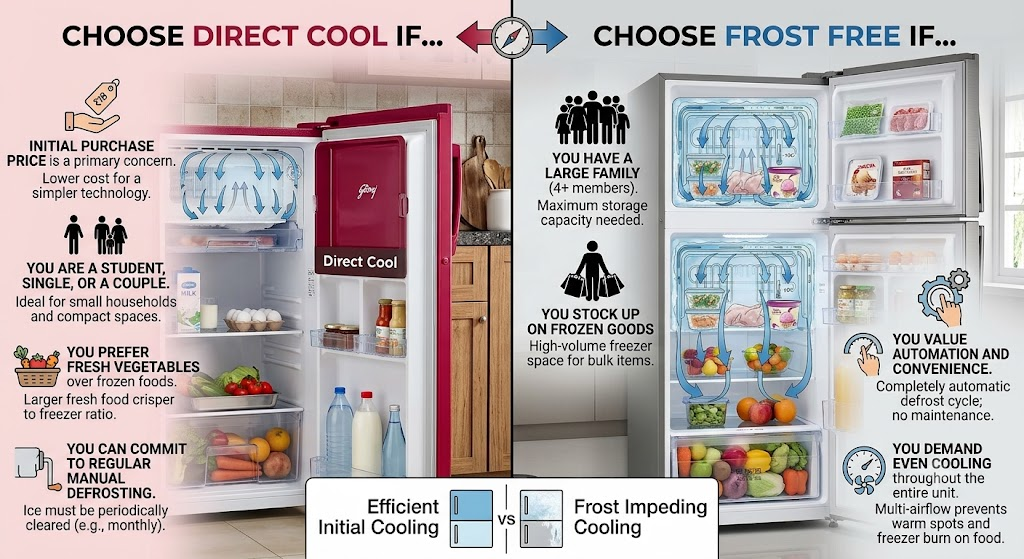
Frost Free vs Direct Cool Refrigerator : Which One Is Better for You?
The answer becomes easy when you look at your lifestyle rather than just refrigerator specifications.
Choose Direct Cool If:
- You have a small family
- You have a limited budget
- You don’t store large quantities of frozen food
- You have limited kitchen space
- You don’t mind manual defrosting
- You want a simple refrigerator
- You’re buying a refrigerator for a rental property or secondary use
Choose Frost Free If:
- You have a medium or large family
- You store a lot of food
- You frequently use the freezer
- You don’t want to manually defrost
- You want more uniform cooling
- Convenience is important to you
- You’re planning to keep the refrigerator for many years
Does Frost Free Mean No Ice Anywhere?
Not exactly.
This is an important point that many simplified articles miss.
“Frost Free” refers to the refrigerator’s ability to automatically manage frost buildup. It doesn’t mean the cooling system magically operates without moisture or frost ever being involved.
The refrigerator periodically manages frost as part of its cooling process. For the user, the practical benefit is simple:
You don’t have to manually defrost the freezer.
Does Direct Cool Mean Poor Cooling?
No. Direct Cool refrigerators can cool food effectively. The main difference is how the refrigerator distributes and manages cooling.
A good Direct Cool refrigerator can be perfectly suitable for everyday use, particularly when you don’t need a large storage capacity.
So don’t confuse “less advanced” with “bad.”
Direct Cool is a simpler technology, not an inherently poor technology.
Does Frost Free Keep Food Fresh for Longer?
Frost Free technology can provide more consistent temperature distribution, which can be useful for food storage.
But refrigerator freshness depends on many other factors too:
- Refrigerator temperature
- Food packaging
- Food type
- Humidity
- How frequently you open the door
- How long the food has already been stored
- Refrigerator cleanliness
- Airflow
- Storage position
So it would be wrong to say: “Frost Free automatically makes food last longer.”
What About Power Cuts?
Power cuts are still a consideration in some Indian households. Some refrigerators offer cooling-retention features that can help maintain lower temperatures for a period after power is interrupted.
But don’t confuse cooling retention with an actual backup power system. A refrigerator doesn’t keep actively cooling during a power cut unless it has an appropriate power source.
When comparing models, look for the manufacturer’s stated cooling-retention capability rather than relying on marketing claims such as “long cooling.“
Important Buying Mistake: Focusing Only on Star Rating
A 5 Star refrigerator sounds attractive, and energy efficiency absolutely matters.
But don’t stop there. A refrigerator’s energy label should be considered together with:
- Capacity
- Annual electricity consumption
- Refrigerator type
- Compressor type
- Warranty
- Service availability
- Storage layout
- Freezer size
- Door design
- Your family size
For example, buying a very large refrigerator for a family of two simply because it has an attractive feature list may not be a smart purchase.
You’re paying for capacity you may never use.
Another Mistake: Buying Too Small to Save Money
The opposite mistake is also common. Someone buys a small Direct Cool refrigerator to save money, then ends up stuffing it with groceries every week.
An overloaded refrigerator can restrict proper airflow and make organisation difficult.
If you regularly struggle to fit everything inside, upgrading to a more suitable capacity may be a better decision than constantly rearranging the shelves like a game of Tetris.
What About Inverter Compressors?
Don’t confuse Direct Cool vs Frost Free with inverter vs non-inverter. They describe different things.
Direct Cool and Frost Free primarily describe the cooling and defrosting system.
Inverter and non-inverter describe the compressor operation.
Therefore, you can have different combinations depending on the model. When buying a refrigerator, consider both. A good refrigerator should offer a sensible combination of:
- Appropriate capacity
- Efficient compressor
- Good insulation
- Suitable cooling technology
- Appropriate energy rating
- Reliable service
How to Choose the Right Refrigerator in India
Before buying, ask yourself these seven questions:
1. How many people are in your family?
A bachelor doesn’t need the same refrigerator as a family of six.
2. How often do you buy groceries?
Weekly bulk shopping usually means you need more storage.
3. Do you use the freezer frequently?
If frozen food is a major part of your routine, Frost Free becomes more attractive.
4. Do you hate manual defrosting?
If the answer is yes, don’t buy Direct Cool just to save a little money upfront.
You’ll probably regret the decision later.
5. What is your budget?
If you’re working with a strict budget, Direct Cool can offer excellent value.
6. How much kitchen space do you have?
Measure the available space before ordering.
Don’t forget to consider:
- Width
- Height
- Depth
- Door opening space
- Ventilation space
- Pathway through doors and corridors
7. What does the energy label say?
Don’t rely only on the number of stars. Check the actual annual energy consumption shown on the label.
Direct Cool vs Frost Free Refrigerator: Pros and Cons
Direct Cool Refrigerator
| Pros | Cons |
|---|---|
| Lower purchase price | Manual defrosting required |
| Simple design | Ice buildup inside the freezer |
| Suitable for small families | Less uniform cooling |
| Compact options available | Freezer space can reduce because of ice |
| Good choice for basic refrigeration needs | Less convenient for heavy usage |
Frost Free Refrigerator
| Pros | Cons |
|---|---|
| Automatic defrosting | Higher initial price |
| More convenient for everyday use | More complex cooling system |
| Better cooling distribution | Fan and defrost system may consume additional power |
| Suitable for larger families | Larger models require more kitchen space |
| Better for frequent freezer use | Higher repair costs may occur if complex components fail |
| Many larger-capacity options available | — |
FAQs
Q. Is Frost Free better than Direct Cool?
For most medium and large families, yes. Frost Free offers automatic defrosting and generally more even cooling. Direct Cool is better suited to people who want a lower-cost refrigerator and don’t mind manual defrosting.
Q. Which refrigerator consumes less electricity, Direct Cool or Frost Free?
There is no universal winner. Direct Cool models can use less electricity because they have a simpler cooling system, but the actual consumption depends on the model, capacity, compressor, insulation, energy rating and usage.
Q. Does Direct Cool refrigerator need defrosting?
Yes. Ice can accumulate in the freezer, so manual defrosting is normally required.
Q. Does Frost Free refrigerator need manual defrosting?
Normally, no. The refrigerator automatically manages frost buildup through its defrost system.
Q. Which is better for a small family?
A Direct Cool refrigerator can be a good choice for a small family if budget is important and you don’t mind occasional defrosting. A Frost Free model is worth considering if convenience is more important.
Q. Which is better for a family of four?
Either can work, but Frost Free is usually more convenient, particularly if the family stores a lot of groceries and frozen food.
Q. Is Frost Free refrigerator more expensive?
Generally, yes. Frost Free refrigerators typically cost more than basic Direct Cool models because of their cooling and automatic defrosting systems and their availability in larger capacities.
Q. Does Frost Free mean the refrigerator never forms frost?
Not literally. It means the refrigerator automatically manages frost so the user doesn’t have to manually defrost it.
Q. Can Direct Cool refrigerators be energy efficient?
Yes. Direct Cool refrigerators can be highly energy efficient, particularly when combined with efficient compressors, good insulation and a strong BEE rating.
Q. Should I buy a 5 Star Direct Cool or 3 Star Frost Free refrigerator?
Don’t decide based on the star rating alone. Compare annual electricity consumption, capacity, purchase price, features and your actual storage needs. A larger Frost Free refrigerator may naturally have different consumption from a smaller Direct Cool model.
Final Verdict: Direct Cool vs Frost Free Refrigerator
So, which is better: Frost Free or Direct Cool?
For most medium and large Indian families, Frost Free is the better overall choice.
If you want a simple, affordable refrigerator for a small household, Direct Cool remains a perfectly sensible choice.
If you want convenience, larger storage, automatic defrosting and better organisation, Frost Free is the better option for most families.
Before buying, compare capacity, BEE star rating, annual electricity consumption, compressor type, warranty, service availability, kitchen dimensions and the features you will actually use.
The best refrigerator isn’t the one with the longest feature list.
It’s the one that fits your family, kitchen, budget and daily habits without making you regret the purchase six months later.
Recommended Reading:
- The Ultimate Refrigerator Buying Guide: What You Need to Know Before You Buy
- What is an Inverter Refrigerator? 15 Powerful Facts Every Indian Buyer Should Know
- 10 Best Refrigerator Brands in India 2026
- 10 Best Refrigerator Under 20000 in India 2026
Sourabh researches and writes about home appliances, kitchen appliances, and common appliance problems to help readers make informed buying decisions. He covers mixer grinders, refrigerators, air conditioners, washing machines, and appliance troubleshooting.
At ReviewSpot, Sourabh compares manufacturer specifications, product features, warranty information, pricing, and customer feedback to turn technical appliance information into practical buying advice. His goal is to help readers understand their options, avoid costly mistakes, and choose products that fit their needs and budget.
ReviewSpot distinguishes manufacturer information, customer feedback, and editorial analysis, and does not describe products as hands-on tested unless they have actually been tested.