What is an Inverter Refrigerator? 15 Powerful Facts Every Indian Buyer Should Know

Buying a refrigerator isn’t as simple as it used to be. Walk into any electronics store or browse online, and you’ll find terms like Inverter Compressor, Digital Inverter, Smart Inverter, and Intelli Inverter. These names sound impressive, but what do they actually mean?
If you’re wondering what is an inverter refrigerator, you’re not alone. Many Indian buyers assume that an inverter refrigerator can run directly on a home inverter or consume zero electricity. That’s not true.
Understanding how inverter technology works can help you choose a refrigerator that saves electricity, reduces noise, and keeps your food fresh for longer. Whether you’re buying your first refrigerator or planning an upgrade, this guide will explain everything in simple English.
What is an Inverter Refrigerator?
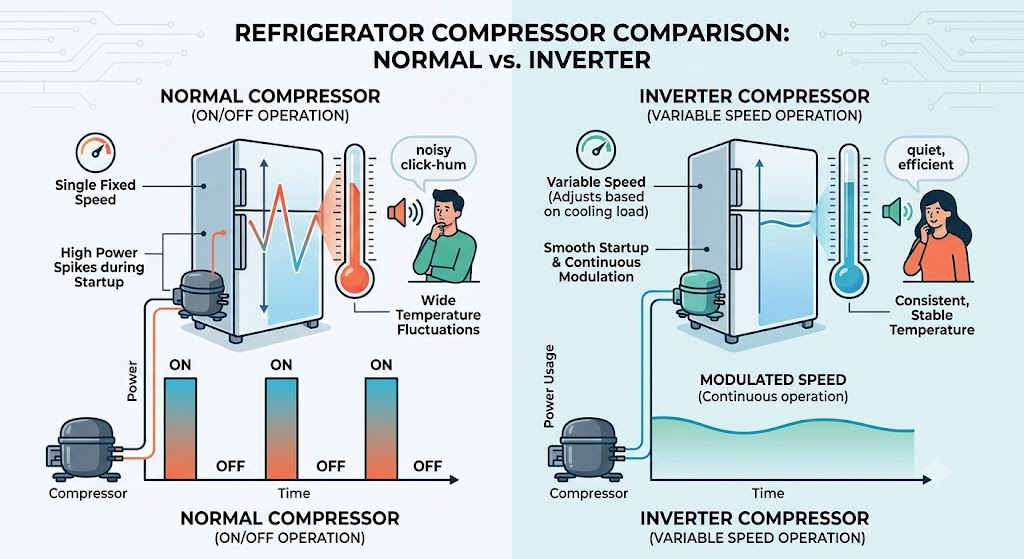
An inverter refrigerator is a refrigerator that uses an inverter compressor, which automatically adjusts its cooling speed according to the cooling requirement inside the fridge. Instead of repeatedly switching ON and OFF like a conventional refrigerator, the compressor runs continuously at different speeds. This helps reduce electricity consumption, maintain a stable temperature, operate more quietly, and improve the life of the compressor.
In simple words:
An inverter refrigerator cools smarter—not harder. It changes its compressor speed instead of constantly stopping and restarting.
This is the biggest reason why most premium refrigerators sold today use inverter technology.
Understanding Inverter Technology in Refrigerators
To understand an inverter refrigerator, let’s first understand how a traditional refrigerator works.
A refrigerator cools the inside using a compressor. Think of the compressor as the heart of the refrigerator. It circulates refrigerant through the cooling system.
Traditional Refrigerator
A conventional refrigerator follows a very simple process.
- Compressor starts.
- Cools the refrigerator quickly.
- Reaches the target temperature.
- Completely switches OFF.
- Temperature gradually rises.
- Compressor starts again.
This ON-OFF cycle repeats hundreds of times every day. Every restart requires a high amount of electricity, which increases power consumption and creates more wear and tear.
Inverter Refrigerator
An inverter refrigerator follows a smarter approach. Instead of switching OFF completely, the compressor slows down after reaching the desired temperature.
When cooling demand increases, it speeds up automatically. When cooling demand is low, it slows down again.
This continuous adjustment results in:
- Lower electricity bills
- Better cooling consistency
- Less compressor noise
- Longer compressor life
- Improved food freshness
Think of it like driving a car. A normal compressor is like pressing the accelerator fully and then applying brakes repeatedly. An inverter compressor is like maintaining a smooth speed depending on road conditions. That’s why inverter technology is considered more efficient.
Why Was Inverter Technology Introduced?
Earlier refrigerators consumed much more electricity because compressors were either fully ON or completely OFF. Manufacturers introduced inverter compressors to solve several problems:
- High electricity consumption
- Temperature fluctuations
- Noisy operation
- Frequent compressor failure
- Reduced food freshness
Today’s inverter refrigerators use electronic sensors and intelligent control systems to monitor:
- Inside temperature
- Outside room temperature
- Door opening frequency
- Food load inside the refrigerator
Based on this information, the compressor adjusts its speed automatically. This means your refrigerator is constantly working in the most efficient way possible.
How Does an Inverter Refrigerator Work?
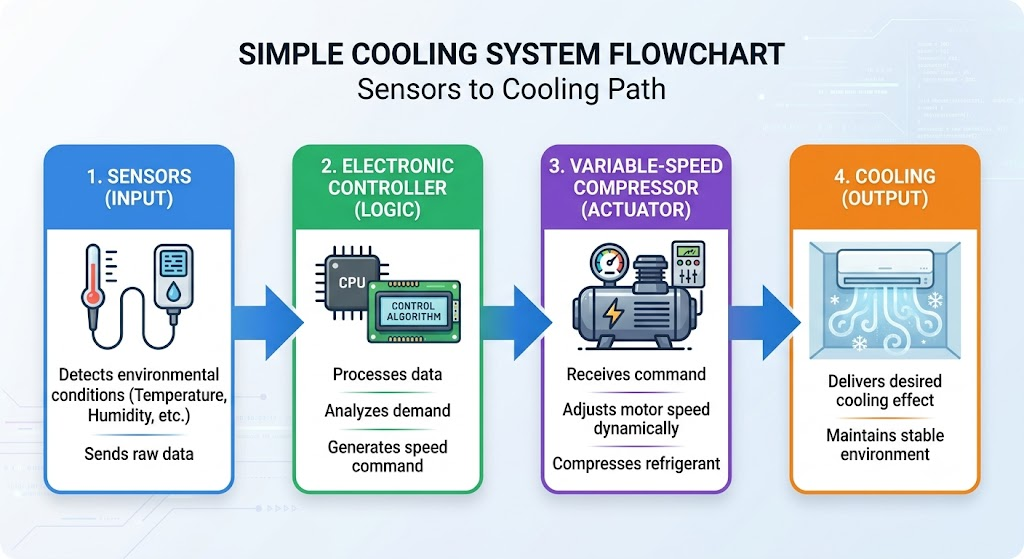
Many people think inverter technology is complicated. In reality, the working principle is quite simple. Here’s the complete process.
Step 1: Temperature Sensors Monitor Cooling
Several sensors continuously measure:
- Internal cabinet temperature
- Freezer temperature
- Ambient room temperature
Step 2: Controller Calculates Cooling Requirement
The electronic control board decides how much cooling is needed.
For example:
- You opened the door several times.
- You placed warm food inside.
- Summer temperature rises to 42°C.
The refrigerator immediately detects these changes.
Step 3: Compressor Adjusts Speed
Instead of switching ON or OFF, the compressor changes its speed.
Examples:
- 20% speed
- 40% speed
- 60% speed
- 80% speed
- 100% speed
The compressor only works as hard as necessary.
Step 4: Stable Cooling
The refrigerator maintains a nearly constant temperature. This helps preserve:
- Fruits
- Vegetables
- Dairy products
- Meat
- Frozen foods
for a longer time.
Main Components of an Inverter Refrigerator
Although an inverter refrigerator looks similar from the outside, its internal technology is more advanced.
| Component | Function |
|---|---|
| Inverter Compressor | Changes cooling speed automatically |
| Temperature Sensors | Detect internal and external temperatures |
| Electronic Control Board | Controls compressor speed |
| Refrigerant | Transfers heat from inside to outside |
| Condenser Coil | Releases heat into the surrounding air |
| Evaporator Coil | Absorbs heat from the refrigerator compartment |
| Expansion Device | Controls refrigerant flow |
Why Are Inverter Refrigerators Becoming Popular in India?
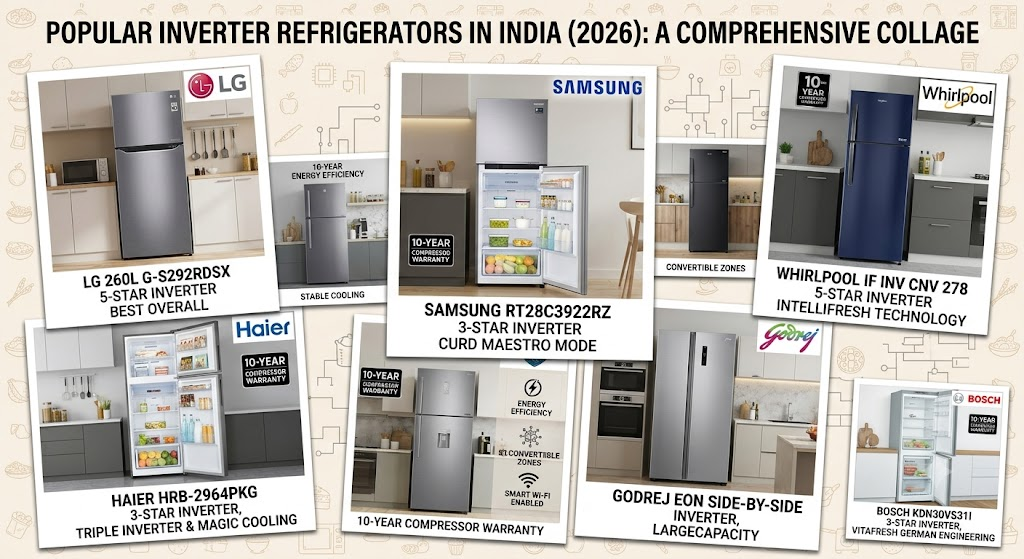
Electricity prices in India continue to increase every year. At the same time, refrigerators are expected to run 24 hours a day throughout the year.
As a result, buyers now look for appliances that reduce long-term electricity costs instead of focusing only on the purchase price.
Another reason is the wide availability of inverter technology across different price segments. Earlier, inverter compressors were mostly found in premium models. Today, many single-door, double-door, bottom-freezer, and side-by-side refrigerators include inverter technology, making it accessible to more households.
Many of the best refrigerator brands in India, including LG, Samsung, Whirlpool, Haier, Godrej, Panasonic, and Bosch, now offer inverter refrigerators in multiple capacities and price ranges.
When combined with a high BEE star rating and good usage habits, an inverter refrigerator can help reduce energy consumption while providing more stable cooling performance.
Difference Between an Inverter Refrigerator and a Normal Refrigerator
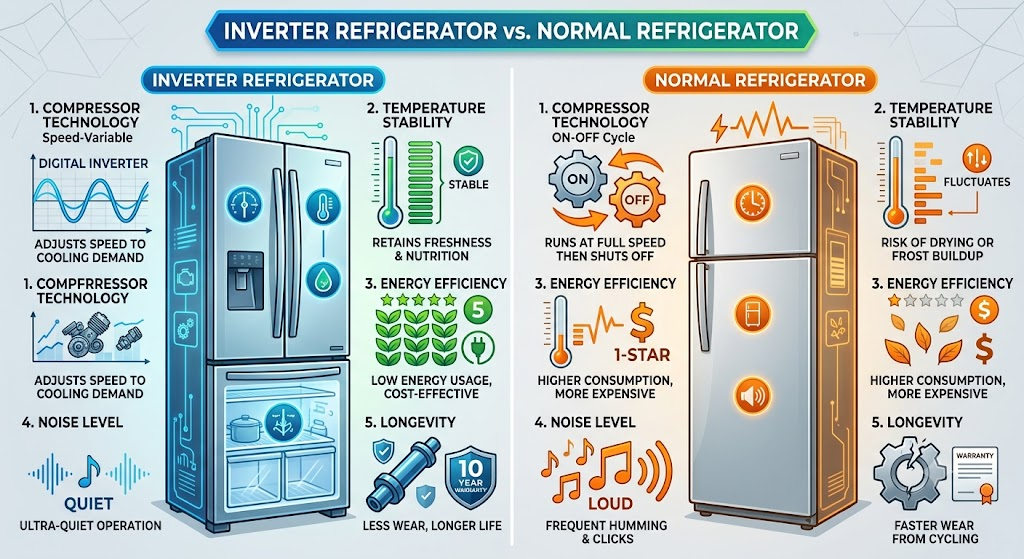
One of the most common questions buyers ask is whether an inverter refrigerator is actually better than a normal refrigerator. The answer depends on how you use your refrigerator, but for most Indian households, an inverter refrigerator offers noticeable advantages in energy efficiency, cooling performance, and long-term reliability.
Here’s a detailed comparison.
| Feature | Inverter Refrigerator | Normal Refrigerator |
|---|---|---|
| Compressor | Variable-speed compressor | Fixed-speed compressor |
| Working | Runs continuously at different speeds | Repeatedly switches ON and OFF |
| Electricity Consumption | Lower | Higher |
| Noise Level | Quieter | Louder during startup |
| Temperature Stability | Excellent | Moderate |
| Food Freshness | Better due to stable cooling | Temperature fluctuates more |
| Compressor Life | Generally longer | More wear due to frequent starts |
| Initial Price | Slightly higher | Lower |
| Long-Term Running Cost | Lower | Higher |
Which One Should You Buy?
If you’re buying a refrigerator that you’ll use for the next 8–12 years, an inverter model is usually the smarter investment. Although it costs more upfront, the lower electricity consumption and smoother operation can offset the higher purchase price over time.
For households that use the refrigerator heavily such as large families or homes where the refrigerator door is opened frequently an inverter refrigerator is especially beneficial.
Advantages of an Inverter Refrigerator
Inverter refrigerators have become popular because they solve many of the limitations of conventional refrigerators.
1. Lower Electricity Consumption
The biggest advantage is energy efficiency. Instead of drawing maximum power every time the compressor starts, an inverter compressor adjusts its speed according to the cooling demand.
This avoids sudden power spikes and reduces unnecessary energy use. Although the exact savings depend on:
- Refrigerator size
- BEE star rating
- Usage habits
- Room temperature
many households notice lower electricity bills after switching to an inverter refrigerator.
2. More Consistent Cooling
Temperature fluctuations can affect food quality. A normal refrigerator cools in cycles, causing the temperature to rise slightly before the compressor starts again.
An inverter refrigerator maintains a more stable temperature because the compressor keeps running at an appropriate speed.
Benefits include:
- Fresher vegetables
- Longer-lasting fruits
- Better milk storage
- Improved meat preservation
- Reduced ice crystal formation in frozen foods
3. Quieter Operation
Frequent compressor restarts create noticeable noise. Since an inverter compressor rarely shuts off completely, it operates much more smoothly. This makes inverter refrigerators ideal for:
- Studio apartments
- Open kitchens
- Small homes
- Homes where the refrigerator is close to bedrooms
4. Longer Compressor Life
Every time a conventional compressor starts, it experiences mechanical stress. An inverter compressor avoids these repeated high-load starts. As a result:
- Components experience less wear.
- The compressor often lasts longer.
- Maintenance needs may be lower over the appliance’s lifetime.
This is one reason many manufacturers confidently offer long compressor warranties.
5. Better Performance During Summer
Indian summers can be extremely hot, especially in cities where temperatures often exceed 40°C. An inverter refrigerator adjusts its cooling capacity automatically. When outside temperatures increase, the compressor speeds up to maintain the desired cooling level. When temperatures drop, it slows down to save energy.
6. Faster Recovery After Door Opening
Every time you open the refrigerator door, warm air enters. An inverter refrigerator detects the temperature increase and temporarily increases compressor speed to restore cooling quickly. This helps maintain food quality even in busy households.
7. Suitable for Modern Lifestyles
Today’s families often:
- Store weekly groceries
- Keep frozen foods
- Use meal prep containers
- Refrigerate leftovers
An inverter refrigerator adapts better to these changing cooling demands than a fixed-speed model.
Disadvantages of an Inverter Refrigerator
No appliance is perfect. While inverter refrigerators offer many benefits, there are a few drawbacks to consider.
1. Higher Purchase Price
The biggest disadvantage is the initial cost.
An inverter refrigerator generally costs more than a similar non-inverter model because of its advanced compressor and electronic controls.
However, the difference has narrowed in recent years as inverter technology has become more common.
2. Electronic Components Can Be Costlier
The inverter control board and related electronics are more sophisticated than those in older refrigerators.
If these components fail outside the warranty period, repairs may be more expensive than on a basic refrigerator.
The good news is that such failures are uncommon with proper use and stable power supply.
3. Electricity Savings Depend on Usage
Some buyers expect dramatic reductions in electricity bills. In reality, savings depend on several factors:
- Household usage
- Ambient temperature
- Refrigerator size
- Star rating
- Maintenance
If you choose a large refrigerator but use very little storage, or frequently leave the door open, energy savings will be lower.
4. Needs Proper Voltage Protection
Although many modern refrigerators can handle voltage fluctuations, areas with frequent power issues may benefit from a compatible voltage stabilizer if recommended by the manufacturer.
Always check the product manual before purchasing one.
How Much Electricity Does an Inverter Refrigerator Consume?
This is one of the most searched questions among Indian buyers. The answer depends on:
- Capacity
- Compressor efficiency
- BEE star rating
- Room temperature
- Number of door openings
- Food load
A refrigerator with inverter technology doesn’t consume a fixed amount of electricity every hour. Instead, it continuously adjusts power consumption according to cooling requirements.
Approximate Annual Electricity Consumption
| Refrigerator Type | Estimated Annual Consumption* |
|---|---|
| 190–220 L Single Door | 120–180 kWh |
| 240–300 L Double Door | 180–280 kWh |
| 300–400 L Frost-Free | 250–380 kWh |
| 500 L+ Side-by-Side | 350–550 kWh |
Tips to Reduce Electricity Consumption
Even an inverter refrigerator performs best when used correctly. Follow these simple habits:
- Keep the door closed whenever possible.
- Don’t place hot food directly inside.
- Leave space around the refrigerator for ventilation.
- Clean the condenser area if recommended by the manufacturer.
- Set the temperature appropriately for the season.
- Avoid overloading or completely emptying the refrigerator.
- Check that the door gasket seals properly.
These practices improve efficiency regardless of the refrigerator brand.
Does an Inverter Refrigerator Work During a Power Cut?
No. An inverter refrigerator does not continue running during a power outage simply because it has an inverter compressor. The term “inverter” refers to the compressor technology, not to a built-in power backup. If electricity goes off:
- The refrigerator stops cooling.
- The compressor stops running.
- Cooling resumes once power returns.
If you want backup during outages, you’ll need a suitable home inverter, UPS, or generator—provided the refrigerator and backup system are compatible.
Is an Inverter Refrigerator Worth Buying in India?
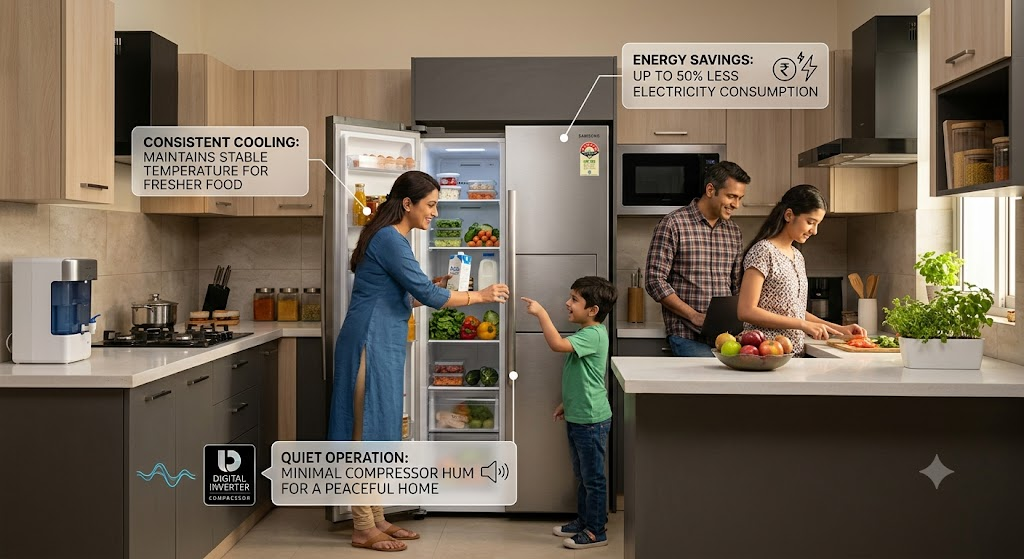
For most Indian households, the answer is yes. It is especially worth considering if:
- You use the refrigerator throughout the year.
- Your family opens the refrigerator frequently.
- You want lower long-term electricity costs.
- You prefer quieter operation.
- You plan to keep the appliance for many years.
However, a non-inverter refrigerator may still be a practical choice if:
- You’re on a very tight budget.
- The refrigerator will be used only occasionally.
- It’s for a guest room, hostel, office pantry, or holiday home with limited usage.
When comparing models, don’t focus only on inverter technology. Also consider:
- BEE star rating
- Storage capacity
- Cooling features
- Build quality
- Warranty
- After-sales service
Many of the best refrigerator brands in India combine inverter compressors with advanced cooling technologies, making them a strong choice for long-term value.
Types of Inverter Refrigerators Available in India
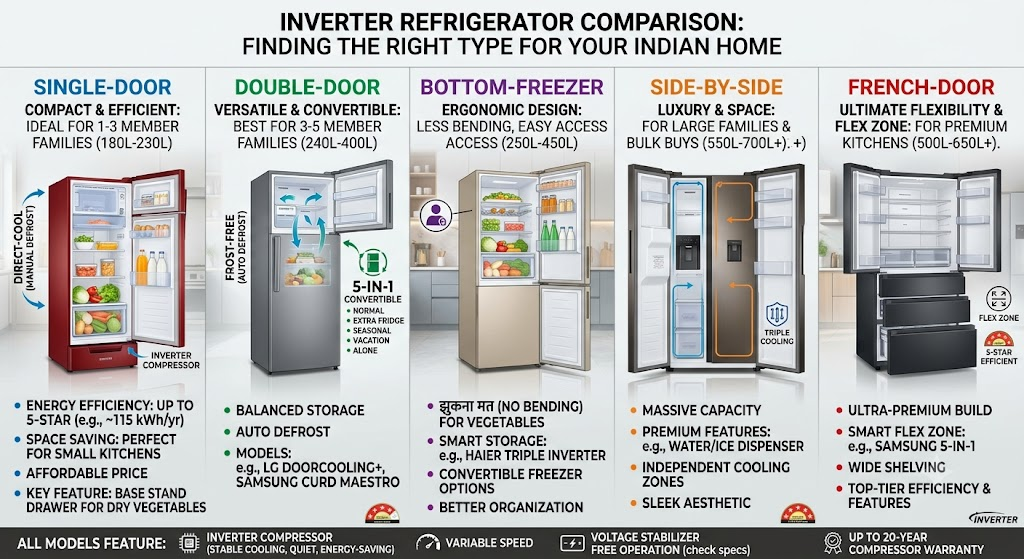
Not all inverter refrigerators are the same. Manufacturers offer different styles to suit various family sizes, kitchen layouts, and budgets. Choosing the right type is just as important as choosing inverter technology.
1. Single Door Inverter Refrigerator
Single-door refrigerators are ideal for:
- Singles and students
- Couples
- Small families (2–3 members)
- Budget-conscious buyers
Typical Capacity: 180–250 Litres
| Pros | Cons |
|---|---|
| Affordable compared to larger refrigerator models | Smaller freezer compartment |
| Low electricity consumption | Manual defrost required in most models |
| Compact size, ideal for small kitchens | Limited overall storage capacity |
| Easy to maintain and clean | Not suitable for large families or bulk food storage |
2. Double Door Inverter Refrigerator
Double-door refrigerators are the most popular choice for Indian families.
Ideal for:
- Families of 3–5 members
- Daily cooking
- Weekly grocery shopping
Typical Capacity: 240–400 Litres
Benefits
- Frost-free cooling
- Larger freezer
- Better organization
- Faster cooling
- More energy-efficient than older double-door models
Many buyers searching for the best refrigerator brands in India choose double-door inverter models because they offer the best balance of price, storage, and efficiency.
3. Bottom Freezer Inverter Refrigerator
In these refrigerators, the freezer is placed at the bottom while the fresh food section remains at eye level. This design is convenient because most people access vegetables, milk, fruits, and cooked food more often than frozen items.
| Advantages | Drawbacks |
|---|---|
| Comfortable access to fresh food at eye level | Higher purchase price |
| Modern and premium appearance | Fewer model options available in India |
| Better organization of fresh and frozen food | Limited availability compared to single- and double-door models |
4. Side-by-Side Inverter Refrigerator
These refrigerators are suitable for:
- Large families
- Luxury kitchens
- Homes that store large quantities of frozen food
Typical Capacity: 500–700 Litres
Features often include:
- Ice maker
- Water dispenser
- Convertible storage
- Smart connectivity
- Multi-airflow cooling
5. French Door Inverter Refrigerator
French door refrigerators combine premium design with excellent storage flexibility.
They usually include:
- Double refrigerator doors
- Bottom freezer
- Convertible compartments
- Premium interiors
These models are best suited for large households and premium kitchens.
How to Choose the Right Inverter Refrigerator
Buying the right refrigerator involves more than selecting a trusted brand. Use the checklist below before making your decision.
1. Choose the Right Capacity
| Family Size | Recommended Capacity |
|---|---|
| 1–2 Members | 180–220 L |
| 2–3 Members | 220–260 L |
| 3–5 Members | 260–350 L |
| 5–7 Members | 350–500 L |
| 7+ Members | 500 L and above |
2. Check the BEE Star Rating
The Bureau of Energy Efficiency (BEE) star rating helps estimate energy efficiency.
In general:
- More stars = Better energy efficiency
- Lower annual electricity consumption
- Lower operating cost over time
However, compare refrigerators of similar size and type. A larger refrigerator with more stars can still consume more electricity than a smaller model.
3. Compare Cooling Technologies
Look beyond inverter technology.
Useful features include:
- Multi Air Flow
- Door Cooling
- Convertible Freezer
- Moisture Balance Crisper
- Digital Temperature Control
- Deodorizer
- Fast Ice Making
These features improve convenience and food preservation.
4. Look at Warranty Coverage
Many manufacturers now offer:
- 1-year comprehensive warranty
- 10-year compressor warranty (varies by brand and model)
Always read the warranty terms carefully to understand what is covered.
5. Consider After-Sales Service
A refrigerator is a long-term investment. Choose brands that have:
- Good service coverage
- Easily available spare parts
- Positive customer support reviews
This is one reason why many buyers prefer established names among the best refrigerator brands in India.
Best Refrigerator Brands in India Offering Inverter Technology
Several leading manufacturers offer inverter refrigerators across different price ranges.
LG
Known for:
- Smart Inverter Compressor
- Reliable performance
- Strong service network
- Good energy efficiency
Suitable for buyers seeking premium features and dependable after-sales support.
Samsung
Samsung’s Digital Inverter technology is widely used across single-door, double-door, and side-by-side models.
Popular features include:
- Digital Inverter Compressor
- Convertible modes
- Twin Cooling technology (selected models)
- Modern designs
Whirlpool
Whirlpool focuses on:
- IntelliSense Inverter technology
- Fast cooling
- Convertible storage
- Fresh food preservation
A good choice for families looking for value and convenience.
Godrej
Godrej offers refrigerators designed specifically for Indian households.
Highlights include:
- Affordable pricing
- Large vegetable storage
- Nano Shield technology (selected models)
- Wide service availability
Haier
Haier has become increasingly popular because of:
- Competitive pricing
- Bottom freezer models
- Convertible refrigerators
- Modern styling
Panasonic
Panasonic refrigerators often include:
- Intelligent inverter control
- ECONAVI sensors (selected models)
- Stable cooling performance
- Quiet operation
Bosch
Bosch focuses on premium quality with features such as:
- Multi Airflow cooling
- Spacious interiors
- Durable construction
- Advanced temperature control
Expert Tips Before Buying an Inverter Refrigerator
Keep these points in mind before making your purchase:
- Measure your kitchen space, including door clearance.
- Choose a capacity based on your family size rather than buying the biggest model.
- Compare annual energy consumption along with the BEE star rating.
- Check compressor and comprehensive warranty terms.
- Read recent customer reviews for reliability and service quality.
- Buy from an authorized seller to ensure genuine warranty support.
- Consider future needs if your family is likely to grow.
FAQs
1. What is an inverter refrigerator?
An inverter refrigerator uses a variable-speed compressor that adjusts its cooling speed based on the temperature inside the refrigerator. Unlike a conventional refrigerator, it doesn’t repeatedly switch completely ON and OFF. This helps maintain consistent cooling while improving energy efficiency and reducing noise.
2. Does an inverter refrigerator save electricity?
Yes, in most cases.
An inverter refrigerator generally consumes less electricity than a conventional refrigerator because the compressor operates at different speeds instead of constantly restarting. The actual savings depend on:
- Refrigerator capacity
- BEE star rating
- Ambient temperature
- Frequency of door opening
- Usage habits
If you’re replacing an older refrigerator, you may notice lower electricity bills over time.
3. Can an inverter refrigerator run on a home inverter?
Not necessarily. The word “inverter” in an inverter refrigerator refers to the compressor technology not a built-in power backup. During a power cut, the refrigerator will stop working unless it is connected to:
- A compatible home inverter
- UPS
- Generator
Always check the refrigerator’s startup power requirements and your inverter’s capacity before using them together.
4. Is an inverter refrigerator better than a normal refrigerator?
For most Indian households, yes. An inverter refrigerator offers several advantages:
- Lower electricity consumption
- More stable cooling
- Quieter operation
- Better food preservation
- Longer compressor life in normal usage
However, if you’re on a tight budget or use the refrigerator only occasionally, a conventional model may still meet your needs.
5. Which refrigerator type is best for a family of four?
For a family of four, a 260–350-litre double-door frost-free inverter refrigerator is usually the best choice. It provides:
- Enough storage for weekly groceries
- Separate freezer compartment
- Better cooling performance
- Lower maintenance
- Good energy efficiency
Many of the best refrigerator brands in India offer models in this capacity range.
6. Does an inverter refrigerator need a stabilizer?
It depends on the model.
Many modern refrigerators can operate within a wide voltage range and may not require an external stabilizer. However, if your area experiences frequent voltage fluctuations outside the manufacturer’s specified operating range, a stabilizer may help protect the appliance.
Always refer to the user manual before purchasing a stabilizer.
7. How long does an inverter refrigerator last?
With proper maintenance, an inverter refrigerator can typically last 10 to 15 years. To maximize its lifespan:
- Clean it regularly.
- Ensure proper ventilation around the appliance.
- Avoid overloading.
- Check the door gasket periodically.
- Follow the manufacturer’s maintenance recommendations.
8. Which are the best refrigerator brands in India with inverter technology?
Several manufacturers offer reliable inverter refrigerators across different budgets. Popular brands include:
- LG
- Samsung
- Whirlpool
- Godrej
- Haier
- Panasonic
- Bosch
The best choice depends on your budget, required capacity, preferred features, warranty, and local after-sales service.
Final Verdict
If you’re planning to buy a refrigerator today, choosing an inverter refrigerator is a smart long-term investment for most households.
Although the initial purchase price is usually higher than that of a conventional refrigerator, the benefits often outweigh the extra cost. Lower electricity consumption, quieter operation, stable cooling, and better food preservation make inverter technology well suited to modern Indian homes.
That said, don’t buy a refrigerator solely because it has an inverter compressor. Compare the overall package, including:
- Capacity
- BEE star rating
- Cooling technology
- Build quality
- Storage layout
- Warranty
- After-sales service
- Customer reviews
A well-chosen refrigerator should meet your family’s needs for many years, not just fit your current budget.
If you’re still deciding, shortlist models from the best refrigerator brands in India, compare their features, and choose one that balances performance, energy efficiency, and value for money.
Key Takeaways
- An inverter refrigerator uses a variable-speed compressor that adjusts cooling automatically.
- It consumes less electricity than a conventional refrigerator under similar conditions.
- Cooling remains more stable, helping keep food fresh for longer.
- The compressor operates more quietly and experiences less wear from frequent restarts.
- It does not include a built-in power backup.
- Choosing the right capacity and BEE star rating is just as important as choosing inverter technology.
- Compare warranty, service support, and storage features before making a purchase.
Final Thoughts
An inverter refrigerator isn’t just a marketing buzzword—it represents a meaningful improvement in how refrigerators cool and consume energy. While it won’t eliminate your electricity bill or run during power cuts without backup power, it can provide a better overall ownership experience through efficient performance, quieter operation, and more consistent cooling.
For most buyers in India, especially those replacing an older refrigerator or purchasing a new one for daily use, an inverter refrigerator is a worthwhile investment when paired with the right capacity, a good BEE star rating, and dependable after-sales support.
Recommended Reading:
- The Ultimate Refrigerator Buying Guide: What You Need to Know Before You Buy
- 10 Best Double Door Refrigerator in India 2026
- 10 Best Refrigerator Brands in India 2026
- 10 Best Refrigerator Under 20000 in India 2026
Sourabh researches and writes about home appliances, kitchen appliances, and common appliance problems to help readers make informed buying decisions. He covers mixer grinders, refrigerators, air conditioners, washing machines, and appliance troubleshooting.
At ReviewSpot, Sourabh compares manufacturer specifications, product features, warranty information, pricing, and customer feedback to turn technical appliance information into practical buying advice. His goal is to help readers understand their options, avoid costly mistakes, and choose products that fit their needs and budget.
ReviewSpot distinguishes manufacturer information, customer feedback, and editorial analysis, and does not describe products as hands-on tested unless they have actually been tested.