
Best Mixer Grinder Buying Guide 2026 – Wattage, Problems & Comparisons

Let’s be honest. A mixer grinder is one of the most used appliances in Indian kitchens. Whether it is grinding masalas, making chutneys, preparing dosa batter, blending smoothies, or crushing spices, this small appliance handles dozens of daily cooking tasks.
Mixer grinders are used for many everyday kitchen tasks, including grinding spices, making chutneys, preparing batter and blending ingredients. Choosing the right model depends on motor power, jar configuration, intended use, warranty and budget.
Many people face common problems like weak grinding performance, loud noise, overheating motors, jar leakage, burning smell, or poor durability.
Not every kitchen task requires a motor-powered appliance. If you mainly prepare small quantities or need a solution during power cuts, compare our guide to hand mixer grinders without electricity to understand the available manual alternatives and their limitations.
That’s why buying a mixer grinder is not just about choosing the cheapest model online. The right appliance depends on your cooking style, family size, ingredients used, and grinding frequency.
What’s in this guide
- What Is a Mixer Grinder?
- How Does a Mixer Grinder Work?
- How to Use a Mixer Grinder Properly
- Mixer Grinder Buying Guide
- Understanding Wattage
- Problems & Troubleshooting
- Popular Buying Categories
- Brand & Feature Comparisons
- Maintenance Tips
- Grinding Hard Ingredients
- Expert Tips Most People Don’t Know
- Frequently Asked Questions
- Final Conclusion
Our Research: We compare manufacturer specifications, current pricing, customer feedback and competing products to evaluate value, features, strengths and limitations. Our recommendations are based on available product information and buyer needs, not paid rankings.
1. What Is a Mixer Grinder?
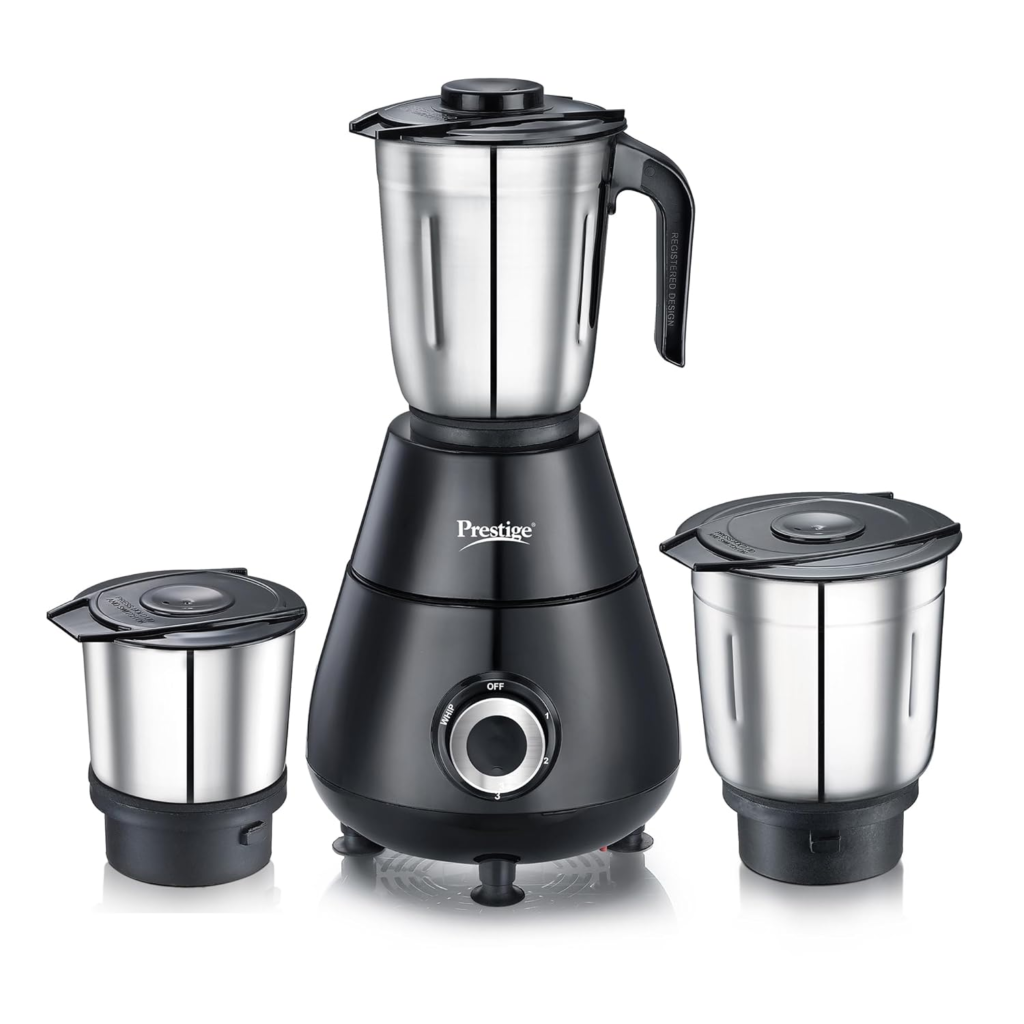
A mixer grinder is a kitchen appliance that uses a motor and rotating blades to grind, mix, blend, and make pastes from different ingredients.
For example, you can use it to:
- Grind spices
- Make chutney
- Blend fruits and vegetables
- Prepare ginger-garlic paste
- Grind soaked ingredients for batter
- Make smoothies and shakes
In simple words, a mixer grinder makes grinding and blending kitchen ingredients faster and easier.
Main Components of Mixer grinder
- Motor body: The heart of the machine. Contains the electric motor, speed control switch, and the spindle.
- Jars: Usually 3 in standard models a large liquidizing jar, a medium wet grinding jar, and a small chutney/dry grinding jar. Some models include a 4th jar.
- Blades: Stainless steel cutting assemblies specific to each jar. Wet grinding blades differ from dry grinding blades.
- Lids: Lock down to prevent spillage. Good lids have a silicone or rubber gasket seal.
- Coupler: The connector between the jar and the spindle. A common failure point in cheaper models.
Types of Jars (and What They’re Actually For)
| Jar Type | Typical Capacity | Best Used For |
|---|---|---|
| Liquidizer jar | 1.5 L | Juices, lassi, smoothies, soups, large batters |
| Wet/Medium jar | 1.0 L | Dosa/idli batter, chutneys, curries, gravies |
| Dry/Chutney jar | 0.4–0.5 L | Dry spices, coffee beans, small chutney quantities |
| Multipurpose 4th jar | 0.3 L | Whisking eggs, small herb grinding, nut powders |
Mixer Grinder vs Blender: What’s the Difference?
A blender is designed purely for liquid-heavy tasks smoothies, protein shakes, soups. It’s not built to handle dry grinding or hard ingredients. A mixer grinder, on the other hand, handles both wet and dry tasks, and its motor is built for the resistance that comes with grinding solid ingredients.
In India, mixer grinders are far more versatile and widely used than standalone blenders.
A food processor is different again it handles slicing, chopping, and shredding using disc attachments, but it’s not as effective at fine grinding. The mixer grinder handles fine grinding better than most food processors.
2. How Does a Mixer Grinder Work?
Understanding how a mixer grinder works helps you use it better and diagnose problems faster. You don’t need to be an engineer. Here’s the simple version.
The Motor
The motor converts electrical energy into rotational motion. It spins a shaft (called the spindle) at high RPM. The jar, when locked onto the motor body, connects to this spindle through a coupler, which then drives the blades inside the jar.
Many mixer grinders publish an RPM figure, but the number should not be considered a standalone measure of grinding performance. Jar design, blade design, motor characteristics and ingredient quantity also affect results.
Copper vs Aluminium Motor Windings
This matters more than most people realise. Motor winding material can be one factor to consider, but buyers should not judge a mixer grinder’s expected lifespan from winding material alone. Motor design, load, operating time, cooling, usage and build quality also matter.
RPM and What It Means for Grinding
RPM (rotations per minute) tells you how fast the blades spin. Higher RPM generally means faster grinding, but the relationship isn’t linear. Higher wattage or RPM does not automatically guarantee better grinding. Buyers should consider the motor, blades, jar design and intended use together.
Read the full article: What is RPM in Mixer Grinders?
Speed Control
Most mixer grinders have 3 speeds plus a pulse (momentary) mode. Lower speeds are better for delicate tasks (coconut chutney, idli batter), while higher speeds suit dry grinding and harder ingredients. The pulse mode where the motor runs only while you hold the button — is useful for coarse grinding or when you need to check consistency frequently.
Overload Protection
Many mixer grinders include overload protection that can stop the motor when excessive load or overheating is detected. If a machine stops suddenly, check the manual for the manufacturer’s recommended reset and cooling procedure.
Tip: If your mixer grinder stops mid-grind, check the bottom of the motor body for a small reset button before assuming the worst. Nine times out of ten, it’s just the overload protector doing its job.
Useful resource for voltage, safety and appliance usage: Bureau of Indian Standards (BIS)
3. How to Use a Mixer Grinder Properly
Most people never read the manual. And most problems people have with mixer grinders are caused by using them incorrectly. Here’s how to get the best results — and avoid common mistakes.
Step-by-Step: The Right Way to Use a Mixer Grinder
- Choose the right jar. Use the large liquidizer jar for liquids and batters, the medium jar for wet grinding, and the small jar for dry spices and small quantities.
- Prepare ingredients first. Cut large vegetables or fruits into smaller chunks before adding them.
- Don’t overfill. Fill the jar to a maximum of two-thirds capacity. Overfilling causes spillage, uneven grinding, and puts strain on the motor.
- Add water before dry ingredients for wet grinding. When making chutneys or batters, add a little water first.
- Close the lid properly. Press down firmly and turn to lock. Then hold the lid with one hand while operating.
- Start at low speed. Begin at speed 1, then increase. Starting at full speed with heavy ingredients causes unnecessary motor strain.
- Use pulse mode for coarse grinding. Short bursts give you better control over texture.
- Don’t run continuously for more than 3 minutes. Give the motor a 2–3 minute break after every 3 minutes of continuous use.
Common Mistakes to Avoid
- Running the machine without any liquid when grinding wet ingredients
- Grinding hot liquids in a sealed jar
- Leaving the machine running unattended
- Using the wrong blade assembly for the task
- Washing blades and leaving them wet — rust forms quickly
- Ignoring the burning smell and continuing to run the motor
Important: Never grind very hot liquids in a closed jar. The steam creates pressure and the lid can burst off, causing burns or injury. Always let hot soups or curries cool before blending, or use a vented lid.
Read the full article: 14 Common Mistakes To Avoid While Using Mixer Grinder
4. Mixer Grinder Buying Guide
Buying a mixer grinder is not as simple as picking the one with the highest wattage and the best-looking jar set. You need to match the machine to how you actually cook. Here’s a framework that helps.
Based on Family Size

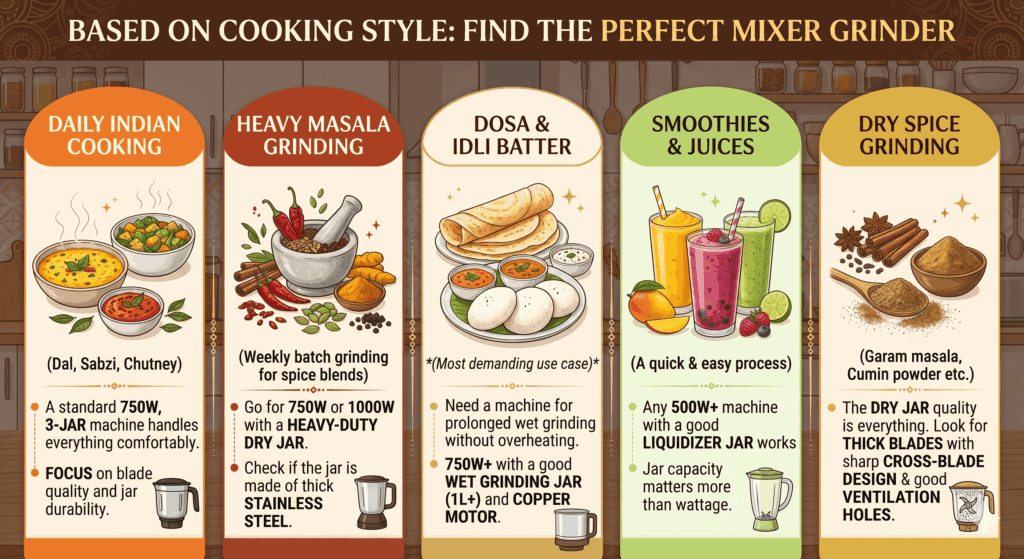
Based on Cooking Style
What to Check in Jar Quality
- Thickness of steel: Check the jar material, construction, capacity and manufacturer’s specifications.
- Grade of stainless steel: Food-grade 304 stainless steel is the standard to look for.
- Blade assembly quality: Blades should be tightly assembled with no wobble. Loose blades grind unevenly and damage the coupler faster.
- Lid gasket: A thick, well-fitted rubber/silicone gasket prevents leakage. Check that it fits snugly before buying.
Noise Levels
Mixer grinders can be relatively noisy during operation. If noise is important to you, compare manufacturer-published noise information where available and check customer feedback for the exact model.
Noise varies by motor design and model. If quiet operation is important, compare models specifically marketed for lower noise and check available specifications or customer feedback.
If keeping kitchen noise to a minimum is your priority, don’t look only at wattage. Compare the silent mixer grinder price and noise levels of models specifically designed for quieter operation before buying.
Warranty: What Actually Matters
Compare the product warranty and motor warranty separately. A longer warranty can provide additional protection, but buyers should also check what the warranty actually covers.
5. Understanding Mixer Grinder Wattage
Wattage is the most misunderstood spec in mixer grinder buying. Higher wattage doesn’t automatically mean better performance — it means the motor can handle more load without straining. Here’s what each wattage tier actually delivers.
500W Mixer Grinder
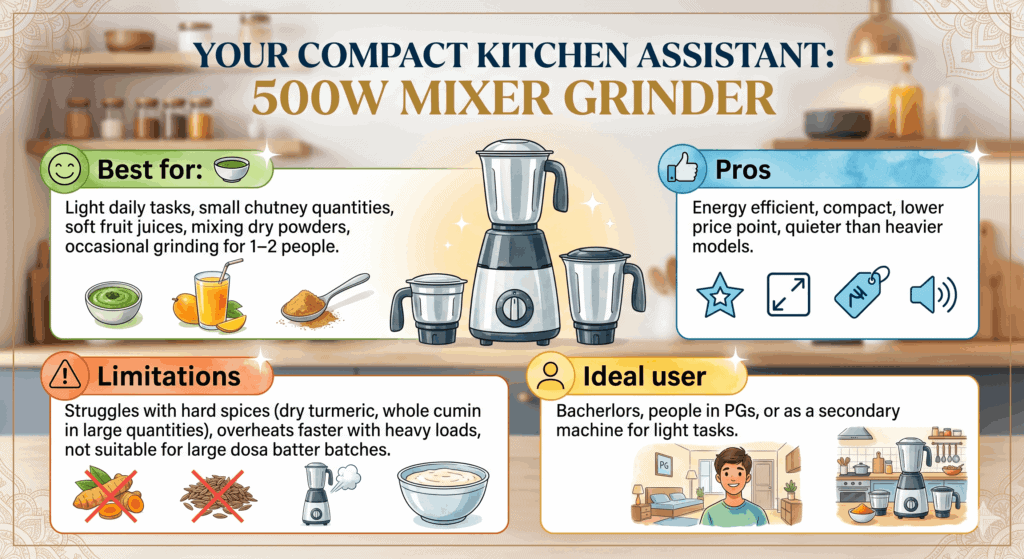
- Best for: Light daily tasks small chutney quantities, soft fruit juices, mixing dry powders, occasional grinding for 1–2 people.
- Pros: Energy efficient, compact, lower price point, quieter than heavier models.
- Limitations: Struggles with hard spices (dry turmeric, whole cumin in large quantities), overheats faster with heavy loads, not suitable for large dosa batter batches.
- Ideal user: Bachelors, people in PGs, or as a secondary machine for light tasks.
A 500W mixer grinder is suitable for light daily tasks and is relatively compact. However, if your main requirement is portability rather than regular home cooking, consider a small mixer grinder for travel.
750W Mixer Grinder
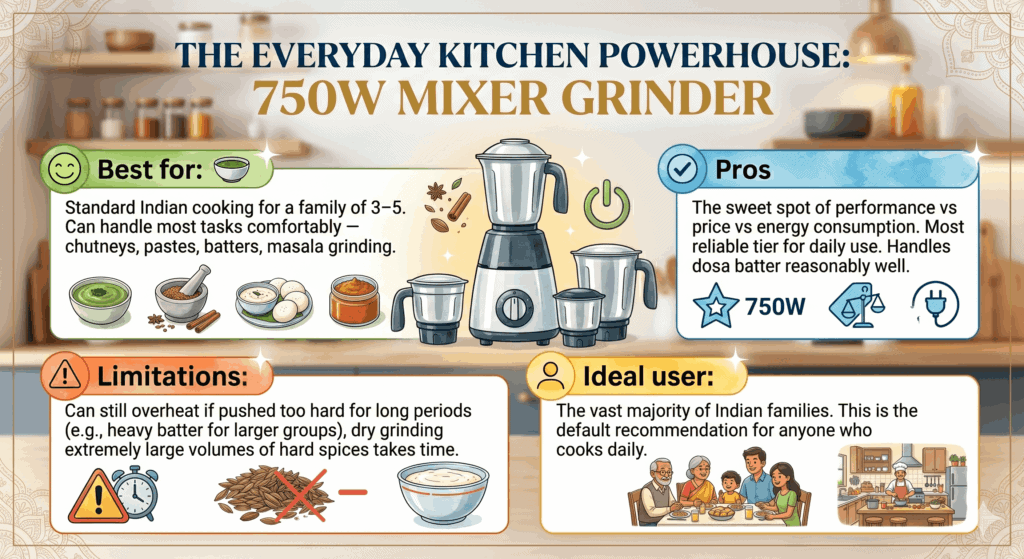
- Best for: Standard Indian cooking for a family of 3–5. Can handle most tasks comfortably — chutneys, pastes, batters, masala grinding.
- Pros: The sweet spot of performance vs price vs energy consumption. Most reliable tier for daily use. Handles dosa batter reasonably well.
- Ideal user: The vast majority of Indian families. This is the default recommendation for anyone who cooks daily.
1000W Mixer Grinder
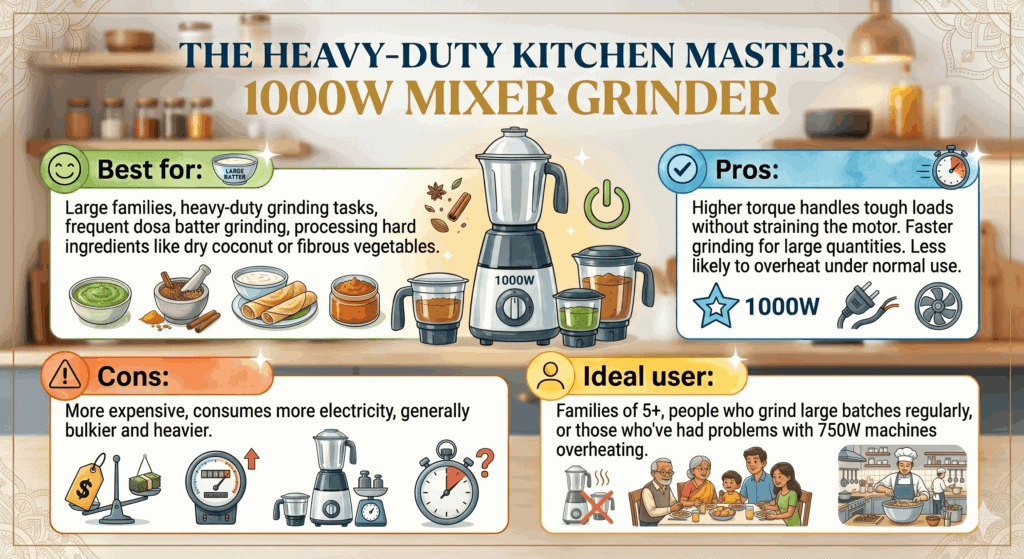
- Best for: Large families, heavy-duty grinding tasks, frequent dosa batter grinding, processing hard ingredients like dry coconut or fibrous vegetables.
- Pros: Higher torque handles tough loads without straining the motor. Faster grinding for large quantities. Less likely to overheat under normal use.
- Cons: More expensive, consumes more electricity, generally bulkier and heavier.
- Ideal user: Families of 5+, people who grind large batches regularly, or those who’ve had problems with 750W machines overheating.
| Feature | 500W | 750W | 1000W |
|---|---|---|---|
| Daily Indian cooking | ✓ Light tasks | ✓✓ Excellent | ✓✓ Overkill for most |
| Dosa / idli batter | ✗ Struggles | ✓ Manageable | ✓✓ Excellent |
| Dry spice grinding | ✓ Small batches | ✓✓ Good | ✓✓ Excellent |
| Crushing ice | ✗ Not recommended | ✓ With caution | ✓✓ Yes |
| Energy per use | Low | Medium | Higher |
| Price range | ₹1,200–₹2,500 | ₹2,200–₹5,000 | ₹4,000–₹9,000 |
| Best for | Singles / light use | Families (3–5 people) | Large families / heavy use |
6. Mixer Grinder Problems & Troubleshooting
Mixer grinder problems are extremely common and most of them are fixable at home before you call a technician by contacting through official support site of company. Here are the five most frequent issues, explained clearly.
❌ Mixer Grinder Not Starting
Causes
- Power supply issue
- Overload protector tripped
- Jar not locked properly
- Blown fuse in plug
- Faulty switch
Fixes: If checking the socket, plug or fuse does not resolve the issue, contact the manufacturer’s service centre or a qualified technician.
🔥 Mixer Grinder Smells Burnt
Causes
- Motor overheated from continuous use
- Overloaded jar (too many ingredients)
- Carbon brushes worn out
- Faulty winding in older motors
Fixes
- Stop immediately and let cool 30 min
- Reduce load and grind in batches
- Have carbon brushes replaced (cheap fix)
- If persistent motor needs service/replacement
Read the full article: Why Mixer Grinder Smells Like Burning After Few Minutes:
📢 Mixer Grinder Making Loud / Unusual Noise
Causes
- Hard ingredient hitting blades unevenly
- Loose blade assembly
- Worn coupler
- Machine on uneven surface
- Bearing wear in old motors
Fixes: Replacement couplers, gaskets and other parts are available for many models, but prices vary by brand, model and seller. Check the availability and current price of the exact spare part before purchasing.
🌡️ Mixer Grinder Overheating
Causes
- Continuous running beyond 3 minutes
- Blocked cooling vents
- Insufficient air circulation around base
- Low-quality aluminium motor
Fixes & Prevention
- Follow the operating-cycle instructions in the product manual.
- Clean cooling vents with a dry brush monthly
- Keep 4–5 cm clearance around the machine
- Upgrade to a copper-wound motor machine
Read the full article: 12 Real Reasons Your Mixer Grinder Motor Overheating
💧 Mixer Grinder Jar Leaking From Bottom
Causes
- Worn or cracked lid gasket
- Blade assembly rubber seal damaged
- Overfilled jar
- Crack in the jar itself (from impact)
Fixes
- Replace the gasket (₹30–₹80, widely available)
- Replace the blade assembly seal
- Reduce jar fill level to max 60%
- Replace the jar (check brand for spare availability)
DIY tip: Most Indian mixer grinder spare parts couplers, gaskets, blade assemblies, even full jar sets are available on Amazon or at local electrical spare parts shops for well under ₹200. Before you spend on servicing or a new machine, check if a simple part replacement fixes the problem.
Read the full article: Mixer Grinder Jar Leaking From Bottom
7. Mixer Grinder vs Other Kitchen Appliances
A mixer grinder is versatile but it’s not the right tool for every job. Before you buy one, here’s an honest comparison of how it is against the four most commonly confused alternatives in Indian kitchens: wet grinders, food processors, hand blenders, and juicer mixer grinders.
Each comparison covers performance, price, use cases, and a clear verdict on which to buy when.
| Task | Mixer Grinder | Wet Grinder | Food Processor | Hand Blender | JMG |
|---|---|---|---|---|---|
| Coconut / green chutney | ✅ Excellent | ✅ Good | ⚠️ Chunky | ⚠️ Only if very liquid | ✅ Excellent |
| Dry spice grinding | ✅ Excellent | ❌ No | ❌ No | ❌ No | ✅ Excellent |
| Dosa / idli batter (daily) | ⚠️ Adequate | ✅ Best | ❌ No | ❌ No | ⚠️ Adequate |
| Smoothies & lassi | ✅ Excellent | ❌ No | ⚠️ Poor texture | ✅ Good | ✅ Excellent |
| Blending hot soup in-pot | ❌ Risk of burns | ❌ No | ❌ No | ✅ Best | ❌ Risk of burns |
| Fresh fruit/veg juice | ⚠️ No pulp separation | ❌ No | ❌ No | ❌ No | ✅ Excellent |
| Slicing / shredding veg | ❌ No | ❌ No | ✅ Excellent | ❌ No | ❌ No |
| Kneading atta dough | ❌ No | ❌ No | ✅ Excellent | ❌ No | ❌ No |
| Peanut butter / nut pastes | ✅ Yes (with patience) | ✅ Good | ✅ Good | ❌ No | ✅ Yes |
| Price range (India, 2026) | ₹2,200–₹5,000 | ₹4,500–₹9,000 | ₹6,000–₹15,000+ | ₹900–₹3,500 | ₹3,500–₹7,000 |
If you regularly prepare soups, lassi or smoothies, explore our guide to the best hand blenders for home in India to compare suitable models and features.
Mixer Grinder vs Wet Grinder
This is the comparison that matters most for South Indian households. Both appliances grind — but they do it differently, and the difference matters enormously for specific tasks like idli and dosa batter.
| 🟠 Mixer Grinder | 🔵 Wet Grinder |
|---|---|
| Handles dry AND wet grinding | Superior batter texture airier, ferments better |
| Chutneys, masalas, smoothies all in one machine | Handles large batter quantities easily (2L+) |
| Compact, easy to clean, quick to use | Stone grinding preserves nutrients better |
| Adequate for occasional dosa batter | Runs for 20–40 minutes continuously without stress |
| 3–5 minute sessions (with rest breaks) | Can only do wet grinding no dry use |
Note: If you make idli or dosa batter more than 3 times a week, owning a wet grinder alongside your mixer grinder is worth it they complement each other rather than compete.
Read full article: Mixer Grinder vs Wet Grinder
Mixer Grinder vs Food Processor
A food processor is a completely different animal. Where a mixer grinder grinds and blends, a food processor preps it slices, shreds, chops, and kneads using interchangeable disc attachments. Think of it as a sous chef that handles repetitive prep work, not the actual cooking.
| 🟠 Mixer Grinder | 🔵 Food Processor |
|---|---|
| Superior for fine grinding — spices, chutneys, pastes | Excellent for slicing, shredding, and chopping |
| Much better at handling small quantities | Kneads atta dough effortlessly |
| Compact, affordable, easy to maintain | Handles large prep quantities fast |
| Ideal for the core tasks of Indian cooking | Poor at fine grinding — wide bowl is a limitation |
| Dry and wet grinding in one machine | More expensive, takes more counter space |
Note: For a standard Indian kitchen, a mixer grinder is the essential purchase and a food processor is a nice-to-have luxury. Don’t replace your mixer grinder with a food processor they’re not interchangeable.
Read full article: Mixer Grinder vs Food Processor: Which One is Better?
Mixer Grinder vs Hand Blender
A hand blender (or immersion blender) is a long stick with a spinning blade at one end that you dip directly into your pot or bowl. It’s the most convenient tool for a very specific job: blending soups, dal, or sauces directly in the cooking vessel without having to transfer hot liquid into a separate jar.
| 🟠 Mixer Grinder | 🔵 Hand Blender |
|---|---|
| Dry and wet grinding full range of tasks | Blend directly in the pot no transfer needed |
| Chutneys, masalas, batters, smoothies | Perfect for hot soups, dal, sauces |
| Multiple jar sizes for different quantities | Easy to clean just rinse the blade end |
| More power for hard ingredients | Very compact storage |
| Requires transferring food to jar | Cannot grind dry spices or hard ingredients |
Note: A hand blender doesn’t replace a mixer grinder it complements one. If you regularly make soups, blended dals, or sauces, consider adding a basic hand blender to your kitchen.
Mixer Grinder vs Juicer Mixer Grinder
A juicer mixer grinder is essentially a mixer grinder with an additional juicer attachment a centrifugal juicing mechanism built into the same motor body. This is different from a “mixer grinder with a juicer jar.” A true JMG has a dedicated juicing bowl with a strainer that separates juice from pulp, like a standalone centrifugal juicer.
| 🟠 Mixer Grinder | 🔵 Juicer Mixer Grinder |
|---|---|
| Lower price — no juicer attachment premium | Dedicated juicing with pulp separation |
| More compact body | Handles harder fruits (apples, carrots, beets) |
| Full grinding and blending capability | One machine for grinding + juicing |
| Liquidizer jar can handle soft fruit smoothies | Saves counter space vs two separate appliances |
| No pulp separation — all fibre stays in | ₹1,000–₹2,000 more than mixer grinder |
Note: If fresh juice is a daily habit in your household, a JMG is smart value it replaces two appliances and saves space.
6. Best Mixer Grinder Buying Guide
Different budgets need different approaches. Here’s what to prioritise in each price bracket and what to watch out for.
Best Mixer Grinder Under ₹1,000
Models under ₹1,000 can vary significantly in motor power, jar configuration, warranty and construction. Verify the specifications of the exact model before buying.
Focus on finding models with good user reviews for jar quality, since at this price the jar is often the first thing to fail. Brands like Orpat and Bajaj have offerings here.
Models in this price range can differ considerably in jar configuration, motor power and warranty. Before buying, compare our best mixer grinders under ₹1,000 guide to check which options fit your budget and what limitations to consider.
Best Mixer Grinder Under ₹2,000
This is where things start to get serious. You can find solid 500W–750W machines with 3 jars, food-grade stainless steel jars, and basic overload protection.
Compare models from established brands such as Bajaj, Prestige and Butterfly, but evaluate the exact model’s specifications, warranty and customer feedback rather than choosing based only on brand.
Read the full article: 10 Best Mixer Grinders Under 2000 In India 2026
Best Mixer Grinder Under ₹3,000
The ideal range for most Indian households. You get 750W performance, good jar quality, copper motor in many cases, and brand reliability.
At ₹2,500–₹3,000, brands like Philips and Preethi offer machines that will genuinely last 5–7 years with proper maintenance. This is the range where the value-to-performance ratio peaks.
Read the full article: 10 Best Mixer Grinders in India Under 3000
Best Mixer Grinder Under ₹4,000
You’re moving into premium territory. Better build quality, quieter operation, often 1000W motors, superior blade quality, and longer warranties.
A longer motor warranty provides a longer period of warranty coverage, but it should not be treated as proof of longer product life.
Best Silent Mixer Grinder
Truly silent mixer grinders use induction motors, which are fundamentally quieter than universal motors. They’re heavier, pricier, and not as widely available in India.
Bosch’s TrueMixx range and some Philips models fall into this category. If noise is a genuine problem, these are worth the premium expect to pay ₹4,000–₹7,000.
Read the full article: 6 Best Silent Mixer Grinder in India 2026
Best Mixer Grinder for Idli Dosa Batter
For frequent dosa or idli batter preparation, look for a suitable motor rating, a sufficiently large wet-grinding jar, overload protection and clear manufacturer guidance for wet grinding. A dedicated wet grinder may be preferable for households that prepare large quantities frequently..
Many serious dosa-makers use a dedicated wet grinder instead of a mixer grinder for batter it’s gentler on the machine and gives a better batter texture.
Read the full article: Top 10 Mixer Grinder for Idli Dosa Batter in 2026
Best Mixer Grinder for Spices
Dry spice grinding is hard on blades. The key specs: a thick-bladed dry jar with a cross-blade design, good motor torque, and a tight-sealing lid (spice powder escapes through loose lids).
Ensure the jar has drainage holes for cooling air circulation. Capacity should be proportional to your batch size don’t grind 50g of spices in a 1L jar.
8. Mixer Grinder Comparisons
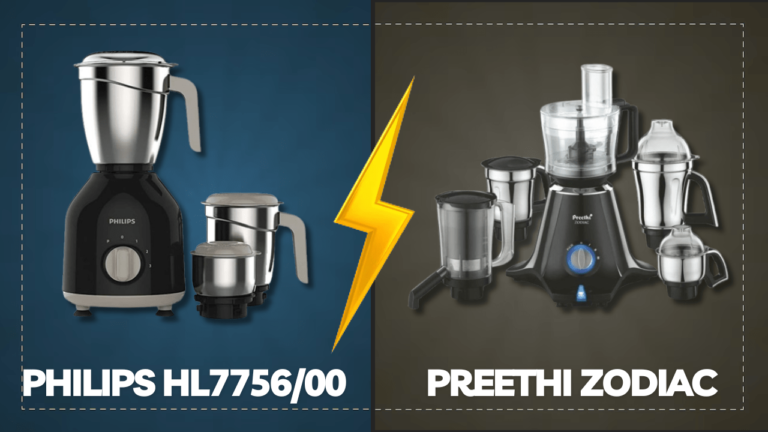
Philips vs Preethi Mixer Grinder
| Feature | Philips | Preethi |
|---|---|---|
| Motor quality | High — copper, ProMix motor | High — copper, Nutro+ technology |
| Noise level | Quieter for the wattage | Standard noise levels |
| Jar quality | Excellent, thick steel | Excellent, good blade design |
| Grinding performance | Consistent, fine texture | Excellent for Indian spices |
| Price range | ₹2,800–₹7,000 | ₹2,500–₹6,500 |
| After-sales service | Good in cities | Excellent pan-India network |
| Warranty | 2 years standard | 2 years (some models 5-year motor) |
| Best for | Those who prioritise quiet operation | Daily Indian cooking, heavy grinding |
Read the full article: Preethi Zodiac MG 218 vs Philips HL7756/00
Bajaj vs Prestige Mixer Grinder
| Feature | Bajaj | Prestige |
|---|---|---|
| Price positioning | Budget to mid-range | Mid-range to premium |
| Motor reliability | Decent for the price | Generally more durable |
| Jar quality | Adequate — some models thinner | Good quality across range |
| Spare parts availability | Wide availability | Good availability |
| Best for | Budget buyers, light use | Regular family use, value-focused |
3-Jar vs 4-Jar Mixer Grinder
Most people honestly don’t need a 4th jar the 3-jar set covers 95% of cooking tasks. A 4th jar (usually a multipurpose or whipping jar) adds cost and another thing to store.
The exception: if you specifically need an egg-white whisker or a very small herb-grinding jar. For most Indian cooking, stick with 3 jars and invest the saved money in better motor or jar quality.
9. Mixer Grinder Maintenance Tips
A well-maintained mixer grinder lasts 7–10 years. A neglected one lasts 2–3. The difference isn’t complicated it’s just consistent small habits.
Cleaning
- Never submerge the motor body in water. Ever. Wipe it with a damp cloth only.
- Rinse jars immediately after use don’t let masala or batter dry inside. Dried residue is much harder to clean and stains the steel.
- Self-cleaning hack: add water and a drop of dish soap, run for 10 seconds, rinse. Perfect for chutney jars.
- Dry jars completely before storing moisture causes rust at the blade assembly joint.
Read the full article: 6 Best Homemade cleaner for mixer grinder
Blade Care
- Don’t use metal scrubbers on blade assemblies they scratch and weaken the steel.
- Check blade sharpness every 6 months. If grinding has become slower for the same ingredient, the blade may be blunt.
- Blade assemblies are replaceable check your brand’s spare part availability before buying the machine.
Vent Cleaning
The cooling vents on the bottom and sides of the motor body collect fine dust and spice particles over time. Blocked vents cause overheating. Clean them with a dry soft brush once a month. Never use wet cloth on the motor body vents.
Coupler Care
The coupler is the plastic connector between the jar and the motor spindle. It wears out over time, especially if you grind hard ingredients frequently. Signs of coupler wear: unusual rattling noise, uneven grinding, or the jar wobbling during operation.
Replace the coupler the moment you notice these signs delaying causes damage to the spindle itself, which is an expensive repair.
Habits That Shorten Mixer Grinder Lifespan
- Running continuously for more than 3–5 minutes without cooling breaks
- Grinding dry ingredients without any moisture in a wet grinding jar
- Using the machine on voltage fluctuation-prone circuits without a stabiliser
- Storing with wet jars and lids closed (moisture traps cause rust)
- Dropping jars or forcing lids that don’t fit properly
- Ignoring small leaks until they worsen
Read the full article: 5 Easy Ways: How to Clean Mixer Grinder Jar & Maintain It For Long Life
10. Can a Mixer Grinder Grind Hard Ingredients?
Can a Mixer Grinder Grind Turmeric?
Yes, but with caution. Fresh turmeric (raw root) is fibrous and requires a 750W+ machine with a good dry jar. Dry whole turmeric is extremely hard and will blunt blades quickly. If you grind turmeric frequently, grind in short bursts with cooling intervals. The yellow staining on jars is unavoidable it doesn’t indicate damage.
Can a Mixer Grinder Crush Ice?
Technically yes, but only with 750W or more, and only if the machine explicitly states ice-crushing capability. Ice is brutal on blades — it chips the edges and strains the motor. If you’re crushing ice regularly, either get a dedicated ice crusher or ensure your machine is rated for it. Many manufacturers void the warranty for blade damage caused by ice.
Can a Mixer Grinder Grind Coffee Beans?
Yes — the small dry jar works well for coffee beans. Use short pulse bursts rather than continuous running to get even, consistent grounds. The downside: coffee oils leave a residue that can transfer flavour to the next ingredient you grind. Wash thoroughly with baking soda solution after grinding coffee.
Can a Mixer Grinder Make Peanut Butter?
Yes, a 750W+ machine can make peanut butter — but it takes patience. Dry-roast the peanuts first, then grind in the wet jar in batches, using short bursts. The oils need to release naturally, which takes longer than commercial machines. Don’t add water — that ruins the texture. A smooth peanut butter takes about 8–10 minutes of grinding with rest intervals.
11. Expert Tips Most People Don’t Know
These aren’t things you’ll find in the user manual. They come from years of actual use, troubleshooting calls, and seeing what separates people who get 10 years from a machine from those who replace it in 3.
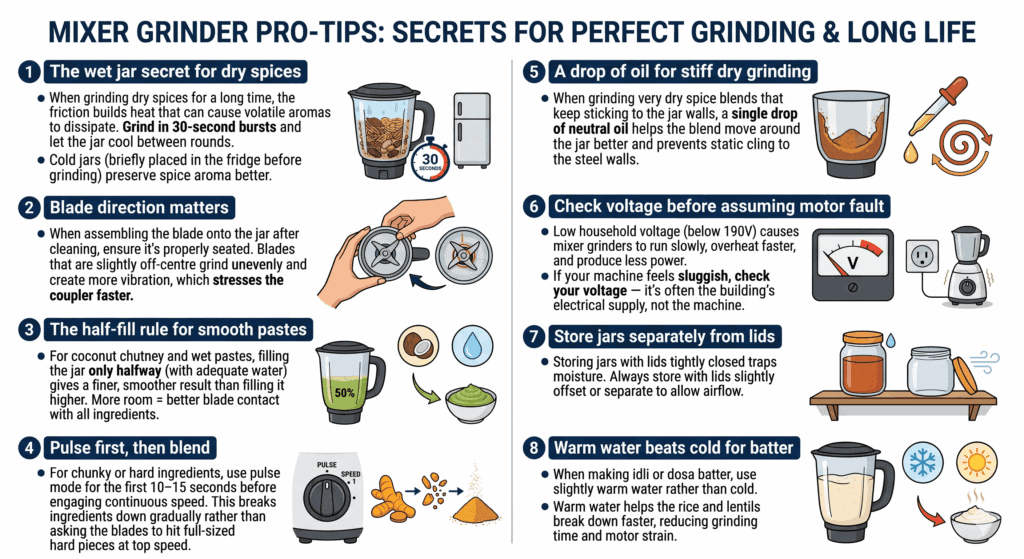
- The wet jar secret for dry spices: When grinding dry spices for a long time, the friction builds heat that can cause volatile aromas to dissipate. Grind in 30-second bursts and let the jar cool between rounds. Cold jars (briefly placed in the fridge before grinding) preserve spice aroma better.
- Blade direction matters: When assembling the blade onto the jar after cleaning, ensure it’s properly seated. Blades that are slightly off-centre grind unevenly and create more vibration, which stresses the coupler faster.
- The half-fill rule for smooth pastes: For coconut chutney and wet pastes, filling the jar only halfway (with adequate water) gives a finer, smoother result than filling it higher. More room = better blade contact with all ingredients.
- Pulse first, then blend: For chunky or hard ingredients, use pulse mode for the first 10–15 seconds before engaging continuous speed. This breaks ingredients down gradually rather than asking the blades to hit full-sized hard pieces at top speed.
- A drop of oil for stiff dry grinding: When grinding very dry spice blends that keep sticking to the jar walls, a single drop of neutral oil helps the blend move around the jar better and prevents static cling to the steel walls.
- Check voltage before assuming motor fault: Low household voltage (below 190V) causes mixer grinders to run slowly, overheat faster, and produce less power. If your machine feels sluggish, check your voltage — it’s often the building’s electrical supply, not the machine.
- Store jars separately from lids: Storing jars with lids tightly closed traps moisture. Always store with lids slightly offset or separate to allow airflow.
- Warm water beats cold for batter: When making idli or dosa batter, use slightly warm water rather than cold. Warm water helps the rice and lentils break down faster, reducing grinding time and motor strain.
Mixer Grinder Features Worth Paying Extra For
Not all features justify the premium. Some are genuine quality-of-life improvements; others are marketing fluff. Here’s an honest breakdown of which extra features are actually worth the money in the Indian context.
Dome Lid vs Flat Lid
Dome lids sit higher over the jar, which means there’s more headroom for ingredients that expand or churn during grinding (coconut paste, chutneys with liquid). Flat lids work fine for most tasks but can be messier when grinding semi-liquid ingredients at high speed. If you regularly make wet chutneys, a dome-lid model is worth seeking out.
Stainless Steel Body vs Polycarbonate Body
Most mixer grinder bodies are made of ABS plastic or polycarbonate. Stainless steel bodies exist (some premium Butterfly and Preethi models) and they’re more durable and easier to clean. They also look better after years of use — plastic bodies scratch and stain. Not essential, but if you’re spending ₹4,000+, a steel body is a nice extra.
Auto-Shutoff / Overload Protection
This is not optional — it’s a must. Any mixer grinder you buy should have thermal overload protection. Some cheaper models omit this to cut costs. Without it, if the motor overheats (and it will), there’s no protection and the winding burns out. Always verify this feature before buying.
Whipping Jar / Multipurpose Jar
Marketed aggressively but genuinely used by very few people. The whipping jar attachment (for beating cream or eggs) works, but most people have a hand blender or simply use a whisk. Unless you specifically need this functionality, don’t pay extra for a 4-jar set just for the multipurpose jar.
Power Cord Length
This sounds trivial until you’re stretching across your kitchen counter trying to reach the socket while holding a jar of hot chutney. Check the cord length — 1.2–1.5 metres is standard. Premium models often have longer cords (1.8 metres) or cord storage clips. Worth noting if your counter layout has distant sockets.
Speed Switch Quality
The speed switch is one of the most common failure points in budget mixer grinders. Cheap switches develop a wobble or stop responding to individual speeds after 1–2 years. Good switches are robust, have clear tactile clicks, and don’t wobble. You can’t always test this in a shop, but brand reputation and user reviews on Amazon are reliable guides here.
750W vs 1000W: When Does the Upgrade Actually Make Sense?
Higher-wattage models may be worth considering when you regularly process larger quantities or ingredients that place greater load on the motor. However, compare the manufacturer’s recommended usage and jar capacity rather than choosing based only on wattage.
- Grinding large batches of dosa batter (1.5L+ quantities) without overheating
- Processing very fibrous ingredients like raw jackfruit, banana stem, or whole dry coconut
- Frequent back-to-back grinding sessions (a caterer or large joint family cooking for 10+ people daily)
- Grinding harder spices like dried Kashmiri chillies or whole coriander seeds in large quantity
If none of those describe you, a quality 750W machine with a copper motor will serve you just as well at a meaningfully lower price. Save the difference and spend it on jar quality or warranty.
Energy note: This assumes the motor operates continuously at its rated wattage for 10 minutes per day. Actual electricity consumption can be lower because the motor does not necessarily draw its rated power continuously.
Read full article: Top 5 Reasons to Upgrade Old Mixer Grinder Now! Upgrade Alert
Mixer Grinder for South Indian vs North Indian Cooking
Indian cooking varies enormously by region, and so do mixer grinder requirements.
South Indian Cooking
South Indian cooking places the heaviest demands on a mixer grinder in all of India. Dosa and idli batter requires extended wet grinding of rice and urad dal this is probably the single most motor-stressing task a home mixer grinder faces.
Fresh coconut chutney is a daily staple in many households and requires effective wet grinding. Rasam and sambar pastes need smooth, fine textures. Chettinad cooking involves grinding elaborate fresh masalas from whole spices.
Recommendation for South Indian cooking: 750W minimum, copper motor, good 1L wet grinding jar, strong overload protection. Budget ₹3,000–₹5,000 and consider brands like Preethi, Butterfly, or Sujata.
North Indian Cooking
North Indian cooking uses more onion-tomato-based gravies, dry spice powders, and is generally less demanding on the wet grinding front. A 500W or 750W machine handles most North Indian cooking tasks comfortably.
Roti dough is not made in a mixer grinder (a food processor with a dough attachment or a dedicated atta maker handles that). Spice grinding, chutneys, and occasional dal blending are the main uses.
Recommendation for North Indian cooking: A good 750W machine at ₹2,500–₹4,000 covers everything comfortably. Don’t overspend on a 1000W machine unless you’re cooking for a very large family regularly.
Read full article: 10 Healthy Mixer Grinder Recipes
Cluster Directory All 62 Articles
Below is the complete list of all mixer grinder articles on this blog. Bookmark this page as it will help you to use mixer grinder effectively.
Basics & Guides:
- Mastering Culinary Art: A Step-by-Step Guide on How to Use a Mixer Grinder Like a Pro!
- Evolution of Mixer Grinders: A Journey from Simple Tools to High-Tech Appliances
- 10 Things Not to Put in a Mixer Grinder: A Comprehensive Guide for Optimal Performance
- How To Sharpen Mixer Grinder Blades
- Unlocking the Benefits and Drawbacks of Mixer Grinders: A Detailed Exploration
- Mixer Grinder Spare Parts Online: Couplers, Gaskets & Blades Explained
- Mixer Grinder Parts and Functions: A Complete Guide for Beginners
- How to Upgrade Your Kitchen with a High-End Mixer Grinde
- How to Use Juicer Mixer Grinder: Comprehensive Guide
- 10 Types of Mixer Grinder blades & their uses: Which One to Use When?
- Unlock Full Flavor: The Secret to grind spices in mixer grinder Perfectly
- How to Grind Different Types of Spices with a Mixer Grinder
- How a Mixer Grinder Can Save You Time in the Kitchen
- Top 5 Reasons to Upgrade Old Mixer Grinder Now! Upgrade Alert
- What is RPM in Mixer Grinders?
- 8 Different Types of Mixer Grinders for Indian Kitchens
- 5 Easy Ways: How to Clean Mixer Grinder Jar & Maintain It For Long Life
- 20 Mixer Grinder Safety Tips 2026: Expert‑Approved Ways to Stay Safe in the Kitchen
- 7 Mixer Grinder Jar Types and Uses: Complete Guide for Indian Kitchens
- Mixer Grinder Power Consumption Per Hour in India: 11 Effective Tips To Save Electricity
- Mixer Grinder Maintenance Checklist: Easy Tips to Prevent Costly Repairs
- How to Choose the Right Mixer Grinder for Your Kitchen (2026 Guide)
Best Mixer Grinders:
- 10 Best Mixer Grinder in India 2026: Top-Rated Picks & Buyer’s Guide
- 10 Best Lifelong Mixer Grinder Review 2026: Best for Indian Kitchens
- 10 Best Mixer Grinder for Hotels: Elevate Your Culinary Operations
- 10 Best Hand Mixer Grinder Without Electricity: Complete Buyer’s Guide 2026
- 10 Best Mixer Grinders in India Under 1000
- 10 Best Mixer Grinders Under 2000 In India 2026
- 10 Best Mixer Grinders in India Under 3000
- 10 Best Mixer Grinder Under 5000 in India
- 9 Best Mini Mixer Grinder Under 500 in India 2026
- 5 Best Mixer Grinder In India 750 Watts watts 2026
- 10 Best Small Mixer Grinders for Travelling in India 2026
- 10 Best Juicer Mixer Grinder in India 2026
- 10 Best 500 Watt Mixer Grinder in India
- 10 Best Bullet Mixer Grinder Under 1500 in India
- Top 6 Best Mixer Grinder for Carrot Juice
- 10 Best Mixer Grinder 1000 Watts in India 2026
- 10 Best Mixer Grinders for Large Families and Heavy Use
- 10 Best Mixer Grinder with 5 Jars
- 10 Best Mixer Grinder For Bachelors in India
- Top 10 Mixer Grinder for Idli Dosa Batter in 2026
- 10 Very Small Mixer Grinders That Fit Any Kitchen
- 10 Best Mixer Grinder for Smoothies
- 6 Must-Have Best Mixer Grinders for South Indian Cooking
- 7 Best Masterchef Mixer Grinders in India
- 5 Preethi Mixer Grinder 750 Watts Price List in India 2026
- 10 Best Philips Mixer Grinder in India 2026 – Which Model Is Worth Buying?
Comparisons:
- Mixer Grinder or Juicer Mixer Grinder
- Mixer Grinder vs Food Processor
- Mixer Grinder vs Wet Grinder
- Blender and Mixer Grinder
- Preethi Zodiac MG 218 vs Philips HL7756/00
- Indian mixer grinder vs western food processor
- 500w vs 750w mixer grinder
- 750W vs 1000W Mixer Grinder
- 500w vs 1000w mixer grinder
Reviews:
- Bosch Pro 1000W Mixer Grinder review
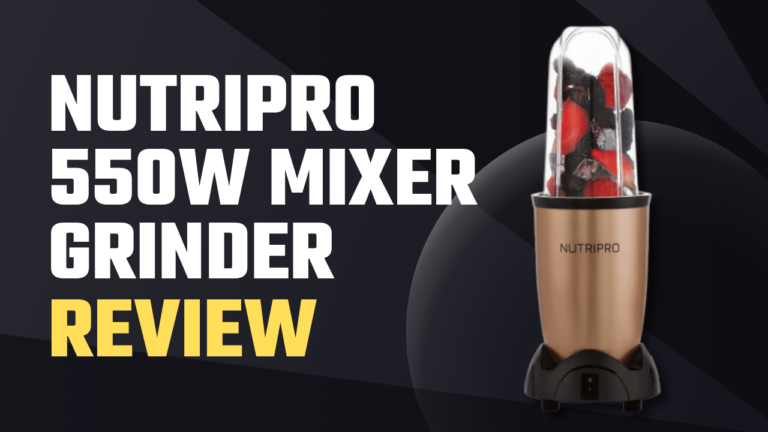
- Nutripro 550w Mixer Grinder Review 2026
- Top 5 Skyline Juicer Mixer Grinder Review 2026
- Best Havells Mixer Grinder 1000 Watts Price and Review
- Butterfly Smart 750 Watts Mixer Grinder Review
Problems & Solutions:
- What to do when Mixer Grinder Stopped Working Suddenly
- 14 Common Mistakes To Avoid While Using Mixer Grinder
- 5 Common Mixer Grinder Blade Problems Troubleshooting
- Why Mixer Grinder Smells Like Burning After Few Minutes
- Mixer Grinder Jar Leaking From Bottom
- 12 Real Reasons Your Mixer Grinder Motor Overheating
- Why Is My Mixer Grinder Vibrating Too Much? (11 Causes + Easy Fixes)
- Mixer Grinder Sparking Inside? Causes, Fixes, Warning Signs & Prevention Guide
- Why Mixer Grinder Not Grinding Properly? 12 Easy Fixes That Actually Work
Recipe Collections:
- Boost Your Meal Prep Efficiency with Mixer Grinders: A Game-Changer in the Kitchen
- 10 Healthy Mixer Grinder Recipes: Nourishing Your Body with Easy-to-Make Dishes
- 10 Classic Indian Chutney Recipe You Can Make in Your Mixer Grinder
12. FAQs
Which wattage is best for daily Indian cooking?
750W is the best balance for daily Indian cooking powerful enough for all standard tasks (chutneys, pastes, batters, spice grinding) without being unnecessarily heavy, expensive, or power-hungry.
How long can a mixer grinder run continuously?
A maximum of 3 minutes continuously. After that, let the motor rest for 2–3 minutes before starting again. Most overheating problems stem from ignoring this simple rule.
Why does my mixer grinder smell like it’s burning?
A burning smell indicates the motor is overheating either from continuous use, an overloaded jar, or worn carbon brushes. Stop immediately, let it cool completely, and check if the problem persists. If the smell continues after cooling, get the carbon brushes inspected.
Can I wash mixer grinder jars in a dishwasher?
Check your brand’s manual. Most stainless steel jars are technically dishwasher-safe, but the blade assembly gaskets can degrade faster in dishwasher conditions. Hand washing is safer for longevity.
Is a copper motor really better than an aluminium motor?
Yes, significantly. Copper has lower electrical resistance, which means less heat generation and more efficient energy use. Copper-wound motors last longer, handle overloads better, and maintain performance over years of use. Aluminium-wound motors are cheaper to make, which is why they appear in lower-priced machines.
My mixer grinder suddenly stopped working. What should I check first?
In order: (1) Check the power socket with another device. (2) Check that the jar is properly locked. (3) Look for a reset button on the bottom of the motor body and press it — this resets the overload protector. (4) Check the plug fuse. If all of these are fine, the issue may be with the speed switch or internal wiring.
How often should I clean the cooling vents?
Once a month with a dry soft brush is sufficient for regular use. If you cook with a lot of fine spices, check vents every two weeks as fine powder clogs them quickly.
Why is my mixer grinder louder than before?
Increased noise usually indicates a worn coupler, loose blade assembly, or worn motor bearings. Start by checking the coupler it’s the most common cause and the cheapest fix.
What’s the lifespan of a good mixer grinder?
A good 750W+ mixer grinder with a copper motor, properly maintained, should last 7–10 years. Budget machines with aluminium motors typically last 3–5 years under similar conditions.
Can a mixer grinder make idli batter?
Yes, with a 750W or 1000W machine and a good wet grinding jar. The quality of the batter is decent but not quite as airy as batter from a dedicated wet grinder. For very frequent dosa and idli making, many households use a wet grinder specifically for batter.
Is it safe to use a mixer grinder without the lid?
Never. The lid creates a safety seal and prevents ingredients from flying out at high speed. Many mixer grinders won’t run at all without the lid properly locked this is a safety interlock feature. Always use the lid.
Can I grind dry ingredients in the wet grinding jar?
Not recommended. Wet grinding jars have different blade configurations optimised for wet ingredients. Dry grinding in them causes uneven results and strains the blade assembly differently than intended. Use the dedicated dry jar.
Do I need a voltage stabiliser for my mixer grinder?
If your area experiences frequent voltage fluctuations, a stabiliser is a worthwhile investment. Low voltage strains motors and causes overheating; high voltage spikes can damage windings. Machines above ₹5,000 often have built-in voltage protection, but for budget machines, a stabiliser adds years to the motor’s life.
What’s the difference between pulse mode and speed 1?
Pulse mode runs the motor only while you hold the button it’s momentary and gives you precise control over how long the machine runs. Speed 1 is continuous at low speed. Use pulse for coarse grinding, checking texture, or when dealing with ingredients that need short bursts to avoid over-processing.
Why does chutney stick to the jar sides and not grind properly?
The jar is probably too full, or there isn’t enough liquid. Add a tablespoon of water at a time and use the pulse function to break things down before running at full speed. Also, the small chutney jar outperforms a large liquidizer jar for small quantities the blades make better contact with ingredients.
How do I remove turmeric stains from mixer grinder jars?
Soak in hot water with a tablespoon of baking soda for 30 minutes, then scrub with a soft sponge. Sunlight works surprisingly well too leave a wet jar in direct sunlight for an hour or two and stains fade significantly.
Can I use a mixer grinder to knead dough?
Not recommended. Mixer grinder blades and jars are not designed for the resistance of kneading stiff dough. Attempting it can damage the coupler, strip the jar threads, and strain the motor significantly. Use a food processor with a dough blade attachment, a dedicated atta maker, or knead by hand.
Does the colour of the mixer grinder jar affect grinding quality?
No, jar colour is purely aesthetic. The steel grade and thickness matter far more than colour. Some brands tint their jars darker to hide staining from spices like turmeric. Clear polycarbonate jars let you monitor grinding progress but are less durable than stainless steel for hard ingredients.
Preethi and Butterfly are widely regarded as having the best service networks in India, particularly in South India. Philips and Prestige also have strong service networks in metros. For smaller cities and towns, check which brand has an authorised service centre near you before buying.
13. Final Thoughts
The right mixer grinder isn’t the most expensive one, and it isn’t the one with the highest wattage. It’s the one that matches how you actually cook your family size, your ingredients, your frequency of use, and your budget.
For most Indian families, a 750W mixer grinder with a copper motor, 3 quality jars, and a 2-year+ warranty is the answer. Spend ₹2,500–₹4,000 on this category and you’ll have a machine that serves you reliably for years, handles daily Indian cooking without complaint, and doesn’t overheat every time you make coconut chutney.
Cook well. Grind smart.
Sourabh researches and writes about home appliances, kitchen appliances, and common appliance problems to help readers make informed buying decisions. He covers mixer grinders, refrigerators, air conditioners, washing machines, and appliance troubleshooting.
At ReviewSpot, Sourabh compares manufacturer specifications, product features, warranty information, pricing, and customer feedback to turn technical appliance information into practical buying advice. His goal is to help readers understand their options, avoid costly mistakes, and choose products that fit their needs and budget.
ReviewSpot distinguishes manufacturer information, customer feedback, and editorial analysis, and does not describe products as hands-on tested unless they have actually been tested.