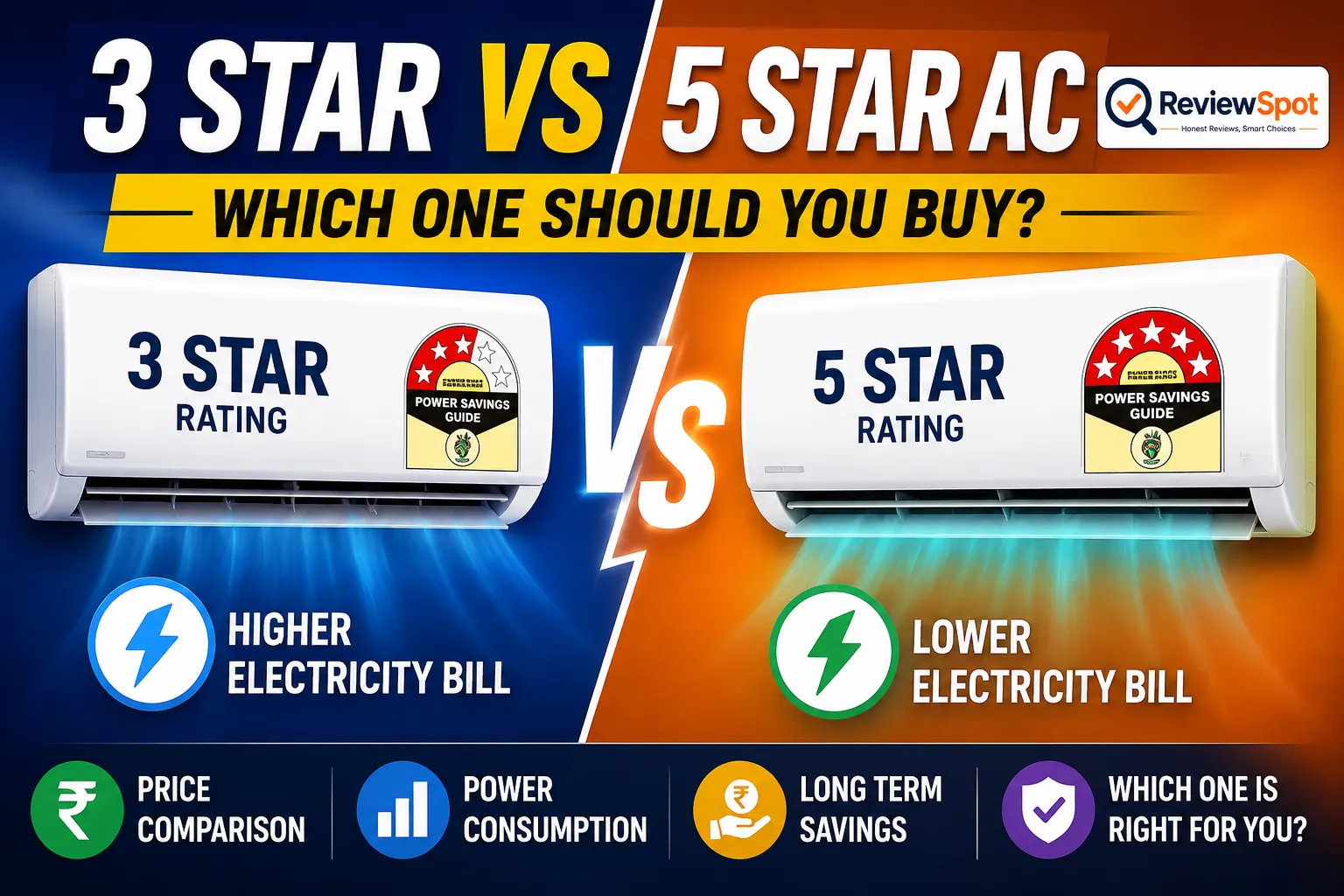
3 Star vs 5 Star AC: Which One Should You Buy in 2026? Price, Electricity Bill & Power Consumption Explained

If you’re planning to buy a new air conditioner, one question probably comes to your mind first—Should I buy a 3 Star AC or a 5 Star AC?
The answer isn’t as simple as choosing the higher star rating. While a 5 Star AC consumes less electricity, it also costs more. On the other hand, a 3 Star AC is cheaper to buy but has slightly higher running costs.
So, which one actually saves you more money in the long run?
In this detailed guide, we’ll compare 3 Star vs 5 Star AC based on price, electricity bill, power consumption, cooling performance, long-term savings, maintenance costs, and overall value for money. By the end of this article, you’ll know exactly which AC is the better choice for your home.
3 Star vs 5 Star AC
A 5 Star AC is the better choice if you use your air conditioner for more than 6–8 hours every day. It consumes less electricity, reduces your monthly power bill, and usually recovers its higher purchase price within a few years.
A 3 Star AC is a better option if you use the AC only occasionally (2–5 hours daily) or have a limited budget. It provides almost the same cooling performance but uses slightly more electricity.
In simple words:
- Buy a 5 Star AC for heavy daily usage and long-term savings.
- Buy a 3 Star AC for occasional use and lower upfront cost.
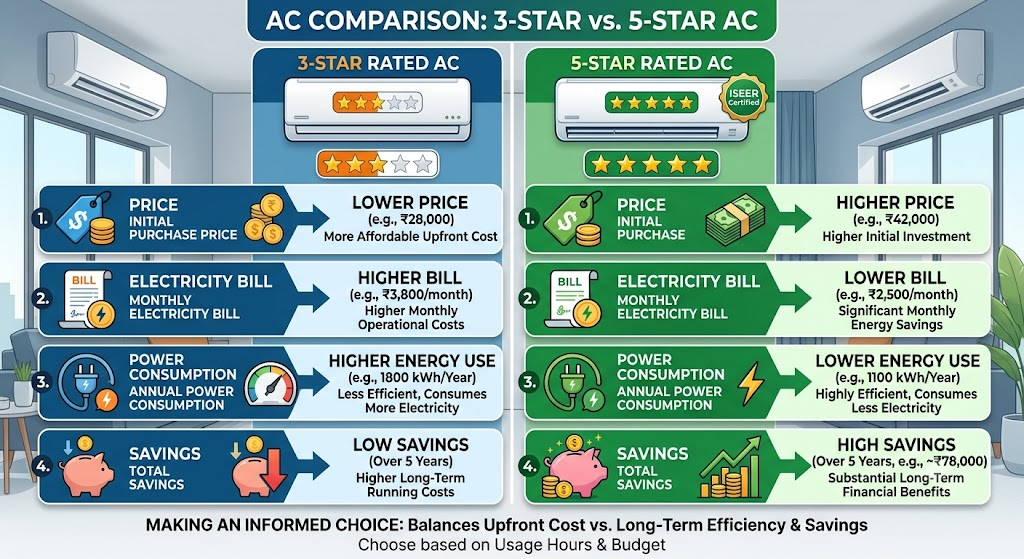
3 Star vs 5 Star AC: Quick Comparison:
| Feature | 3 Star AC | 5 Star AC |
|---|---|---|
| Purchase Price | Lower | Higher |
| Electricity Consumption | Higher | Lower |
| Monthly Electricity Bill | Slightly Higher | Lower |
| Cooling Speed | Almost Same | Almost Same |
| Compressor Technology | Same (Inverter/Non-Inverter depends on model) | Same |
| Long-Term Savings | Moderate | Excellent |
| Best For | Occasional users | Heavy daily users |
| Resale Value | Good | Better |
| Eco-Friendly | Good | Better |
What Does AC Star Rating Mean?
Many people believe that a higher star rating means better cooling. That’s actually a myth.
The Bureau of Energy Efficiency (BEE) gives star ratings to air conditioners based on how efficiently they use electricity, not how cold they can make your room.
A higher star rating simply means:
- The AC uses less electricity.
- It delivers more cooling for every unit of electricity consumed.
- It helps reduce your electricity bill.
- It is more energy efficient.
Whether you buy a 3 Star AC or a 5 Star AC, both can cool your room to the same temperature if they have the same capacity (for example, 1.5 Ton).
The main difference is that a 5 Star AC needs less electricity to achieve that cooling.
How Does the BEE Star Rating Work?
Every air conditioner sold in India comes with a BEE energy label. This label contains useful information such as:
- Star Rating
- Annual electricity consumption
- ISEER (Indian Seasonal Energy Efficiency Ratio)
- Brand and model number
- Year of rating
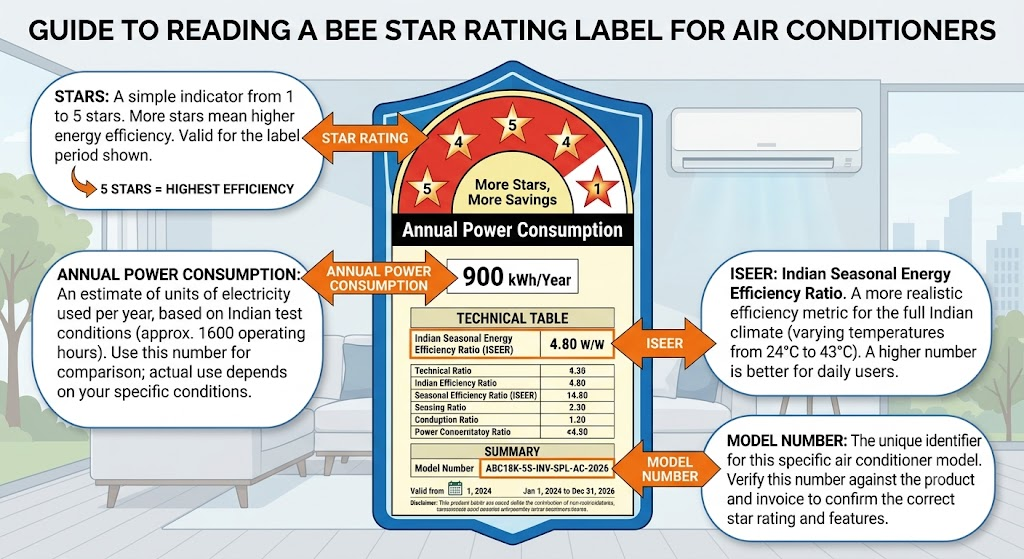
The most important value on the label is annual electricity consumption because it gives buyers a standard way to compare different AC models.
However, remember that this number is calculated under standard testing conditions. Your actual electricity bill depends on factors such as:
- Daily usage hours
- Room temperature
- Outdoor weather
- Thermostat setting
- Room insulation
- Number of people in the room
That’s why two families using the same AC can receive different electricity bills.
Why Doesn’t a 5 Star AC Cool Faster?
One of the biggest misconceptions is that a 5 Star AC cools faster than a 3 Star model. That’s not true. Cooling speed mainly depends on:
- AC capacity (Ton)
- Compressor performance
- Indoor and outdoor temperature
- Room insulation
- Airflow
- Installation quality
If you compare two 1.5 Ton inverter ACs from the same brand, one with a 3 Star rating and the other with a 5 Star rating, both will cool the room in almost the same time.
The difference is that the 5 Star AC uses less electricity while doing the same job.
Think of it like two cars travelling at the same speed. One car gives better mileage, so it uses less fuel. Similarly, a 5 Star AC delivers the same cooling while consuming less power.
3 Star vs 5 Star AC: Detailed Comparison
Let’s compare both options across all the important factors.
1. Energy Efficiency
This is where a 5 Star AC has a clear advantage. It is designed with better energy efficiency, allowing it to consume less electricity for the same amount of cooling.
A 3 Star AC is still energy efficient compared to older ACs, but it requires more electricity over time. If your AC runs every day during summer, this difference becomes noticeable on your electricity bill.
Winner: 5 Star AC
2. Cooling Performance
When it comes to cooling, there is almost no difference. Both ACs:
- Can reach the same temperature
- Maintain comfortable cooling
- Use inverter technology (if applicable)
- Offer similar cooling modes
The cooling experience depends much more on choosing the correct AC size than on the star rating.
For example:
- A 1 Ton 5 Star AC will not cool a large room better than a 1.5 Ton 3 Star AC.
- Choosing the correct tonnage is more important than choosing a higher star rating.
Winner: Tie
3. Electricity Consumption
This is the biggest difference in the 3 Star vs 5 Star AC comparison.
A 5 Star AC requires less electricity because its compressor and overall system operate more efficiently.
Although the daily difference may appear small, it adds up significantly over months and years. If you use your AC every night throughout summer, the savings can become substantial. We’ll calculate actual electricity bill differences later in this guide.
Winner: 5 Star AC
4. Purchase Price
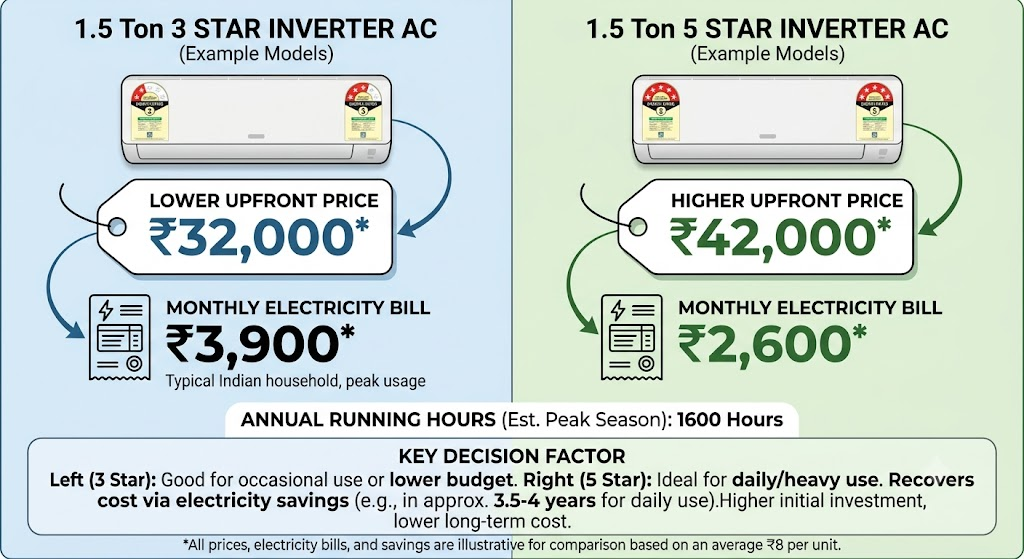
One reason many buyers choose a 3 Star AC is its lower price. On average, the difference between comparable models is:
| AC Type | Typical Price (India) |
|---|---|
| 3 Star Inverter AC | ₹30,000–₹40,000 |
| 5 Star Inverter AC | ₹35,000–₹48,000 |
The exact difference depends on:
- Brand
- Capacity
- Features
- Copper condenser
- Smart Wi-Fi functions
- Warranty
In most cases, you’ll pay ₹3,000–₹8,000 more for a 5 Star AC. The important question is whether that extra investment is worth it—which depends entirely on your usage pattern.
Winner: 3 Star AC
Image Suggestion: Side-by-side price comparison graphic showing a 3 Star AC with a lower price tag and a 5 Star AC with higher price but lower electricity bill.
3 Star vs 5 Star AC Price: Is the Higher Price Worth Paying?
Many buyers focus only on the purchase price and ignore the total cost of ownership.
For example: Suppose:
- 3 Star AC price = ₹34,000
- 5 Star AC price = ₹40,000
The difference is ₹6,000.
Now imagine you use the AC every day for several months each year. If the 5 Star AC saves around ₹1,500–₹2,500 annually on electricity (depending on usage and tariff), the extra amount you paid can be recovered over time.
After that, every reduction in your electricity bill becomes a direct saving. On the other hand, if you switch on the AC only during weekends or for a few hours at night, recovering the higher purchase cost may take much longer.
That’s why there is no one-size-fits-all answer. The right choice depends on how often you actually use your AC, not just the star rating.
Which Factors Affect the Real Difference Between a 3 Star and 5 Star AC?
Even with the same star rating, actual performance can vary depending on:
- Daily usage hours
- Electricity tariff in your state
- Room size
- Correct AC capacity
- Inverter or non-inverter technology
- Outdoor temperature
- Sunlight entering the room
- Ceiling height
- Insulation quality
- Number of occupants
- Frequency of AC servicing
- Dirty air filters
- Thermostat temperature (24°C is generally more energy-efficient than 18°C)
Ignoring these factors can increase your electricity bill far more than the difference between a 3 Star and 5 Star AC.
3 Star vs 5 Star AC Electricity Bill
For most buyers, the biggest concern isn’t the purchase price it’s the monthly electricity bill.
A 5 Star AC is designed to use less electricity than a 3 Star AC. While the daily difference may seem small, it adds up over an entire summer and over the life of the air conditioner.
However, your actual electricity bill depends on several factors:
- Number of hours you use the AC every day
- Room size
- Outdoor temperature
- Electricity tariff in your state
- Thermostat setting
- AC capacity (1 Ton, 1.5 Ton, or 2 Ton)
- Whether the AC is inverter or non-inverter
Let’s understand the difference with practical examples.
3 Star vs 5 Star AC Power Consumption
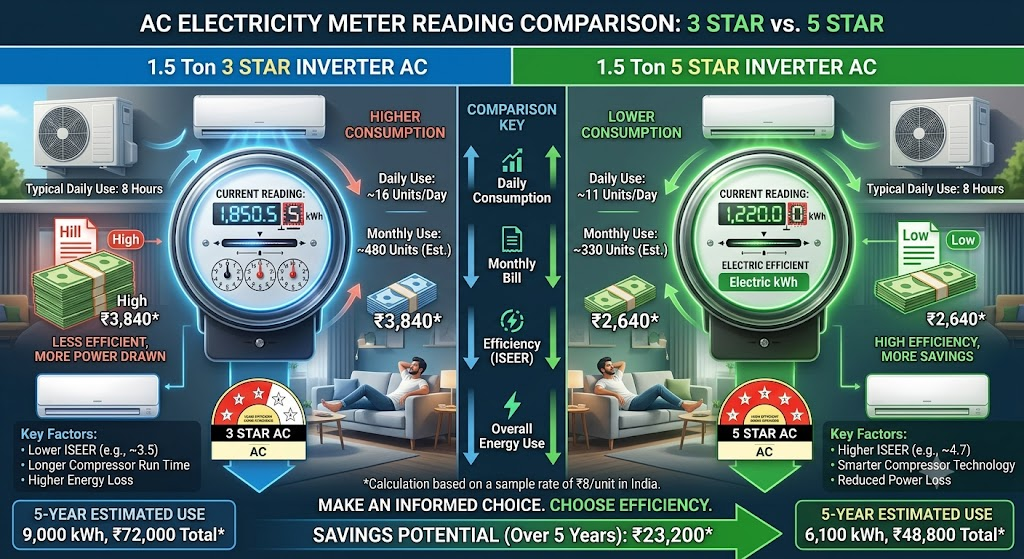
Power consumption simply means the amount of electricity an AC uses to cool your room.
A 5 Star AC consumes less electricity because it has a higher energy efficiency (higher ISEER rating). It delivers the same cooling while drawing less power.
The table below shows approximate power consumption for inverter ACs.
| AC Capacity | 3 Star AC | 5 Star AC |
|---|---|---|
| 1 Ton | 0.75–0.90 kWh/hour | 0.60–0.75 kWh/hour |
| 1.5 Ton | 1.00–1.25 kWh/hour | 0.80–1.00 kWh/hour |
| 2 Ton | 1.40–1.70 kWh/hour | 1.10–1.40 kWh/hour |
Note: These are average running values. Actual consumption varies depending on compressor speed, room temperature, and cooling load.
Estimated Annual Electricity Consumption
The BEE energy label provides an estimated annual electricity consumption. Typical values are:
| AC Type | Approximate Annual Electricity Consumption |
|---|---|
| 1 Ton 3 Star Inverter AC | 650–750 Units |
| 1 Ton 5 Star Inverter AC | 520–620 Units |
| 1.5 Ton 3 Star Inverter AC | 820–980 Units |
| 1.5 Ton 5 Star Inverter AC | 650–800 Units |
| 2 Ton 3 Star Inverter AC | 1100–1350 Units |
| 2 Ton 5 Star Inverter AC | 900–1150 Units |
3 Star vs 5 Star AC Electricity Bill Calculation
Let’s assume:
- Electricity tariff = ₹8 per unit
- Usage = 8 hours daily
- Summer season = 180 days
- 1.5 Ton inverter AC
Example 1
3 Star AC
Average consumption = 1.10 units/hour
Daily consumption
1.10 × 8 = 8.8 units
Monthly consumption (30 days)
8.8 × 30 = 264 units
Monthly electricity bill
264 × ₹8 = ₹2,112
Example 2
5 Star AC
Average consumption = 0.90 units/hour
Daily consumption
0.90 × 8 = 7.2 units
Monthly consumption
7.2 × 30 = 216 units
Monthly electricity bill
216 × ₹8 = ₹1,728
Monthly Savings
₹2,112 − ₹1,728 = ₹384
Annual Savings
₹384 × 12 = ₹4,608
This example shows that even a small difference in hourly power consumption can lead to significant savings over time.
Electricity Bill Comparison for Different Daily Usage
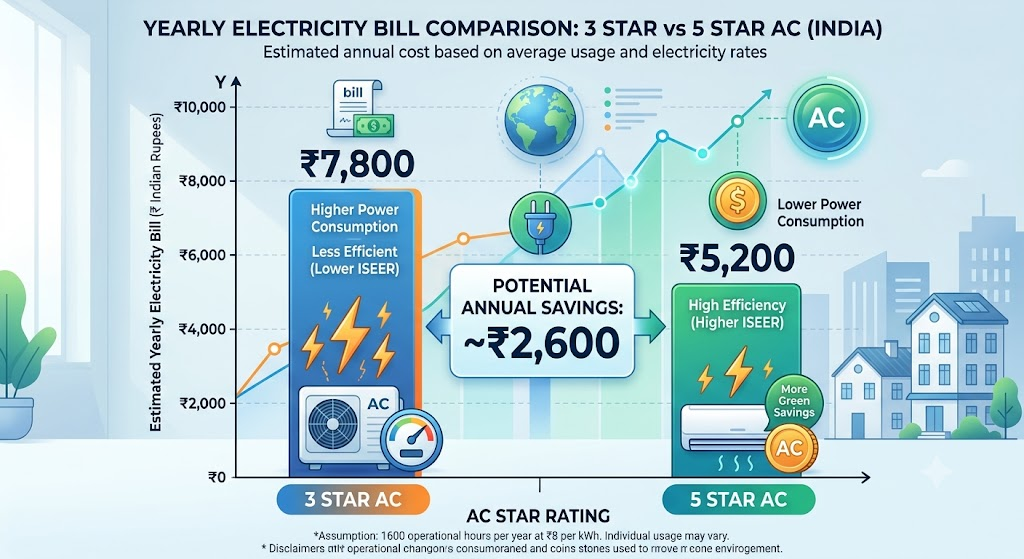
The table below assumes:
- 1.5 Ton inverter AC
- Electricity rate = ₹8/unit
| Daily Usage | 3 Star AC | 5 Star AC | Monthly Savings |
|---|---|---|---|
| 2 Hours | ₹528 | ₹432 | ₹96 |
| 4 Hours | ₹1,056 | ₹864 | ₹192 |
| 6 Hours | ₹1,584 | ₹1,296 | ₹288 |
| 8 Hours | ₹2,112 | ₹1,728 | ₹384 |
| 10 Hours | ₹2,640 | ₹2,160 | ₹480 |
| 12 Hours | ₹3,168 | ₹2,592 | ₹576 |
The more you use your AC, the more valuable a 5 Star model becomes.
Annual Electricity Cost Comparison
| Daily Usage | 3 Star AC | 5 Star AC | Estimated Annual Savings |
|---|---|---|---|
| 2 Hours | ₹6,336 | ₹5,184 | ₹1,152 |
| 4 Hours | ₹12,672 | ₹10,368 | ₹2,304 |
| 6 Hours | ₹19,008 | ₹15,552 | ₹3,456 |
| 8 Hours | ₹25,344 | ₹20,736 | ₹4,608 |
| 10 Hours | ₹31,680 | ₹25,920 | ₹5,760 |
These calculations are estimates. Actual savings depend on climate, electricity tariff, and AC efficiency.
Does a 5 Star AC Recover Its Higher Price?
This is one of the most common questions buyers ask. Let’s assume:
| Item | Value |
|---|---|
| 3 Star AC Price | ₹35,000 |
| 5 Star AC Price | ₹41,000 |
| Price Difference | ₹6,000 |
If the 5 Star AC saves around ₹2,000 every year on electricity, it can recover the extra investment in about 3 years. After that, the lower electricity bill becomes a long-term financial benefit.
If your daily usage is higher, the payback period becomes even shorter. If you use the AC only occasionally, recovering the additional cost may take much longer.
Is a 5 Star AC Worth It for Low Usage?
Not always. Suppose you use your AC:
- Only on weekends
- Around 2–3 hours daily
- Only for two or three summer months
In this situation, the electricity savings will be relatively small. The lower purchase price of a 3 Star AC may make it the smarter financial choice.
Is a 5 Star AC Worth It for Heavy Usage?
Yes. A 5 Star AC is generally worth the extra investment if:
- You use the AC every day.
- Usage exceeds 6–8 hours daily.
- You live in very hot cities such as Delhi, Nagpur, Jaipur, Ahmedabad, Hyderabad, or Raipur.
- Multiple family members stay at home during the day.
- The AC runs both during the day and at night.
- You plan to use the AC for the next 7–10 years.
Real-Life Example
Let’s compare two neighbours.
Family A
- Bought a 3 Star AC
- Uses it 3 hours every night
Electricity bill difference compared to a 5 Star AC remains small. They save more money by buying the cheaper AC.
Family B
- Bought a 5 Star AC
- Uses it 10 hours every day
- Works from home
- Children stay home during summer holidays
Although they paid more initially, their electricity savings become noticeable every month. Within a few years, the extra purchase cost is recovered.
Hidden Factors That Affect Electricity Bills
Many people blame the AC when the real issue lies elsewhere.
Your electricity bill can increase because of:
- Dirty air filters
- Low refrigerant gas
- Direct sunlight entering the room
- Poor room insulation
- Windows left open
- Frequent door opening
- Incorrect AC capacity
- Thermostat set at 18°C instead of 24–26°C
- Lack of annual servicing
Addressing these issues can reduce electricity consumption regardless of whether you own a 3 Star or 5 Star AC.
Tips to Reduce AC Electricity Bill
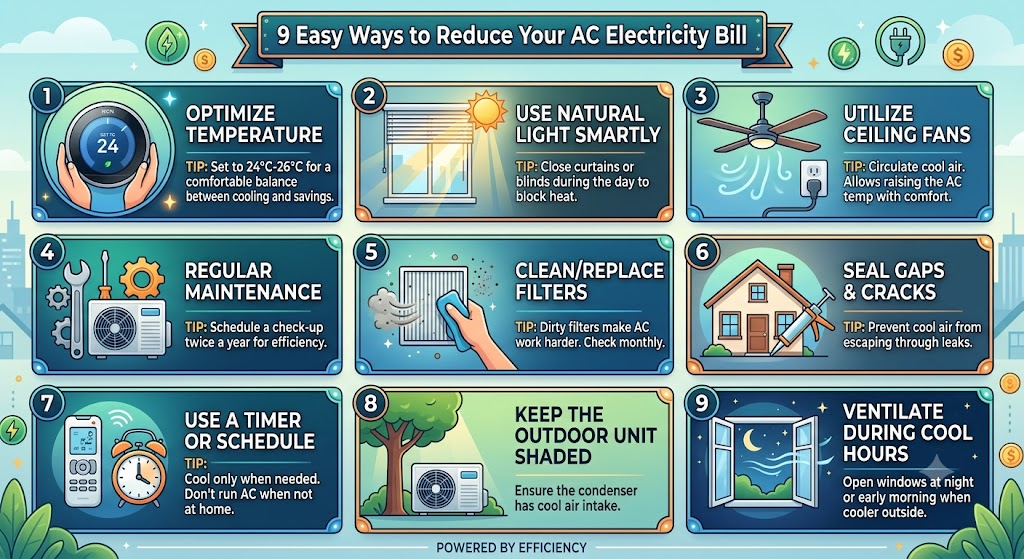
Whether you own a 3 Star or a 5 Star AC, these habits can help lower your power consumption:
- Set the temperature between 24°C and 26°C for a good balance of comfort and efficiency.
- Use Sleep Mode at night to reduce unnecessary compressor operation.
- Clean the air filters every 2–4 weeks during heavy use.
- Keep doors and windows closed while the AC is running.
- Use curtains or blinds to block direct sunlight.
- Switch on ceiling fans to circulate cool air more effectively.
- Schedule professional servicing at least once a year.
- Choose the correct AC capacity for your room size to avoid overworking the compressor.
- Turn off the AC when the room is unoccupied for long periods.
Which AC Should You Buy: 3 Star or 5 Star?
There is no single winner in the 3 Star vs 5 Star AC debate. The right choice depends on how often you use the AC, your budget, and how long you plan to keep it.
Here’s a simple recommendation.
| Your Usage Pattern | Best Choice | Why? |
|---|---|---|
| Less than 3 hours daily | 3 Star AC | Lower purchase cost, electricity savings are minimal |
| 3–5 hours daily | 3 Star AC | Better value if budget is limited |
| 6–8 hours daily | 5 Star AC | Lower electricity bill offsets higher price over time |
| More than 8 hours daily | 5 Star AC | Maximum long-term savings |
| Work From Home | 5 Star AC | AC runs throughout the day |
| Rental House | 3 Star AC | Lower upfront investment |
| Permanent Home | 5 Star AC | Better long-term ownership cost |
3 Star vs 5 Star AC for Different Room Sizes
Choosing the correct AC capacity is more important than choosing a higher star rating. A 5 Star AC with the wrong capacity will still consume extra electricity because it has to work harder.
| Room Size | Recommended Capacity |
|---|---|
| Up to 120 sq. ft. | 1 Ton |
| 120–180 sq. ft. | 1.5 Ton |
| 180–260 sq. ft. | 2 Ton |
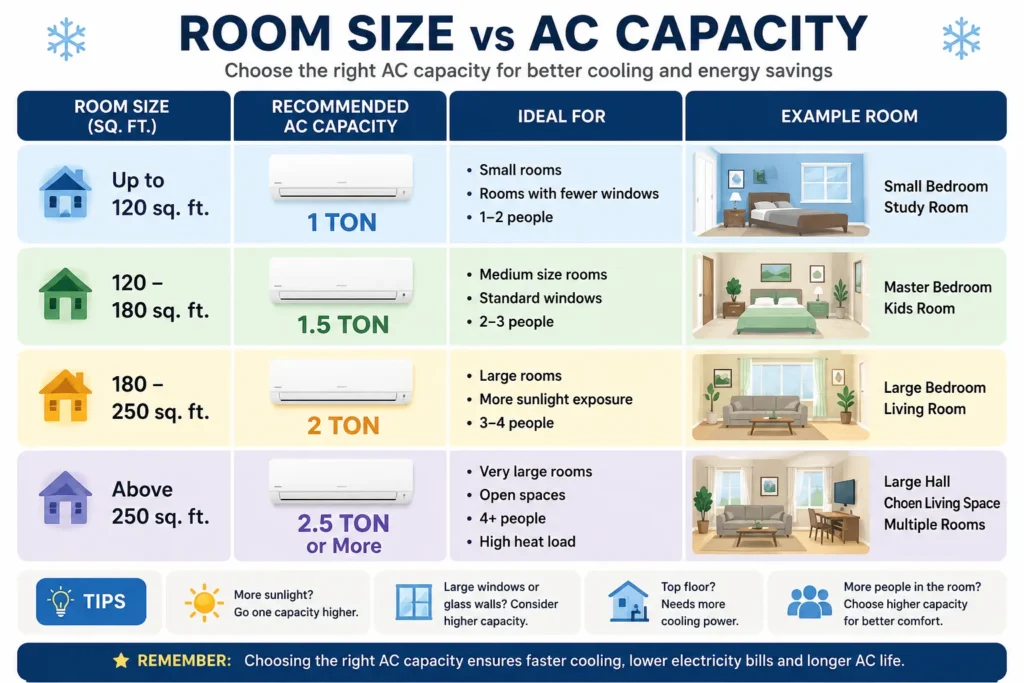
For example:
- A 1 Ton 5 Star AC is not suitable for a 200 sq. ft. room.
- A 1.5 Ton 3 Star AC will cool that room much more effectively.
Always choose the correct tonnage first, then decide between 3 Star and 5 Star.
Image Suggestion: Room size vs AC capacity infographic.
Which Cities Benefit Most from a 5 Star AC?
In India, climate plays a major role in deciding which AC makes sense. A 5 Star AC offers greater savings in places where the AC runs for long hours due to high temperatures.
Ideal for 5 Star AC
- Delhi
- Jaipur
- Nagpur
- Ahmedabad
- Raipur
- Hyderabad
- Lucknow
- Kanpur
- Patna
A 3 Star AC May Be Enough
- Bengaluru
- Pune
- Shillong
- Ooty
- Shimla
- Dehradun (moderate summers)
If your city experiences extreme summer temperatures for four to six months, investing in a 5 Star AC usually makes more financial sense.
3 Star vs 5 Star AC for Different Types of Users
Students
Students staying in hostels or rented apartments usually use the AC for a few hours at night.
Recommended: 3 Star AC
Working Professionals
If you’re away at the office all day and use the AC only while sleeping, a 3 Star AC is often sufficient. However, if you work remotely, a 5 Star AC is a better investment.
Families
Families with children or elderly members often keep the AC running for longer periods.
Recommended: 5 Star AC
Senior Citizens
Many senior citizens stay at home throughout the day. A 5 Star AC helps reduce electricity bills over several years.
Holiday Homes
If the AC is used only occasionally, spending extra on a 5 Star model may not provide enough savings.
Recommended: 3 Star AC
Does Inverter Technology Matter More Than Star Rating?
Yes, in many cases. Many buyers compare only star ratings and ignore whether the AC is inverter or non-inverter. Here’s why inverter technology matters:
An inverter AC adjusts compressor speed based on the cooling requirement. Instead of switching on and off repeatedly, it runs smoothly at variable speeds.
Benefits include:
- Lower electricity consumption
- Better temperature control
- Quieter operation
- Longer compressor life
- Improved comfort
If you have to choose between:
- 5 Star Non-Inverter AC
- 3 Star Inverter AC
The better option often depends on usage, but in many modern homes, a 3 Star Inverter AC can be a smarter purchase than an older non-inverter design because inverter technology itself significantly improves efficiency.
3 Star Inverter AC vs 5 Star Inverter AC
This is the comparison most buyers should focus on today because almost all premium ACs are inverter models.
| Feature | 3 Star Inverter AC | 5 Star Inverter AC |
|---|---|---|
| Cooling | Same | Same |
| Compressor | Variable Speed | Variable Speed |
| Noise | Low | Low |
| Electricity Consumption | Higher | Lower |
| Purchase Price | Lower | Higher |
| Long-Term Savings | Good | Excellent |
If your budget allows, a 5 Star Inverter AC is the best combination of energy efficiency and comfort.
Common Myths About 3 Star vs 5 Star AC
Myth 1: A 5 Star AC Cools Faster
Reality: Cooling speed depends on capacity, compressor performance, and room conditions—not the star rating.
Myth 2: A 3 Star AC Is Outdated
Reality: Modern 3 Star inverter ACs are still highly efficient and suitable for many households.
Myth 3: Electricity Bill Will Be Half with a 5 Star AC
Reality: The difference is usually around 10–20%, depending on the model and usage. A 5 Star AC saves money, but it doesn’t reduce the bill by 50%.
Myth 4: Bigger Star Rating Means Bigger Compressor
Reality: Compressor size depends on AC capacity (Ton), not the star rating.
Myth 5: A 5 Star AC Needs Less Maintenance
Reality: Both require regular servicing, filter cleaning, and proper installation.
Mistakes Buyers Make While Choosing an AC
Avoid these common mistakes:
- Buying Only Based on Price: A cheaper AC may cost more in electricity over the years.
- Ignoring Daily Usage: Think about how many hours you’ll actually use the AC.
- Choosing the Wrong Capacity: A 2 Ton AC in a small bedroom wastes electricity. A 1 Ton AC in a large living room struggles to cool effectively.
- Not Checking the BEE Label Year: Always compare models using the latest BEE star rating label.
- Ignoring Installation Quality: Poor installation can reduce cooling performance and increase electricity consumption.
Long-Term Ownership Cost
Most buyers compare only the purchase price. A smarter approach is to compare the total cost of ownership.
For example:
| Expense | 3 Star AC | 5 Star AC |
|---|---|---|
| Purchase Price | Lower | Higher |
| Installation | Same | Same |
| Annual Service | Similar | Similar |
| Electricity Cost | Higher | Lower |
| Five-Year Running Cost | Higher | Lower |
| Overall Value | Good | Better for heavy users |
When you calculate the total money spent over five to ten years, a 5 Star AC often becomes the more economical option for households with high daily usage.
Expert Buying Recommendations
Buy a 3 Star AC If:
- Your budget is under ₹35,000.
- You use the AC for less than 5 hours daily.
- You’re buying for a rental property.
- You live in a city with mild summers.
- You don’t expect to keep the AC for many years.
Buy a 5 Star AC If:
- You use the AC every day.
- Daily usage exceeds 6–8 hours.
- You work from home.
- You want lower electricity bills.
- You live in a hot region.
- You plan to use the AC for the next 7–10 years.
FAQs:
Q. Is a 5 Star AC worth buying?
Yes, if you use your AC for 6–8 hours or more every day, a 5 Star AC is usually worth the higher upfront cost because it consumes less electricity and helps reduce your monthly power bill.
Q. Is there a big difference between a 3 Star and a 5 Star AC?
The biggest difference is energy efficiency, not cooling.
A 5 Star AC:
- Uses less electricity
- Has a lower electricity bill
- Costs more to buy
A 3 Star AC:
- Has a lower purchase price
- Consumes slightly more electricity
- Offers almost the same cooling performance
Q. Does a 5 Star AC cool faster?
No. Cooling speed mainly depends on:
- AC capacity (Ton)
- Room size
- Outdoor temperature
- Compressor performance
- Installation quality
A 1.5 Ton 3 Star AC and a 1.5 Ton 5 Star AC from the same brand will cool a room at almost the same speed.
Q. Which AC is better for home use?
If your family uses the AC every day during summer, a 5 Star inverter AC is usually the better choice because it offers lower running costs. If you use the AC occasionally, a 3 Star inverter AC provides better value for money.
Q. Which AC has a lower electricity bill?
A 5 Star AC generally has a lower electricity bill because it consumes less power for the same cooling output.
Q. How much electricity does a 3 Star AC consume?
Approximate hourly power consumption:
- 1 Ton: 0.75–0.90 units
- 1.5 Ton: 1.00–1.25 units
- 2 Ton: 1.40–1.70 units
Actual consumption depends on usage, room conditions, and temperature settings.
Q. How much electricity does a 5 Star AC consume?
Approximate hourly power consumption:
- 1 Ton: 0.60–0.75 units
- 1.5 Ton: 0.80–1.00 units
- 2 Ton: 1.10–1.40 units
Q. Which AC is better for Indian summers?
For cities with long and hot summers such as Delhi, Jaipur, Ahmedabad, Nagpur, Raipur, Hyderabad, and Lucknow, a 5 Star inverter AC is generally the better investment because of the higher daily usage.
Q. Does AC star rating affect cooling?
No. The star rating indicates energy efficiency, not cooling performance.
Q. How many years does it take to recover the extra price of a 5 Star AC?
For households using the AC around 8 hours daily, the additional purchase cost is often recovered in 2–4 years, depending on the electricity tariff and usage pattern.
Q. Should I buy a 3 Star AC if my budget is limited?
Yes.
A 3 Star AC is still an energy-efficient option and is a practical choice if:
- Your budget is tight.
- You use the AC only for a few hours daily.
- You’re buying for a guest room or rental property.
Final Verdict: 3 Star vs 5 Star AC
Choosing between a 3 Star vs 5 Star AC is not about which one is “better”—it’s about which one matches your usage.
If you use your AC only occasionally, spending extra on a 5 Star model may not provide enough savings to justify the higher price. In this case, a 3 Star inverter AC offers an excellent balance of performance and affordability.
However, if your AC runs for long hours every day—especially during peak summer—a 5 Star inverter AC is the smarter long-term investment. Although it costs more initially, the lower electricity consumption helps reduce your monthly power bill and can recover the extra purchase cost over time.
Before making your decision, consider these three questions:
- How many hours will you use the AC every day?
- How long do you plan to keep the AC?
- What is the electricity tariff in your area?
Answering these questions will help you choose the right model and avoid unnecessary expenses. For most Indian households, the ideal approach is simple:
- Choose the correct AC capacity first.
- Prefer an inverter AC.
- Then decide between a 3 Star and a 5 Star model based on your daily usage and budget.
By following this approach, you’ll enjoy comfortable cooling while keeping your electricity bills under control.
Recommended Reading:
- 8 Best AC Cleaning Kits in India (2026)
- How to Unlock AC Remote
- Split AC vs Window AC: Which One is Better for Your Home in India?
- Inverter AC vs Non-Inverter AC: Which One Should You Buy in 2026?
Sourabh researches and writes about home appliances, kitchen appliances, and common appliance problems to help readers make informed buying decisions. He covers mixer grinders, refrigerators, air conditioners, washing machines, and appliance troubleshooting.
At ReviewSpot, Sourabh compares manufacturer specifications, product features, warranty information, pricing, and customer feedback to turn technical appliance information into practical buying advice. His goal is to help readers understand their options, avoid costly mistakes, and choose products that fit their needs and budget.
ReviewSpot distinguishes manufacturer information, customer feedback, and editorial analysis, and does not describe products as hands-on tested unless they have actually been tested.