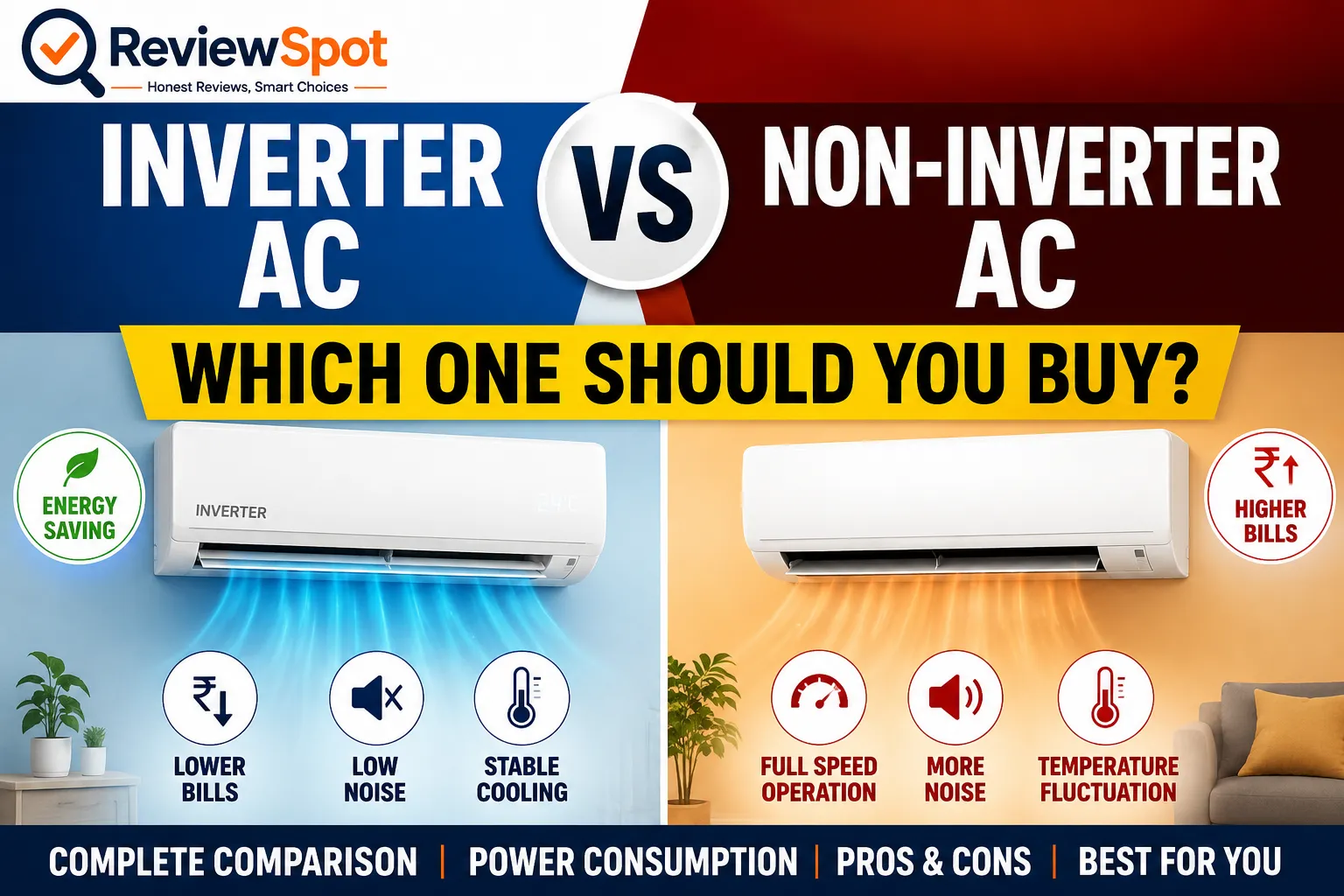
Inverter AC vs Non-Inverter AC: Which One Should You Buy in 2026?

Buying an air conditioner isn’t as simple as choosing a 1 Ton or 1.5 Ton model anymore. One of the biggest decisions you’ll face is choosing between an Inverter AC vs Non-Inverter AC.
Many buyers assume that an inverter AC always saves electricity or that a non-inverter AC is outdated. The truth is more practical. The best option depends on how long you use the AC every day, your budget, room size, electricity tariff, and even your city’s weather.
In this guide, we’ll explain everything in simple English without confusing technical terms. Whether you’re buying your first AC or replacing an old one, you’ll know exactly which type suits your home.
Still deciding which type of air conditioner suits your home? Read our complete guide on Which AC Is Best for Home to compare AC types, capacities, and features before making a purchase.
Inverter AC vs Non-Inverter AC
An inverter AC is the better choice for most Indian homes because it adjusts the compressor speed according to the cooling requirement. This helps save 20–40% electricity, maintains a more comfortable room temperature, and operates more quietly.
A non-inverter AC runs the compressor at full speed and repeatedly turns it ON and OFF. It usually costs less to buy but consumes more electricity during regular use.
Choose an Inverter AC if:
- You use the AC more than 4 hours daily.
- You want lower electricity bills.
- You prefer quieter operation.
- You plan to keep the AC for many years.
Choose a Non-Inverter AC if:
- You have a limited budget.
- You use the AC occasionally.
- The AC runs only for a few hours each week.
- You want a lower upfront purchase price.
Bottom Line: For most families in India, an inverter AC offers better value over time despite its higher initial cost.
Inverter AC vs Non-Inverter AC Comparison Table
| Feature | Inverter AC | Non-Inverter AC |
|---|---|---|
| Compressor | Variable-speed | Fixed-speed |
| Compressor Operation | Adjusts speed automatically | Runs at full speed or turns OFF |
| Electricity Consumption | Lower | Higher |
| Cooling Speed | Fast and consistent | Fast initially, then fluctuates |
| Temperature Control | Stable | Temperature keeps rising and falling |
| Noise Level | Quieter | Louder due to compressor restarting |
| Initial Cost | Higher | Lower |
| Running Cost | Lower | Higher |
| Maintenance | Similar, but repairs can be costlier if major electronic parts fail | Simpler technology, often cheaper to repair |
| Best For | Daily use | Occasional use |
| Comfort Level | Excellent | Average |
| Lifespan | Long when maintained properly | Good, but frequent start-stop cycles can increase wear |
| Best Choice | Most Indian homes | Budget-conscious buyers with limited usage |
What is an Inverter AC?
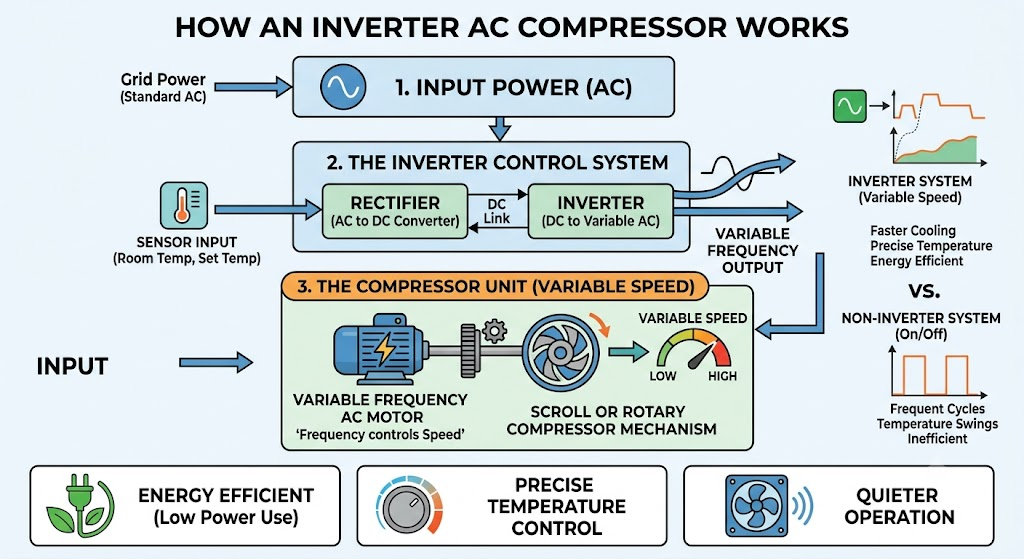
An Inverter AC is an air conditioner that changes the speed of its compressor instead of simply turning it ON and OFF.
Think of it like driving a car. When you’re driving in city traffic, you don’t keep pressing the accelerator fully and then braking every few seconds. Instead, you adjust your speed smoothly depending on traffic conditions.
An inverter AC works in the same way. Once the room reaches the desired temperature, the compressor slows down instead of stopping completely. It continues running at a lower speed to maintain consistent cooling while using less electricity.
Example
Suppose you set the temperature to 24°C. The inverter compressor works at full speed initially to cool the room quickly. Once the room reaches 24°C:
- The compressor slows down.
- Cooling remains steady.
- Electricity consumption decreases.
- Temperature stays comfortable.
- There are fewer sudden temperature changes.
This smart operation makes inverter ACs more energy-efficient than traditional fixed-speed models.
Key Features of an Inverter AC
- Variable-speed compressor
- Lower electricity consumption
- Faster cooling
- Consistent room temperature
- Quieter operation
- Better comfort during long usage
- Usually comes with higher BEE star ratings
If you’re buying an AC for a small bedroom, our guide on the Best AC for 10×10 Room will help you choose the correct capacity and model.
What is a Non-Inverter AC?
A Non-Inverter AC, also known as a Fixed-Speed AC, uses a compressor that operates at only one speed. It has just two modes full power and Completely OFF mode.
When the room temperature rises above the set temperature, the compressor starts at full speed. Once the desired temperature is reached, the compressor shuts off completely. As the room becomes warm again, the compressor restarts at full speed.
This cycle repeats continuously. Because starting a compressor requires a high amount of electricity, these frequent start-stop cycles increase overall power consumption.
Example
Suppose your room is set to 24°C. The AC cools the room. Once temperature reaches 24°C compressor turns OFF. After some time room temperature rises to 26°C compressor starts again at full speed. The cycle repeats throughout the night. This repeated switching causes:
- Higher electricity usage
- Slight temperature fluctuations
- More compressor noise
- Reduced comfort during long operation
Key Features of a Non-Inverter AC
- Fixed-speed compressor
- Lower purchase price
- Easy to understand technology
- Suitable for occasional use
- Higher electricity consumption during long operation
- Temperature keeps fluctuating
Quick Decision Guide to Buy AC
Use this checklist to decide which AC suits you best.
Buy an Inverter AC if:
- You use the AC daily.
- You want lower electricity bills.
- You prefer quiet operation.
- You value consistent comfort.
- You’re planning for long-term use.
Buy a Non-Inverter AC if:
- You have a limited budget.
- You use the AC only occasionally.
- The room is used infrequently.
- Upfront cost is your top priority.
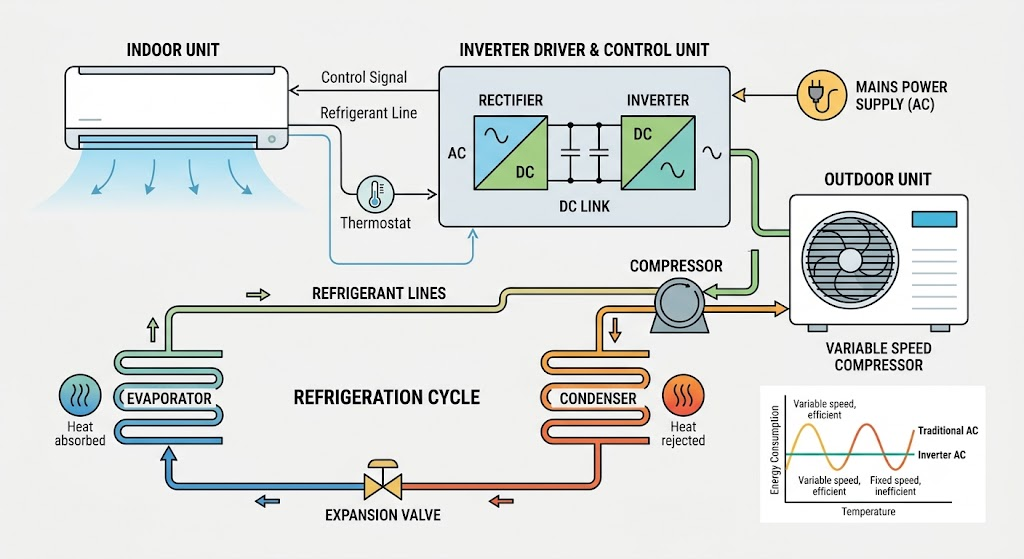
How Does an Inverter AC Work?
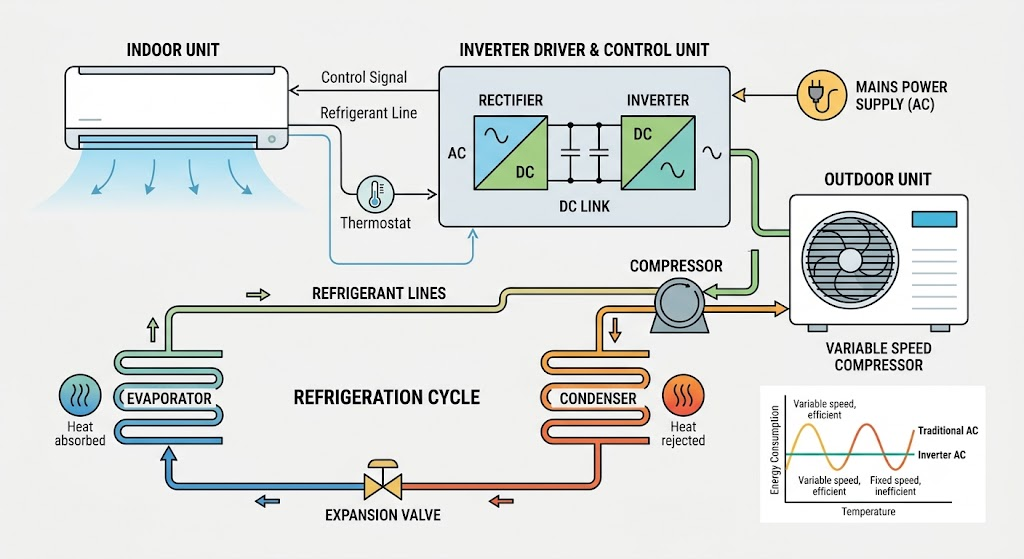
Understanding the working principle is easier than most people think. An inverter AC has three main parts:
- Indoor unit
- Outdoor unit
- Variable-speed compressor
Here’s are the steps:
- Room Temperature is Measured: Sensors continuously monitor the room temperature.
- Compressor Starts: If the room is hot, the compressor runs at high speed.
- Fast Cooling: The room cools quickly until the desired temperature is reached.
- Compressor Slows Down: Instead of stopping, the compressor reduces its speed.
- Continuous Cooling: The compressor keeps running slowly to maintain a stable room temperature. This process avoids unnecessary power spikes and improves energy efficiency.
Why Does This Save Electricity?
The compressor consumes the highest amount of electricity in an air conditioner. Since an inverter compressor rarely switches off completely, it avoids repeated high-power starts. That is why inverter ACs consume significantly less electricity during extended use.
Easy Analogy
Imagine filling a water tank. A non-inverter AC is like turning the tap fully ON and then completely OFF every few minutes.
An inverter AC is like adjusting the tap so that only the required amount of water flows continuously. The second method wastes less water—and similarly, an inverter AC wastes less electricity.
How Does a Non-Inverter AC Work?
A non-inverter AC follows a much simpler operating cycle.
- The thermostat detects that the room is warmer than the set temperature.
- The compressor starts at 100% capacity.
- The room cools down.
- Once the desired temperature is reached, the compressor stops completely.
- As the room warms up again, the compressor restarts at full speed.
- This process continues until you switch off the AC.
Why Does It Consume More Electricity?
Every time the compressor starts:
- It draws a high amount of current.
- It runs at maximum power.
- Energy consumption increases.
Frequent ON-OFF cycles make non-inverter ACs less efficient, especially if you use the AC for several hours every day.
Easy Analogy
Think about driving in heavy traffic. If you keep accelerating to full speed and braking every few seconds, your car uses more fuel. A non-inverter AC behaves in a similar way. An inverter AC, on the other hand, adjusts its speed smoothly, helping save energy.
Why Compressor Technology Matters
The compressor is often called the heart of an air conditioner because it circulates refrigerant and enables the cooling process.
The biggest difference in the Inverter AC vs Non-Inverter AC comparison lies in how the compressor operates.
| Feature | Inverter Compressor | Non-Inverter Compressor |
|---|---|---|
| Compressor Speed | Adjusts speed based on cooling demand | Runs at a fixed speed |
| Temperature Control | Maintains a stable room temperature | Creates noticeable temperature swings |
| Electricity Consumption | Reduces electricity consumption | Uses more power, especially during start-up |
| Operation | Runs continuously at variable speeds | Turns ON and OFF repeatedly |
| Noise Level | Produces less noise | Can be noisier during operation |
| Compressor Wear | Minimises wear caused by frequent restarting | Frequent ON/OFF cycles can increase wear over time |
While both types cool a room effectively, the compressor technology influences comfort, energy efficiency, and long-term operating costs.
Common Myths About Inverter ACs
Many buyers are confused by marketing claims. Let’s clear up a few common myths.
Myth 1: Inverter ACs Cool More Than Non-Inverter ACs
Reality: Both can cool a room to the same temperature. The difference is that inverter ACs maintain that temperature more consistently.
Myth 2: Inverter ACs Always Save 60% Electricity
Reality: Actual savings depend on usage patterns, room insulation, outdoor temperature, and AC capacity. For most Indian households, savings are typically between 20% and 40% over comparable fixed-speed models.
Myth 3: Non-Inverter ACs Are Obsolete
Reality: They are still suitable for users who operate the AC only occasionally or have a tight budget.
Myth 4: Inverter ACs Need an Inverter Battery
Reality: The term “inverter” refers to the compressor’s variable-speed technology, not to a home power backup system. An inverter AC does not require an inverter battery to function.
Myth 5: Inverter ACs Never Turn Off
Reality: During low cooling demand, the compressor slows down significantly. Depending on the model and conditions, it may still stop temporarily, but it does so far less frequently than a fixed-speed AC.
Difference Between Inverter AC and Non-Inverter AC
If you’re still confused about Inverter AC vs Non-Inverter AC, this section compares both technologies side by side. Instead of looking only at the purchase price, it’s important to consider electricity consumption, cooling performance, maintenance costs, and long-term savings.
For most Indian households, an air conditioner is used for several years. A slightly higher investment today can lead to significant savings on electricity bills over the life of the AC.
Although both air conditioners cool a room, they achieve it in different ways.
1. Compressor Technology
The compressor is the main component responsible for cooling.
| Feature | Inverter AC | Non-Inverter AC |
|---|---|---|
| Compressor Operation | Continuously adjusts compressor speed | Compressor runs only at full speed |
| Power Consumption | Uses only the required amount of power | Uses full power whenever the compressor starts |
| Cooling Performance | Delivers smooth and consistent cooling | Stops cooling after reaching the set temperature |
| Temperature Control | Maintains a more stable room temperature | Restarts whenever the room becomes warm again, causing temperature fluctuations |
This repeated ON-OFF cycle is the biggest difference in the Inverter AC vs Non-Inverter AC comparison.
2. Electricity Consumption
Electricity usage is one of the main reasons people choose an inverter AC. Since the compressor rarely switches off completely, it avoids repeated high-power starts. A non-inverter AC consumes more electricity because every restart requires a surge of power.
Typical Electricity Savings
| Daily Usage | Estimated Savings with Inverter AC |
|---|---|
| 2 Hours | 5–10% |
| 4 Hours | 10–20% |
| 6 Hours | 20–30% |
| 8 Hours or More | 25–40% |
Note: Actual savings depend on factors such as room insulation, outdoor temperature, thermostat setting, AC capacity, and the BEE star rating.
Buying an inverter AC is only part of the equation. Learn Which Mode is Best for AC to Save Electricity to reduce your monthly power bill even further.
Real Electricity Bill Comparison
Let’s look at a practical example for an Indian household.
Example
Room Size: 150 sq. ft.
AC Capacity: 1.5 Ton
Daily Usage: 8 Hours
Electricity Rate: ₹8 per unit
Non-Inverter AC
Approximate Consumption:
Around 1.5 kWh per hour
Daily:
12 units
Monthly:
360 units
Monthly Cost:
₹2,880
Inverter AC
Average Consumption:
Around 1.0–1.2 kWh per hour (varies with load)
Daily:
Approximately 8.8 units
Monthly:
264 units
Monthly Cost:
₹2,112
Monthly Savings
₹768
Yearly Savings
₹9,216
If you keep the AC for 8–10 years, the electricity savings can easily recover the higher purchase price of an inverter AC.
Expert Tip: If your household uses the AC every night during summer, the lower running cost of an inverter AC often outweighs its higher upfront price within a few years.
3. Cooling Performance Comparison
Many buyers believe inverter ACs cool more slowly than non-inverter ACs. This isn’t always true.
Modern inverter ACs can increase compressor speed during the initial cooling phase, allowing them to cool the room quickly. Once the desired temperature is reached, they reduce compressor speed to maintain comfort.
Inverter AC
- Fast initial cooling
- Maintains a stable temperature
- Less fluctuation
- Better comfort during long usage
Non-Inverter AC
- Fast cooling when compressor is running
- Cooling stops when compressor switches off
- Room temperature rises before cooling starts again
Winner: Inverter AC
4. Temperature Stability
Imagine sleeping at night. With a non-inverter AC:
- Room becomes cold.
- Compressor stops.
- Room becomes warmer.
- Compressor restarts.
This cycle continues throughout the night. With an inverter AC:
The compressor adjusts its speed continuously, keeping the room temperature close to your selected setting. This creates a more comfortable sleeping environment.
5. Humidity Control
Humidity is a common issue in many Indian cities, especially during the monsoon and in coastal regions.
Cities like:
- Mumbai
- Chennai
- Kochi
- Goa
- Visakhapatnam
often experience high humidity.
An inverter AC performs better because it runs for longer periods at lower speeds, allowing it to remove moisture from the air more effectively. A non-inverter AC stops frequently, reducing its ability to dehumidify consistently.
Winner: Inverter AC
5. Noise Level Comparison
The compressor is usually the loudest component in an air conditioner.
Inverter AC
Since the compressor changes speed gradually, it produces less noise. Typical indoor sound levels are often around 25–40 dB, depending on the model and fan speed.
Non-Inverter AC
The compressor starts and stops repeatedly. Each restart can produce a noticeable sound, making it seem louder during operation.
6. Which Is Better for Bedrooms?
If you’re a light sleeper or plan to install the AC in a bedroom or study room, an inverter AC generally offers a quieter and more comfortable experience.
Winner: Inverter AC
7. Which AC Gives Better Comfort?
Comfort isn’t just about cooling. It also includes:
- Stable room temperature
- Low humidity
- Quiet operation
- Smooth airflow
Inverter AC
- Consistent cooling
- Better sleep quality
- Less temperature fluctuation
- Improved comfort during long operation
Non-Inverter AC
- Good cooling
- Temperature changes frequently
- Compressor noise is more noticeable
Winner: Inverter AC
8. Maintenance Cost Comparison
Many buyers assume inverter ACs require much higher maintenance. That’s not entirely true. Routine maintenance is almost the same for both types.
Both need:
- Air filter cleaning every 2–4 weeks during heavy use
- Indoor unit servicing
- Outdoor unit cleaning
- Refrigerant leak checks if cooling performance drops
The difference appears mainly when major components fail.
Inverter AC
If the inverter PCB (Printed Circuit Board) or electronic control module needs replacement, repairs can be more expensive.
Non-Inverter AC
Uses simpler electronics, so certain repairs may be less costly.
However, this doesn’t mean inverter ACs fail more often. With proper installation, regular servicing, and a stable power supply, they are generally reliable.
9. Lifespan Comparison
People often ask whether inverter ACs last longer. The answer depends largely on maintenance and usage. Because the compressor doesn’t start and stop as frequently, it experiences less mechanical stress.
A well-maintained inverter AC can have a service life comparable to or even longer than a fixed-speed AC.
Tips to Increase AC Lifespan
- Clean filters regularly.
- Service the AC before the summer season.
- Avoid setting extremely low temperatures (like 16°C) for long periods.
- Ensure proper installation by trained technicians.
- Keep the outdoor unit free from dust and debris.
Initial Price vs Long-Term Savings
This is where many buyers hesitate.
Approximate Price Comparison (India)
| AC Type | Typical Price Range (1.5 Ton) |
|---|---|
| Non-Inverter AC | ₹28,000–₹38,000 |
| Inverter AC | ₹35,000–₹50,000 |
The inverter model may cost ₹5,000–₹12,000 more initially.
However, if your electricity bill reduces significantly each year, that additional investment can be recovered over time through lower operating costs.
For occasional users, the savings may not be enough to justify the higher purchase price. But for families using the AC daily, the long-term economics often favour an inverter AC.
BEE Star Rating Explained
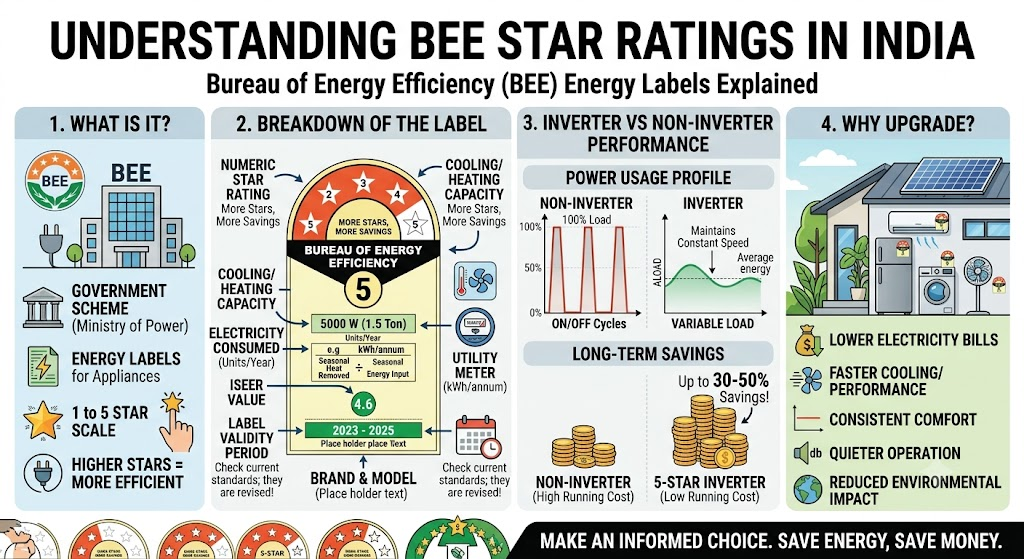
Many people confuse Inverter AC with 5-Star AC, but they are not the same.
- Inverter technology refers to how the compressor works.
- BEE Star Rating indicates how energy-efficient the AC is.
You can find inverter ACs with different star ratings, such as 3-Star or 5-Star. Likewise, some non-inverter models also carry BEE star ratings.
When comparing two ACs, consider both:
- The compressor technology (inverter or fixed-speed)
- The BEE star rating
A higher star rating generally means lower electricity consumption under standard test conditions.
Which AC Should You Buy? A Practical Buying Guide
By now, you know the technical differences in the Inverter AC vs Non-Inverter AC comparison. The final decision depends on how you use your AC, your budget, and your long-term plans.
Instead of asking, “Which AC is better?” ask, “Which AC is better for my needs?”
Let’s look at different situations.
Choose an Inverter AC If…
An inverter AC is a smart investment if you use the air conditioner regularly.
It is the better option if:
- You use the AC for more than 4–5 hours every day.
- You work from home and need cooling throughout the day.
- You live in a city with long and hot summers.
- You want lower electricity bills.
- You plan to use the same AC for 8–10 years.
- You value quiet operation and consistent cooling.
- You have children or elderly family members who are sensitive to temperature changes.
Ideal for:
- Homeowners
- Families
- Daily users
- Bedrooms
- Living rooms
- Home offices
Choose a Non-Inverter AC If…
A non-inverter AC still makes sense in certain situations.
It is suitable if:
- You have a limited budget.
- You use the AC only occasionally.
- The AC is installed in a guest room.
- You switch it on only during extremely hot days.
- You don’t mind slightly higher electricity bills due to limited usage.
Ideal for:
- Guest bedrooms
- Vacation homes
- Shops with occasional cooling needs
- Budget-conscious buyers
Which AC is Best for Different Indian Cities?
India’s climate varies widely. Choosing the right AC based on your local weather can improve comfort and reduce electricity costs.
| City Type | Recommended AC | Reason |
|---|---|---|
| Delhi, Jaipur, Nagpur | Inverter AC | Handles long, hot summers efficiently |
| Mumbai, Chennai, Kochi | Inverter AC | Better humidity control |
| Bengaluru, Pune | Inverter AC | Suitable for moderate but regular use |
| Shimla, Ooty | Non-Inverter AC (if used occasionally) | Lower cooling demand |
| Tier-2 & Tier-3 cities | Depends on usage | Daily users benefit more from inverter models |
Which AC is Best Based on Daily Usage?
| Daily Usage | Recommended AC |
|---|---|
| Less than 2 hours | Non-Inverter AC |
| 2–4 hours | Either option |
| 4–6 hours | Inverter AC |
| More than 6 hours | Inverter AC |
Expert Advice: If you expect your AC usage to increase in the future, buying an inverter AC today can be more economical over its lifespan.
Is an Inverter AC Worth the Extra Money?
For many buyers, this is the biggest question. The answer depends on how often you use the AC.
Example
Suppose an inverter AC costs ₹8,000 more than a comparable non-inverter model.
If it saves around ₹7,000–₹9,000 per year in electricity (depending on usage and local tariffs), the additional cost can be recovered within 1–3 years for heavy users.
After that, the savings continue. However, if you use the AC only occasionally, the payback period will be much longer, and a non-inverter AC may be the more sensible choice.
Common Mistakes to Avoid When Buying an AC
Many buyers focus only on the price tag. That can lead to higher running costs later.
Avoid these common mistakes:
1. Buying the Cheapest AC
A lower purchase price doesn’t always mean lower overall cost. Electricity bills can quickly outweigh the initial savings.
2. Choosing the Wrong Capacity
An undersized AC struggles to cool the room, while an oversized AC may cycle inefficiently and increase costs.
Always choose the correct capacity based on room size, insulation, ceiling height, and sun exposure.
3. Ignoring the BEE Star Rating
Two inverter ACs can have very different energy efficiencies. Compare the BEE label before buying.
4. Setting the Temperature Too Low
Many people set the AC to 16°C, expecting faster cooling.
The AC cools at its maximum capacity until the set temperature is reached. Setting a much lower temperature doesn’t cool the room faster—it simply makes the compressor work longer and increases electricity consumption.
For most homes, 24–26°C offers a good balance between comfort and energy efficiency.
5. Skipping Regular Maintenance
Dirty filters reduce airflow, increase power consumption, and affect cooling performance.
Clean the filters every few weeks during heavy use and schedule professional servicing before each summer.
Myths vs Facts
| Myth | Fact |
|---|---|
| Inverter ACs cool more than non-inverter ACs. | Both can reach the same temperature. Inverter ACs maintain it more consistently. |
| Inverter ACs always save 60% electricity. | Savings depend on usage, room conditions, and the AC’s efficiency. |
| Non-inverter ACs are outdated. | They remain a practical option for occasional users. |
| Inverter ACs require a home inverter battery. | The term “inverter” refers to compressor technology, not power backup. |
| All inverter ACs are equally efficient. | Efficiency varies with BEE star rating, ISEER value, and model design. |
FAQs
1. Which is better: Inverter AC or Non-Inverter AC?
For most Indian households, an inverter AC is the better choice because it offers lower electricity consumption, quieter operation, and more consistent cooling during regular use.
2. Does an inverter AC save electricity?
Yes. Compared with a similar fixed-speed model under similar conditions, an inverter AC can reduce electricity consumption, especially when used for long hours.
3. Is a non-inverter AC cheaper?
Yes. Non-inverter ACs generally have a lower purchase price, but they may cost more to operate over time if used frequently.
4. Which AC cools faster?
Modern inverter ACs can cool a room just as quickly as non-inverter ACs by increasing compressor speed during the initial cooling phase.
5. Which AC is better for a bedroom?
An inverter AC is generally better because it provides quieter operation and maintains a more stable room temperature.
6. Does an inverter AC work during a power cut?
No. Like any standard AC, it requires electricity to operate unless your home has an appropriate backup system capable of supporting the AC’s power requirements.
7. Which AC lasts longer?
With proper installation and regular maintenance, both can last many years. Reduced compressor cycling may lower mechanical stress in inverter models.
8. Is inverter technology available in Window ACs?
Yes. Several manufacturers now offer inverter window ACs.
9. Does an inverter AC require a stabilizer?
Many modern inverter ACs include wide voltage protection, but in areas with frequent voltage fluctuations, a compatible stabilizer may still be recommended. Check the manufacturer’s guidelines.
Some inverter ACs are designed to operate without an external stabilizer, but requirements vary by model and local voltage conditions. If your AC needs additional voltage regulation, see our guide to the best stabilizer for a 1.5-ton AC.
10. What temperature should I set to save electricity?
For most homes, 24–26°C provides a comfortable balance between cooling and energy efficiency.
Final Verdict: Inverter AC vs Non-Inverter AC
If you’re choosing between Inverter AC vs Non-Inverter AC, there isn’t a one-size-fits-all answer—but there is a clear winner for most Indian households.
An inverter AC is the better choice if you use your air conditioner regularly. It offers:
- Lower electricity consumption
- Consistent cooling
- Quieter operation
- Better humidity control
- Improved long-term value
A non-inverter AC is still worth considering if:
- Your budget is limited.
- The AC is used only occasionally.
- The room doesn’t need daily cooling.
Before making your final decision, compare:
- Room size
- AC capacity
- BEE Star Rating
- ISEER value
- Warranty terms
- Annual electricity cost not just the purchase price
Looking at the total cost of ownership rather than the sticker price will help you choose an AC that delivers better comfort and value for years to come.
Recommended Reading:
- Split AC vs Window AC: Which One is Better for Your Home in India?
- 10 Best AC Under ₹50000 in India 2026
- 10 Best AC for Bedroom in India 2026
- 7 Best Stabilizer for 1.5 Ton AC in India (2026)
Sourabh researches and writes about home appliances, kitchen appliances, and common appliance problems to help readers make informed buying decisions. He covers mixer grinders, refrigerators, air conditioners, washing machines, and appliance troubleshooting.
At ReviewSpot, Sourabh compares manufacturer specifications, product features, warranty information, pricing, and customer feedback to turn technical appliance information into practical buying advice. His goal is to help readers understand their options, avoid costly mistakes, and choose products that fit their needs and budget.
ReviewSpot distinguishes manufacturer information, customer feedback, and editorial analysis, and does not describe products as hands-on tested unless they have actually been tested.