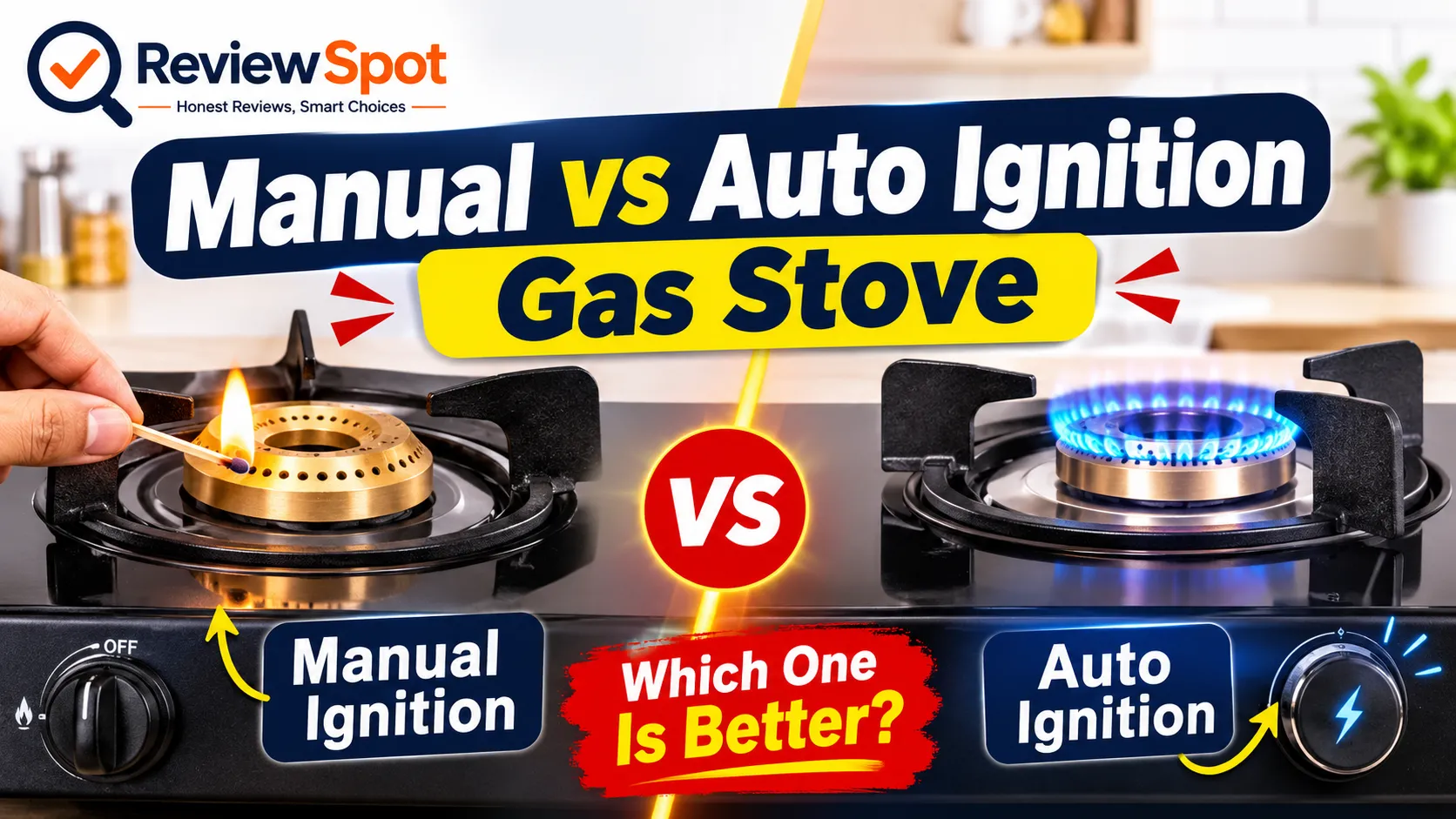
Manual vs Auto Ignition Gas Stove: Which Is Better for Your Kitchen?

Choosing a gas stove for an Indian kitchen isn’t just about the number of burners, glass finish or price. The way you light the burner also affects your daily cooking experience. Some families prefer the familiar method of using a gas lighter, while others want the convenience of turning a knob and getting a flame.
But is an auto ignition gas stove worth paying extra for? Does manual ignition offer better value? And what happens when the ignition system stops working?
In this guide, we’ll compare both options based on convenience, safety, maintenance, running costs and real household needs so you can make a practical buying decision.
Quick answer: An auto ignition gas stove is generally better for convenience because it creates a spark without requiring a separate lighter or matchstick. A manual ignition gas stove is usually the more budget-friendly option, with a simpler ignition mechanism. Neither is automatically safer or longer-lasting. Your best choice depends on the exact model, its safety features, your budget and how you cook.

Manual vs Auto Ignition Gas Stove: Quick Decision Table
Use this table to shortlist the right type before comparing individual products.
| Your requirement | Recommended option | Why |
|---|---|---|
| Lower purchase price | Manual ignition | Usually costs less upfront |
| Quick lighting during daily cooking | Auto ignition | No separate lighter is needed |
| Fewer ignition components | Manual ignition | Has a simpler lighting arrangement |
| Convenience for frequent cooking | Auto ignition | Reduces the steps needed to light a burner |
| Operation during power cuts | Either, depending on ignition type | Manual, battery-powered and piezo systems don’t rely on mains electricity in the same way |
| Minimum ignition-related maintenance | Manual ignition | No built-in spark system to maintain |
| Modern kitchen convenience | Auto ignition | Integrates the spark mechanism into the stove |
| Specific flame-out protection | Check the exact model | This depends on features such as a Flame Failure Device, not merely ignition type |
| Rental home with a limited budget | Manual ignition | A practical option when basic functionality matters most |
| Household where ease of lighting is a priority | Auto ignition | Avoids handling a separate lighter for routine lighting |
The key point is that ignition type only determines how you start the flame. Burner quality, pan support, fuel compatibility, construction and safety features need separate evaluation.
What Is a Manual Ignition Gas Stove?
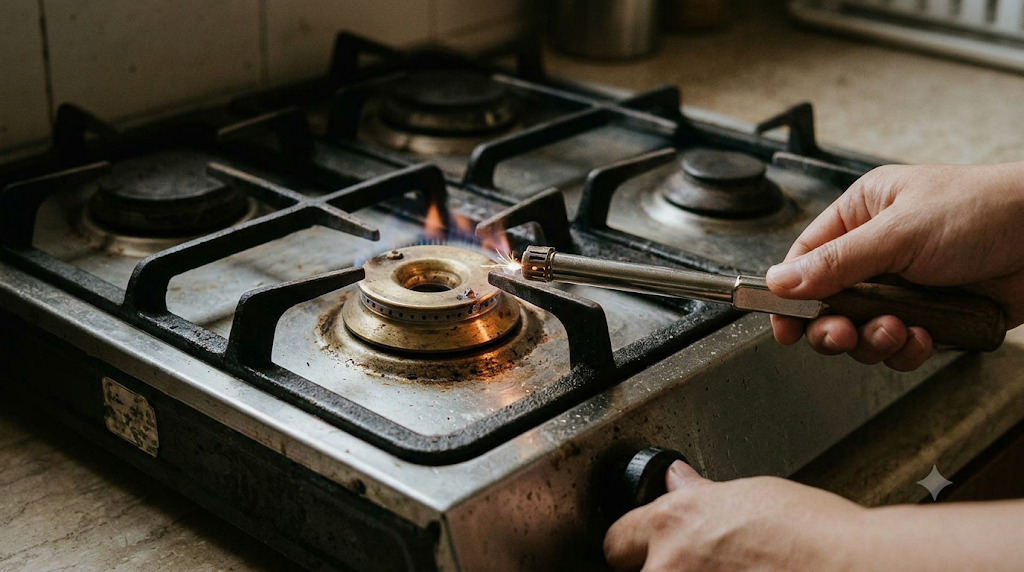
A manual ignition gas stove requires an external source of flame, such as a suitable gas lighter or matchstick, to light the burner.
You operate the gas control knob and use the external igniter according to the appliance instructions. Once the gas catches fire, you adjust the flame to suit the dish.
Manual ignition remains a practical option for Indian homes because it is straightforward and generally affordable.
Advantages of manual ignition
- Lower initial cost: Manual models are often cheaper than comparable auto ignition models.
- Simple mechanism: There is no integrated automatic spark system to troubleshoot.
- No ignition battery requirement: You don’t need to replace a battery for an ignition system that doesn’t use one.
- Straightforward operation: Many households are already familiar with this type of stove.
- Independent of mains electricity: You can light the burner with an appropriate external igniter even during a power cut, provided the gas supply is available.
Example: Suppose you’re furnishing a rented flat and want a basic two-burner stove. If you don’t mind using a lighter and want to keep the initial expense low, a manual model may make more sense than paying extra for automatic lighting.
Disadvantages of manual ignition
- You need a separate lighter or matchstick.
- You must handle the external flame carefully.
- Lighting can be inconvenient if the lighter is missing or faulty.
- Delayed lighting can allow unburned gas to accumulate around the burner.
Never keep releasing gas while repeatedly searching for a working lighter. Turn the gas off if the burner doesn’t ignite promptly, follow the manufacturer’s safety instructions, and allow any accumulated gas to disperse before attempting again. If you smell gas, don’t operate electrical switches or create a spark.
Manual ignition is not inherently unsafe. The important factors are correct lighting technique, proper installation and attention to gas leaks.
What Is an Auto Ignition Gas Stove?
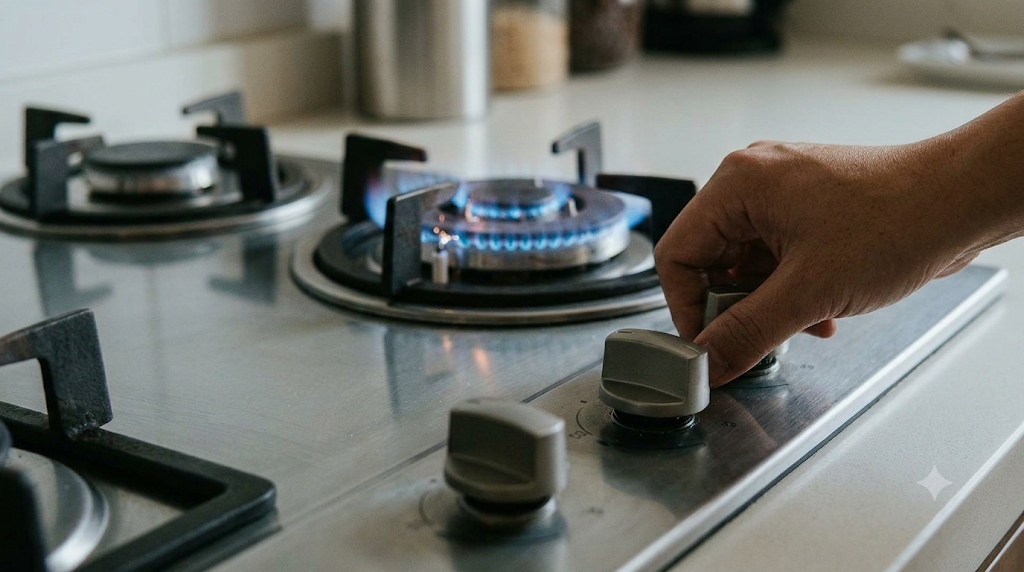
An auto ignition gas stove has a built-in mechanism that produces a spark to ignite the gas. On a typical model, you turn or press the control knob as instructed, and the ignition system generates a spark near the burner.
This removes the need to bring a separate lighter or matchstick to the burner for normal lighting.
However, auto ignition is not one single technology. Some models use battery-powered ignition, others use a mechanical piezoelectric mechanism, and some use mains electricity. Always check the exact product specification rather than assuming every automatic model works the same way. Köche+1
Advantages of auto ignition
- Convenient daily operation: You don’t need to pick up a separate lighter each time.
- Fewer steps: Lighting is integrated into the stove’s controls.
- Useful during busy cooking: You can start a burner without setting down every utensil or ingredient, although you should still operate the controls safely.
- Less dependence on a separate lighter: You don’t need a working external lighter for normal operation when the built-in system functions correctly.
- A cleaner cooking routine: You can avoid keeping a lighter beside the stove solely for ignition, though a suitable backup may still be sensible.
Example: Imagine preparing breakfast while making tea, heating milk and cooking parathas. A working auto ignition system can make starting each burner more convenient, especially when you cook several times a day.
Disadvantages of auto ignition
- Higher initial price in many product ranges: The convenience can come at an extra cost.
- Additional components: The ignition mechanism, wiring or battery system can require maintenance.
- Possible ignition problems: Moisture, food spills, dirt, a depleted battery or component faults can interfere with sparking.
- Model-dependent backup requirements: You need to understand how the stove can be lit if its automatic ignition stops working.
Auto ignition improves convenience, but it doesn’t automatically improve cooking performance, reduce LPG consumption or guarantee better safety.
Auto Ignition vs Manual Ignition Gas Stove: Main Differences
| Feature | Manual ignition | Auto ignition |
|---|---|---|
| How the burner lights | External lighter or matchstick | Built-in spark mechanism |
| Everyday convenience | Requires an extra step | Generally more convenient |
| Initial purchase price | Usually lower | Often higher |
| Ignition components | Simpler arrangement | Additional ignition components |
| Battery maintenance | Not required for ignition | Required only if the model uses a battery |
| Power-cut performance | Independent of mains power | Depends on the ignition system |
| Backup lighter | Required for normal lighting | Useful if automatic ignition fails |
| Cleaning | Follow the stove’s cleaning instructions | Keep the ignition area clean and dry as directed |
| Flame-out protection | Must be checked separately | Must be checked separately |
| Cooking speed | Depends mainly on burner and flame settings | Depends mainly on burner and flame settings |
| LPG consumption | Depends on actual fuel use and burner performance | Not automatically lower because of auto ignition |
| Best suited to | Budget-conscious buyers who prefer simplicity | Buyers who value convenient daily lighting |
The distinction matters because some online comparisons incorrectly treat automatic ignition as a complete safety or efficiency upgrade. It is primarily a lighting feature. Köche+1
Which Is Safer: Manual or Auto Ignition?
This is one of the most important questions in the manual vs auto ignition gas stove comparison.
Auto ignition can reduce the need to bring an external flame near a burner. However, that convenience alone doesn’t prove that the entire appliance is safer than a manual model.
Both types require correct installation, suitable cookware placement, regular cleaning and responsible operation.
What about a Flame Failure Device?
A Flame Failure Device (FFD) is a separate safety feature designed to stop the gas supply if the flame goes out under the conditions covered by its design.
For example, if a flame goes out unexpectedly, an appropriate flame-failure protection system may shut off the gas instead of allowing it to continue flowing.
But don’t assume every auto ignition stove includes an FFD. Check the manufacturer’s documentation for the exact model and verify what the feature does. Köche+1
Safety checks before buying
- Check the applicable certification and required product markings.
- Confirm that the stove is compatible with your gas supply.
- Read the installation and operating instructions.
- Check whether flame-failure protection is included.
- Confirm that the pan supports hold your regular pressure cooker, kadhai and other utensils securely.
- Keep the cooking area ventilated as recommended by the manufacturer.
- Follow the specified procedure if a burner fails to light or you suspect a gas leak.
Our recommendation: Prioritise verified safety features and correct installation over the words manual or auto ignition on the product page.
Does Auto Ignition Work During a Power Cut?
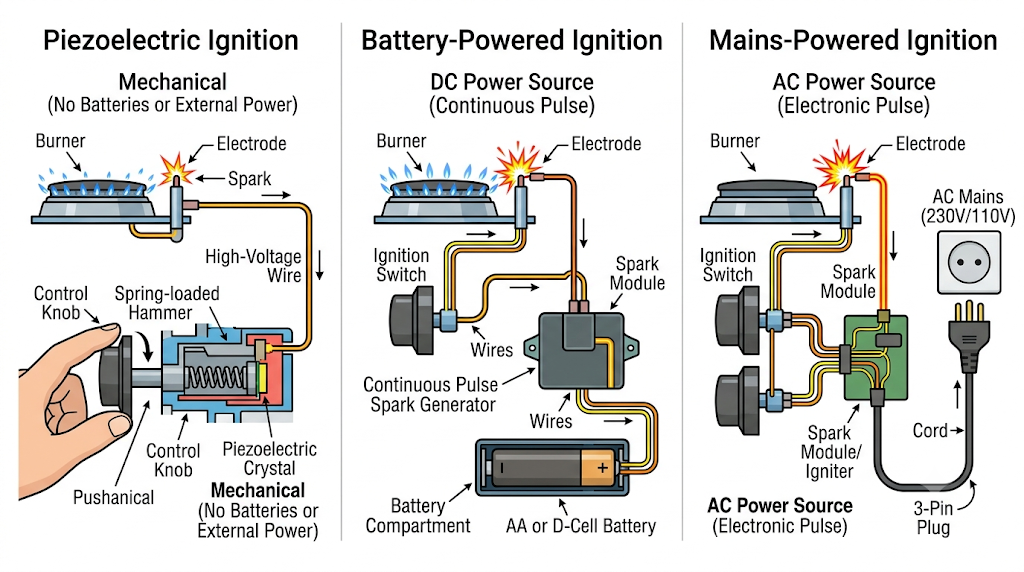
The answer depends on the type of ignition system.
| Ignition type | What happens during a power cut? |
|---|---|
| Manual ignition | You can use an external lighter or matchstick as appropriate. |
| Battery-powered auto ignition | It can generally continue working if the battery has sufficient power. |
| Piezoelectric ignition | It generates a spark mechanically and doesn’t depend on mains electricity. |
| Mains-powered ignition | The ignition may stop working without electricity. |
These are general characteristics of the technologies, not a guarantee for every product sold as auto ignition. Some designs use different mechanisms or have specific operating instructions. Köche+1
Before buying: Ask whether the stove uses a battery, piezoelectric mechanism or mains electricity. Also check the manufacturer’s approved backup-lighting procedure. Don’t attempt to modify the ignition system or bypass safety components.
Which Type Costs Less Over Time?
Manual ignition usually has the lower initial price, but the actual value depends on the price difference between comparable models and how long you use the stove.
Consider these costs:
| Cost factor | Manual ignition | Auto ignition |
|---|---|---|
| Purchase price | Often lower | Often higher |
| Replacement lighter | May be needed over time | Still useful as a backup |
| Ignition battery | Not required | Applies to battery-powered models |
| Ignition repair | No built-in spark system to repair | May require service if the mechanism fails |
| General stove maintenance | Depends on construction and use | Depends on construction and use |
| LPG cost | Depends on cooking and fuel efficiency | Depends on cooking and fuel efficiency |
A simple example of the extra cost
Suppose two genuinely comparable stoves cost ₹3,000 and ₹3,800. The auto ignition version costs ₹800 more.
That ₹800 is the additional amount you pay upfront for the differences between those two particular products. It isn’t a universal market price difference, and it shouldn’t be attributed entirely to ignition if the models also differ in other features.
Ask yourself whether the convenience is worth that amount for your household. If you cook multiple meals every day, you may value the convenience more than someone who uses a stove occasionally.
Also, don’t assume that an auto ignition stove saves LPG. Both types can use similar amounts of gas when their burners, heat settings and cooking conditions are comparable. Actual consumption depends on factors such as burner design, flame adjustment, cookware and cooking duration.
Recommended Models: What Should You Compare?
A useful product comparison should focus on models that genuinely differ in ignition type, rather than comparing an expensive four-burner hob with a basic two-burner stove.
One useful starting point is the Köche Flamaro family, which its published comparison article lists in both manual and auto ignition versions. The article reports the following prices. These are retailer-published figures, not independently confirmed live checkout prices. Köche
| Listed model | Manual ignition price | Auto ignition price | Reported difference |
|---|---|---|---|
| Köche Flamaro, 3 burner | ₹17,990 | ₹19,990 | ₹2,000 |
| Köche Flamaro, 4 burner | ₹11,490 | ₹12,990 | ₹1,500 |
How to compare products fairly
For each model, verify:
- The exact model number and burner count.
- Whether the manual and automatic versions have the same body, burner design and pan supports.
- The actual ignition mechanism and battery requirements.
- LPG or PNG compatibility, as applicable.
- Certification and required markings.
- Warranty coverage for the stove body, glass top and ignition components.
- Delivery, installation and service availability in your area.
If two versions differ in burner material, construction or included features, their entire price difference cannot be attributed to ignition alone.
What about budget-conscious buyers?
If you want to compare an entry-level manual stove with a more expensive automatic model, start with the same burner count and similar construction.
A basic stainless-steel manual stove might be sufficient for a rental home. A comparable auto ignition stove may be a better fit for a household that cooks frequently and values convenient lighting.
Don’t pay extra for a premium-looking finish if the actual feature you want is simply automatic ignition.
How to Check Exchange Offers and Fake Discounts
Online appliance offers can make it difficult to tell whether a gas stove is genuinely good value. The displayed discount isn’t necessarily the amount you’ll save.
1. Check the exchange offer carefully
If a retailer advertises an exchange offer, confirm these details before ordering:
- Is an old gas stove eligible, or does the offer apply only to selected appliances?
- Is the exchange available at your PIN code?
- Does the discount apply automatically or require a separate coupon?
- Is the old appliance’s collection included?
- Are there collection fees, delivery fees or other conditions?
- What happens if the old appliance doesn’t meet the exchange conditions?
Don’t subtract an advertised exchange benefit from the product price until you know you’re eligible for it.
2. Look for misleading discounts
A product showing 40% off isn’t automatically cheaper than a competing model with a smaller discount.
Check the current selling price against the manufacturer’s listed price and the price of comparable products. Where possible, review the price history or compare the final checkout price across reputable sellers.
Watch out for:
- Inflated reference prices that make ordinary selling prices look like special deals.
- Coupons that apply only to selected payment methods.
- Exchange benefits included in the headline price.
- Delivery or installation charges shown only at checkout.
- Different model numbers hidden behind similar product photographs.
3. Read the return policy before paying
Check whether the retailer accepts returns for defective products, transit damage or incorrect items. Gas stoves can have specific return conditions, and a change-of-mind return may not be treated the same as a defective-product claim.
Read the applicable terms for opened packaging, installation, pickup and refund timelines.
Photograph the package and appliance when they arrive. If you notice damage or missing parts, report it through the seller’s stated process promptly.
4. Verify the warranty
Don’t rely on a general statement such as “one-year warranty” without reading the actual terms.
Confirm:
- The warranty period for the complete appliance.
- Whether the ignition system has separate coverage.
- Whether the glass top and burners are covered differently.
- Whether labour, service visits or replacement parts cost extra.
- Whether unauthorised repairs or modifications affect coverage.
- Which service centres cover your location.
Warranty terms can vary by model and seller. Save the invoice, product model number, warranty document and seller correspondence.
Which Gas Stove Is Better for Different Indian Households?
The right choice becomes clearer when you consider your actual cooking routine.
For small families and apartment residents
A two-burner stove may be enough for a household that prepares simple meals and has limited counter space. If your budget is tight, manual ignition is a sensible starting point.
Choose auto ignition instead if you cook several times a day and find the built-in lighting feature worth the additional price.
If you have a compact kitchen or a small family, read our guide to choosing a two-burner gas stove before deciding which ignition type to buy.
For families that cook several dishes daily
A three- or four-burner stove can help when you need to prepare dal, sabzi, rice and rotis at the same time. But burner count and layout matter more to multitasking than the ignition type.
Auto ignition may improve convenience, while manual ignition can still perform the same basic cooking tasks.
For everyday family cooking, compare the layout and features in our 4 burner gas stove and three-burner gas stove buying guide
For tenants and people who move frequently
A manual table-top stove can be attractive because of its simpler ignition arrangement and often lower upfront price.
Before buying, check the appliance dimensions, gas connection arrangement and compatibility with your existing setup. If you’re renting, avoid making permanent kitchen modifications without permission.
For elderly family members or anyone who finds lighters difficult to use
Auto ignition may reduce the need to handle a separate lighter. However, the control knob may still require a particular grip or amount of force.
If ease of use is a major concern, check the actual knob operation and installation arrangement rather than relying on the ignition label alone.
What Else Matters More Than Ignition Type?
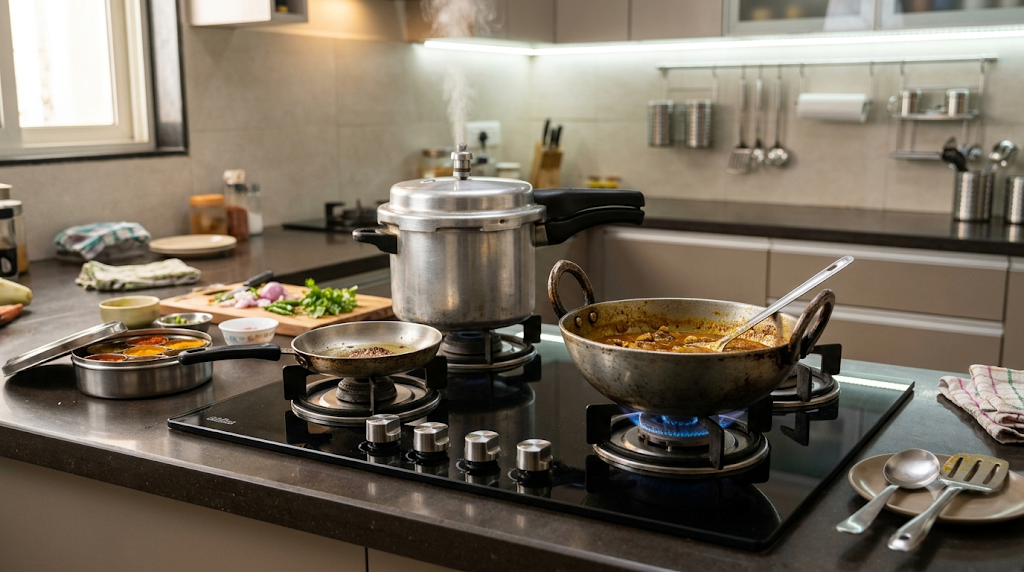
A gas stove is a long-term kitchen purchase. Consider these features before deciding between manual and auto ignition.
| Feature | What to check | Why it matters |
|---|---|---|
| Burner count | Two, three or four burners based on your routine | Determines how many dishes you can cook at once |
| Burner layout | Space between burners and supports | Large kadhais and pressure cookers need room |
| Burner material | Verify the manufacturer’s specification | Helps you compare construction and maintenance needs |
| Body material | Stainless steel, glass top or other specified material | Affects cleaning, appearance and care requirements |
| Pan supports | Stability with your regular utensils | Reduces wobbling during cooking |
| Flame adjustment | Check control range and usability | Helps you manage simmering and high-heat cooking |
| Fuel compatibility | LPG or PNG, as applicable | The appliance must match your supply |
| Safety features | Verify the model’s documented features | Helps you assess protection beyond ignition convenience |
| Service availability | Confirm support in your area | Matters if a part needs repair or replacement |
A stove with good pan support, appropriate burners and reliable service may be a better purchase than a model with extra features you rarely use.
How to Maintain an Auto Ignition Gas Stove
Auto ignition requires some attention to keep the spark area working properly.
- Switch off the stove and let it cool before cleaning.
- Follow the manufacturer’s instructions for cleaning the burner and ignition area.
- Keep the ignition electrode clean and dry as directed.
- Don’t pour water directly into the controls or ignition components.
- If the model uses a battery, use the specified type and follow the replacement instructions.
- If clicking continues without ignition, turn the gas off and consult the manual.
- Contact an authorised technician if the problem persists.
Food spills and moisture can interfere with ignition, but not every ignition problem is caused by dirt. A faulty component may require professional service.
How to Maintain a Manual Ignition Gas Stove
Manual ignition has fewer built-in ignition components, but the rest of the stove still needs regular care.
- Clean the cooktop according to the manufacturer’s instructions.
- Keep burner ports clear of food residue.
- Check that removable parts are correctly positioned before use.
- Use a suitable lighter in good condition.
- Keep the lighter away from children.
- Arrange professional inspection if you suspect a gas leak or damaged connection.
Don’t use a pin, wire or other object to modify burner openings unless the manufacturer explicitly permits the specified cleaning method.
Frequently Asked Questions
Is auto ignition better than manual ignition in a gas stove?
Auto ignition is generally better for convenience because it lights the burner using a built-in spark. Manual ignition is usually more affordable and has a simpler ignition arrangement. The best choice depends on your budget, cooking habits and the exact model.
Is a manual ignition gas stove safer?
Not automatically. Manual ignition requires careful use of an external lighter, while auto ignition reduces that extra step. Both require correct installation and safe operation. Features such as a Flame Failure Device should be checked separately.
Does auto ignition consume more LPG?
The ignition mechanism alone doesn’t establish LPG consumption. Fuel use depends mainly on burner performance, flame settings, cookware and cooking duration. Compare verified specifications and actual usage rather than assuming auto ignition increases or decreases consumption.
Does every auto ignition gas stove need a battery?
No. Some use batteries, some use piezoelectric mechanisms, and others use mains electricity. Check the specific model’s documentation to identify the ignition type.
Can I use an auto ignition gas stove without electricity?
Many models can operate without mains electricity, including battery-powered and piezoelectric designs. Mains-powered models may not be able to generate a spark during a power cut. Check the manufacturer’s instructions before buying.
Is auto ignition worth the extra money?
It can be worth the additional cost if you cook frequently and value convenient lighting. If you rarely use the stove or want to minimise upfront spending, manual ignition may offer better value for your needs.
Can I convert a manual gas stove to auto ignition?
Don’t attempt a DIY conversion. Ignition components and gas appliances need to be compatible with the manufacturer’s design. Ask the manufacturer or an authorised technician whether an approved conversion exists for your exact model.
Which gas stove lasts longer?
Ignition type alone doesn’t determine the lifespan of a complete stove. Construction, component quality, cleaning, usage and service support all matter. Manual ignition has fewer ignition components, but that doesn’t prove every manual stove will outlast every auto ignition model.
Should I choose a two-, three- or four-burner stove?
Choose based on how many dishes you regularly cook at once, available counter space and the size of your cookware. A larger burner count is useful only if the layout suits your kitchen and cooking routine.
Sourabh researches and writes about home appliances, kitchen appliances, and common appliance problems to help readers make informed buying decisions. He covers mixer grinders, refrigerators, air conditioners, washing machines, and appliance troubleshooting.
At ReviewSpot, Sourabh compares manufacturer specifications, product features, warranty information, pricing, and customer feedback to turn technical appliance information into practical buying advice. His goal is to help readers understand their options, avoid costly mistakes, and choose products that fit their needs and budget.
ReviewSpot distinguishes manufacturer information, customer feedback, and editorial analysis, and does not describe products as hands-on tested unless they have actually been tested.