What is RPM in Mixer Grinders? Here’s What You Need to Know Before You Buy

When comparing mixer grinders, you may wonder, “What is RPM in Mixer Grinders?” You may see specifications such as 18,000, 20,000 or 22,000 RPM, but does higher RPM mean better grinding?
RPM (Revolutions Per Minute) indicates how many times the motor shaft or blades rotate in one minute. However, the advertised RPM is usually the no-load speed, measured without ingredients. Once food is added, resistance can reduce the actual operating speed.
So, a higher RPM does not automatically mean better grinding. Motor power, torque, blade design, jar design and performance under load also matter.
What Is RPM in Mixer Grinder?
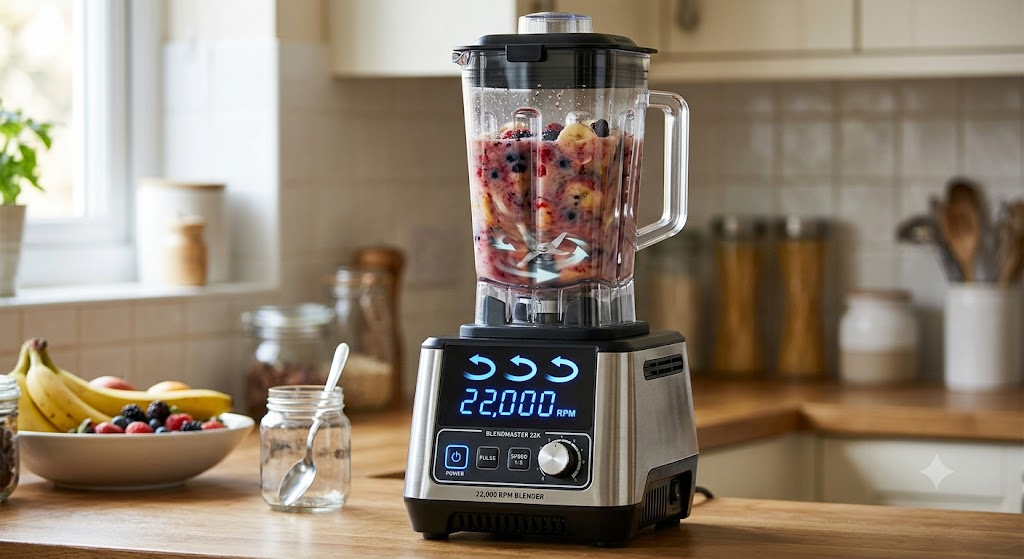
RPM stands for Revolutions Per Minute. It tells you how many times the motor shaft or blades rotate in one minute.
For example, a mixer grinder rated at 20,000 RPM can rotate up to 20,000 times per minute under the conditions used to measure that specification.
However, the RPM shown on a product page is usually the no-load speed, measured without ingredients. Once you add food, the motor faces resistance and its actual operating speed can be lower.
That is why RPM should not be treated as a direct measure of grinding performance.
No-Load RPM vs Loaded RPM
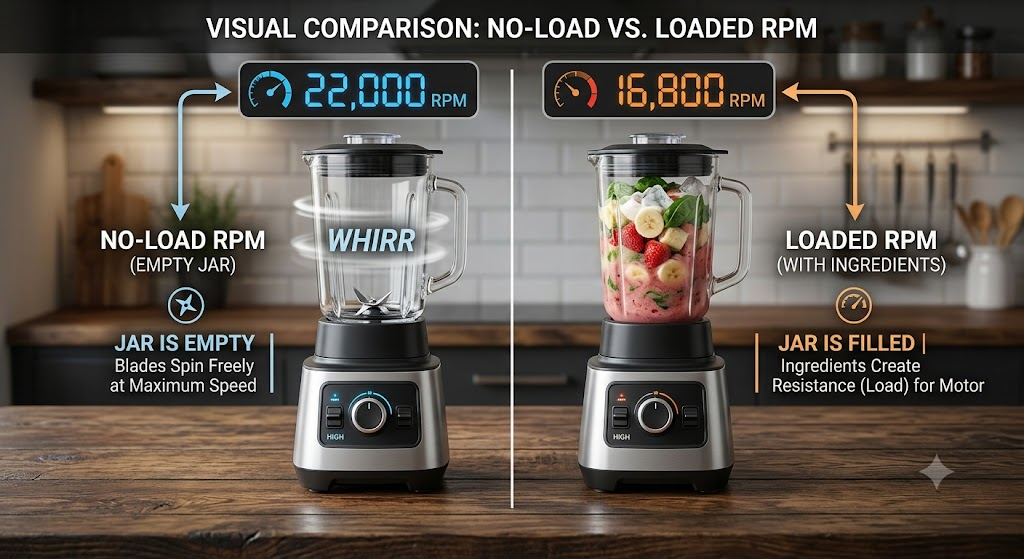
The difference between no-load and loaded RPM is important when comparing mixer grinders.
| RPM type | What it means |
|---|---|
| No-load RPM | Motor speed measured without ingredients |
| Loaded RPM | Motor speed when the mixer is working with ingredients |
| Advertised RPM | Usually refers to the no-load speed unless stated otherwise |
For example, Philips lists 22,000 RPM with no load and 11,500 RPM with load for the HL7555/00 mixer grinder. This shows why the advertised RPM can be considerably higher than the speed during actual grinding.
Buyer takeaway: Do not compare two mixer grinders only by their advertised RPM. Check whether the manufacturer provides loaded RPM and consider the motor, blades, jar design and intended use as well.
Does Higher RPM Mean Better Grinding?
No. A 22,000 RPM mixer is not automatically better than an 18,000 RPM mixer.
Grinding performance depends on several factors, including:
- How well the motor maintains speed under load
- Motor power and overall motor design
- Blade design
- Jar shape and design
- Quantity and type of ingredients being processed
A mixer may have a high no-load RPM but lose considerable speed when processing thick or hard ingredients. Another mixer with a lower advertised RPM may perform better if it handles the load more effectively.
So, do not choose a mixer grinder simply because it has the highest RPM.
How to Read Mixer Grinder RPM When Buying
Use RPM as one specification rather than the deciding factor.
| What the specification says | What it tells you |
|---|---|
| No-load RPM | Shows the maximum motor speed under no-load conditions |
| Loaded RPM | Gives a better indication of speed while processing ingredients |
| Higher no-load RPM | Means higher potential speed, but does not guarantee better grinding |
| Higher loaded RPM | Can be more useful for understanding operating speed |
| RPM not listed | Does not automatically mean poor performance |
What should you check?
- Check the advertised RPM to understand the motor’s maximum speed.
- Look for loaded RPM if the manufacturer provides it.
- Check motor power based on your cooking requirements.
- Look at blade and jar design, not just the RPM number.
- Consider the ingredients you normally grind, because the required performance varies with the load.
What RPM Should You Look for in a Mixer Grinder?
There is no single RPM number that is ideal for every mixer grinder.
For everyday home use, it is better to choose a model based on your grinding requirements, motor power, blade and jar design, and performance under load rather than setting a fixed RPM target.
If two models have similar features and one has a higher RPM, that can be useful as a comparison point. But a small difference in advertised RPM should not be the main reason for choosing one model over another.
The key point: RPM tells you how fast the blades can rotate. It does not tell you by itself how well the mixer grinder will perform when ingredients are added.
Does Motor Power Affect Mixer Grinder RPM?
Motor power and RPM are related, but they are not the same specification.
Wattage tells you how much electrical power the motor is designed to use, while RPM tells you how fast the motor rotates under a particular measurement condition.
A higher-wattage mixer grinder does not automatically have a higher RPM. More importantly, a mixer grinder with higher wattage can be more suitable for demanding loads if its motor is designed to handle them effectively.
For home use, consider wattage together with RPM, motor design, blade design and the type of ingredients you normally grind.
What Matters More Than RPM?
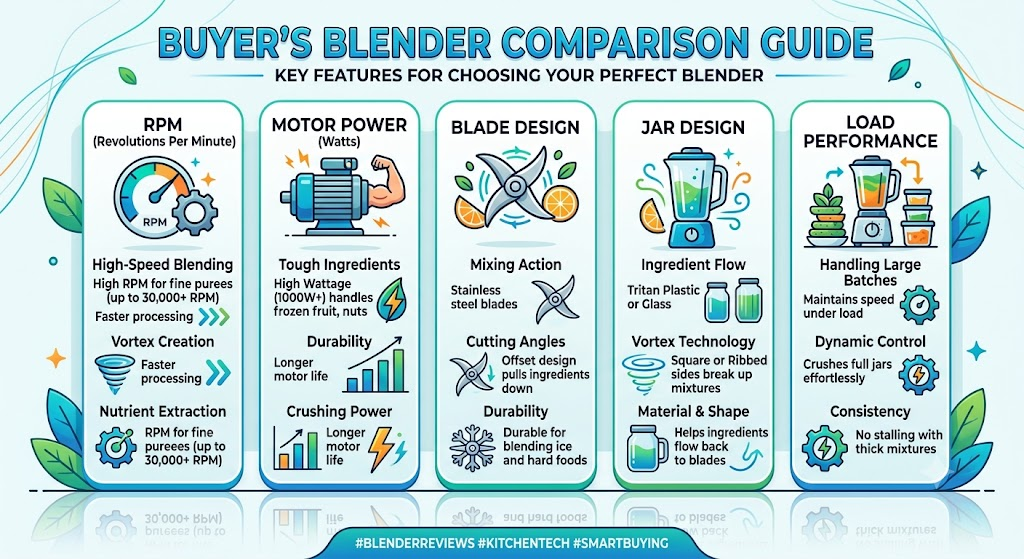
RPM is only one part of a mixer grinder’s performance. These factors can be equally or more important:
| Factor | Why it matters |
|---|---|
| Motor power | Helps determine how well the mixer handles different loads |
| Motor performance under load | Shows how effectively the motor works when ingredients create resistance |
| Blade design | Affects how ingredients are cut and circulated inside the jar |
| Jar design | Influences ingredient movement and grinding consistency |
| Ingredient quantity | Overloading can affect grinding performance |
| Type of ingredients | Hard, dry, wet and thick ingredients place different demands on the mixer |
Bottom line: A high RPM number cannot compensate for poor blade design, unsuitable jar design or weak performance under load.
RPM is only one specification. Our mixer grinder buying guide explains how to compare wattage, jars, blades and other important factors.
Common RPM Buying Mistakes
Avoid these mistakes when comparing mixer grinders:
Choosing the highest RPM
A higher advertised RPM does not automatically mean better grinding.
Comparing only no-load RPM
Two mixers may show similar RPM figures but behave differently when ingredients are added.
Assuming RPM determines grinding quality
Grinding depends on the motor, blades, jar design, load and ingredients, not RPM alone.
Looking for one “ideal” RPM
There is no single RPM number that is best for every home or every grinding task.
Ignoring the type of ingredients
The requirements for grinding spices, making chutney, preparing batter or blending liquids are different.
High RPM vs. Low RPM: What You Need to Know
A higher RPM means the blades can rotate faster, but it does not automatically mean better grinding.
| High RPM | Lower RPM |
|---|---|
| Faster blade rotation | Slower blade rotation |
| Can help process ingredients quickly | May provide more controlled processing |
| Useful when fast blade movement is beneficial | Suitable when the recipe or appliance design calls for slower operation |
| Does not guarantee finer grinding | Does not mean the mixer is weak |
If dry spices and masalas are your main concern, see our guide to the best mixer grinders for dry grinding.
What should you choose?
Do not choose a mixer grinder simply because it has the highest RPM. First consider the motor power, performance under load, blade design, jar design and the type and quantity of ingredients you usually process.
Maintenance Tips for Consistent Mixer Grinder Performance
Proper use and maintenance can help your mixer grinder continue to work efficiently over time.
- Avoid overloading the jar: Process large quantities in smaller batches when required. Overloading puts more resistance on the motor.
- Use the right jar: Use the jar designed for the type of ingredient you are processing.
- Do not run the mixer continuously for too long: Follow the manufacturer’s recommended operating and resting time.
- Keep the blades and jars clean: Food residue can affect proper ingredient movement and blade operation.
- Check for unusual noise or vibration: These can indicate a problem with the jar, blade assembly or motor and should not be ignored.
- Use the correct speed: Start at a suitable speed and use the pulse function when recommended by the manufacturer.
- Do not process unsuitable ingredients: Check the product manual before grinding very hard or unusually large ingredients.
Important: Maintenance does not increase the rated RPM of a mixer grinder. It helps the appliance operate as intended and can reduce problems caused by overloading, incorrect use or poor maintenance.
FAQs: What Is RPM in Mixer Grinder?
Q. Is higher RPM better in a mixer grinder?
Not necessarily. Higher RPM means faster blade rotation, but it does not guarantee better grinding. Motor performance under load, blade design, jar design, and the type and quantity of ingredients also matter.
Q. What is a good RPM for a mixer grinder?
There is no single RPM that is ideal for every mixer grinder. Compare RPM with motor power, blade design, jar design, and the type of grinding you usually do.
Q. What is the difference between no-load RPM and loaded RPM?
No-load RPM is measured without ingredients. Loaded RPM refers to the motor’s speed while processing ingredients. Since ingredients create resistance, loaded RPM can be lower than the advertised no-load RPM.
Q. Does a 750W mixer grinder have higher RPM?
Not necessarily. Wattage and RPM measure different things. A 750W mixer grinder can have a higher, similar, or lower RPM than another model.
Q. Should I buy a mixer grinder based on RPM?
No. RPM should be one of several specifications you compare. Also consider motor power, performance under load, blade design, jar design, and your intended use.
Q. Why does my mixer grinder seem slower than the advertised RPM?
The advertised figure is often the no-load RPM, measured without ingredients. Once ingredients are added, resistance can reduce the operating speed.
Q. Which is better, 500W or 750W at the same RPM?
If both mixers have the same RPM, the higher-wattage model may be designed to handle greater loads, but wattage alone does not guarantee better grinding. Compare the complete specifications, including motor design, blades, jars, and intended use.
Q. Can a lower-RPM mixer grinder still grind well?
Yes. RPM alone does not determine grinding performance. A mixer with a lower advertised RPM can still perform well when its motor, blade design, jar design, and load performance are suitable for the job.
Q. How can I maintain consistent mixer grinder performance?
Avoid overloading the jar, use the appropriate jar and speed setting, follow the manufacturer’s recommended operating time, and clean the jars and blades regularly.
Conclusion
RPM tells you how fast the motor or blades can rotate, but it does not tell you by itself how well a mixer grinder will grind.
Do not choose a mixer grinder simply because it advertises 20,000, 22,000 or 25,000 RPM. First check whether the specification is no-load RPM, then consider the motor, blade and jar design and how the mixer is expected to perform under load.
Related Posts:
- Why Mixer Grinder Not Grinding Properly? 12 Easy Fixes That Actually Work
- 10 Best Mixer Grinder Under ₹3000 in India 2026
- Bajaj Ninja Mixer Grinder Review: Carve, Virtue, Grace, Helios, Trinity & GX75 Compared
- How to Sharpen Mixer Grinder Blades: Easy & Effective Methods
Sourabh researches and writes about home appliances, kitchen appliances, and common appliance problems to help readers make informed buying decisions. He covers mixer grinders, refrigerators, air conditioners, washing machines, and appliance troubleshooting.
At ReviewSpot, Sourabh compares manufacturer specifications, product features, warranty information, pricing, and customer feedback to turn technical appliance information into practical buying advice. His goal is to help readers understand their options, avoid costly mistakes, and choose products that fit their needs and budget.
ReviewSpot distinguishes manufacturer information, customer feedback, and editorial analysis, and does not describe products as hands-on tested unless they have actually been tested.