Mixer Grinder Lifespan in India: How Long Should Yours Actually Last?

“Beta, this mixer is older than you” if you’ve grown up in an Indian household, chances are you’ve heard some version of this line from your mother or grandmother. And honestly, it’s not an exaggeration. Some mixer grinders in Indian kitchens have outlived two house renovations and three festivals’ worth of laddoo-making.
Others give up within a year of unboxing. So what’s the real, honest answer? How long is a mixer grinder actually supposed to last, and why does the same brand sometimes last 15 years in one home and barely 2 in another?
This guide breaks down everything that decides Mixer Grinder Lifespan in India from motor type and voltage fluctuations to brand-wise lifespan comparisons, including a closer look at Philips mixer grinder lifespan specifically, plus how to tell when it’s time to repair versus replace.
Average Mixer Grinder Lifespan
On average, a decent mixer grinder used daily in an Indian household lasts between 5 to 8 years. Budget models (under ₹2,500) often last 3 to 5 years, mid-range models (₹2,500 to ₹5,000) typically run for 6 to 8 years, and premium models with copper-wound motors and better build quality can comfortably cross 10 to 15 years with reasonable care.
The single biggest factor isn’t the brand name – it’s the motor winding (copper vs aluminium), how often the appliance is used, and how stable your home’s electricity supply is.
What Decides Mixer Grinder Lifespan? (The Real Factors)
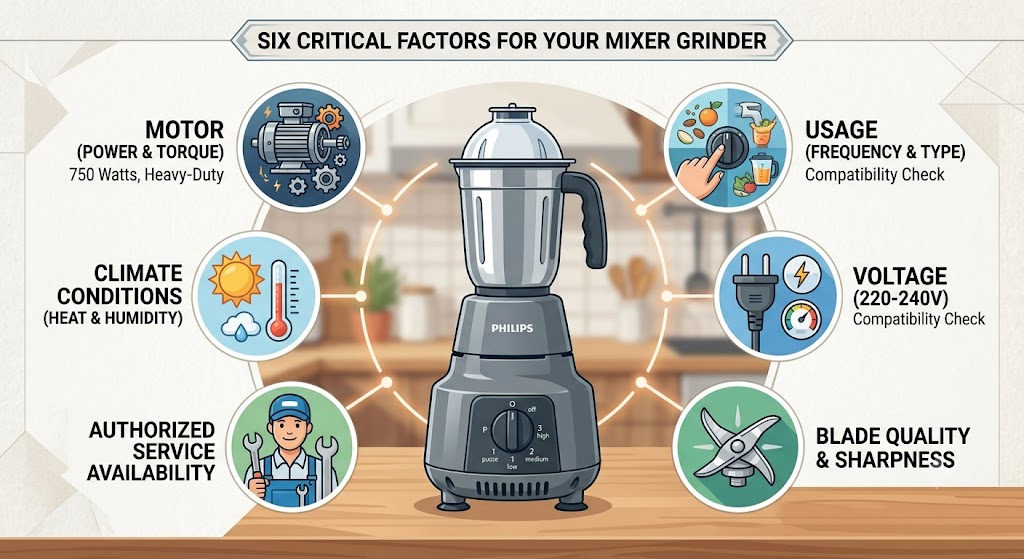
Most articles online talk about cleaning and maintenance, which definitely matters, but very few explain why two mixer grinders from the same brand can have completely different lifespans in two different homes. Here’s what actually drives Mixer Grinder Lifespan:
- Motor winding type: Copper-wound motors handle heat better and last significantly longer than aluminium-wound motors, even at the same wattage rating.
- Usage frequency and load: A mixer used 2-3 times a day for light tasks ages very differently from one used 8-10 times a day for heavy batters and masalas, like in a joint family kitchen.
- Voltage fluctuations and power cuts: This is a uniquely Indian factor that most guides skip entirely. Frequent voltage drops and sudden power restoration after outages put real stress on the motor’s internal windings over time, especially in semi-urban and rural areas without stable supply.
- Jar and blade quality: Cheaper alloy blades dull faster and force the motor to work harder for the same result, indirectly shortening motor life.
- Service and spare part availability: A mixer that gets a worn coupler or gasket replaced promptly lasts longer than one where a minor part is ignored until it damages the motor.
- Climate and storage: Coastal and high-humidity regions see faster corrosion on metal parts compared to drier regions, even with similar usage patterns.
Philips Mixer Grinder Lifespan: What to Expect
Philips remains one of the most searched and trusted brands for Indian kitchens, so it’s worth addressing Philips mixer grinder lifespan specifically. Philips mixer grinders, particularly the mid-to-premium range models, generally use better quality motor windings and sturdier jar couplers compared to entry-level budget brands.
In typical Indian household use daily grinding of masalas, chutneys, and batters a Philips mixer grinder commonly lasts 7 to 10 years with regular care, and well-maintained units have been known to cross the 12-year mark.
That said, Philips entry-level models priced under ₹2,000 are built to a lower cost point and tend to sit closer to the 4-6 year range, similar to other budget options in that price bracket. The lifespan difference within the same brand, across its budget and premium lines, is often larger than the difference between two premium models of different brands altogether.
This is exactly why checking the specific model’s build quality matters more than just trusting a brand name.
Best Mixer Grinder Lifespan: Brand-Wise Comparison
If you’re hunting for the best mixer grinder lifespan in India, here’s a general comparison based on typical motor build quality and what Indian users commonly report across brands and price segments.
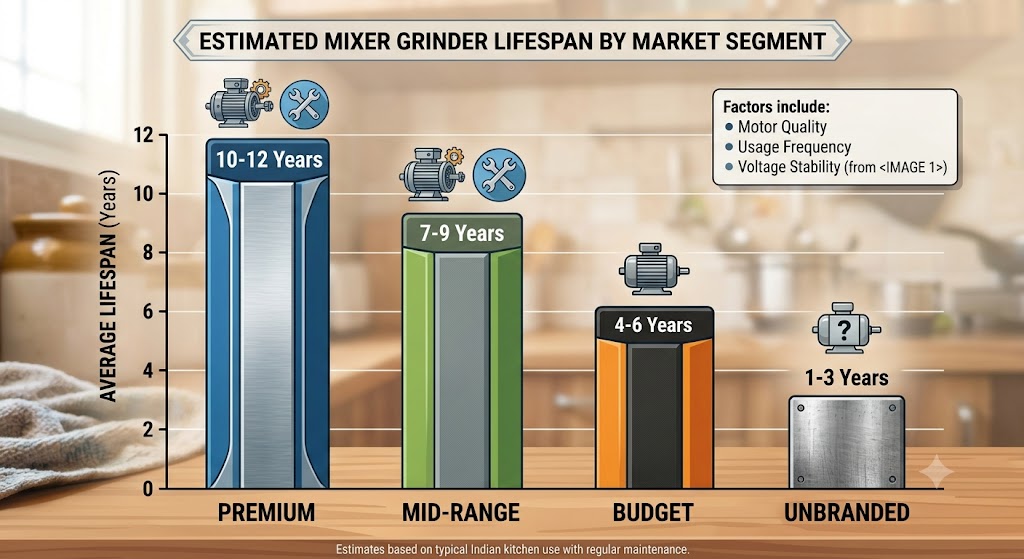
These are realistic estimates for typical daily household use, not laboratory figures:
| Brand / Segment | Typical Motor Type | Average Lifespan | Price Segment |
| Premium brands (e.g. Premier, Sujata, Philips premium range) | Copper-wound | 8-15 years | ₹5,000+ |
| Mid-range brands (e.g. Philips, Preethi mid-tier) | Copper or mixed winding | 6-10 years | ₹2,500-5,000 |
| Budget/entry-level brands | Mostly aluminium winding | 3-5 years | Under ₹2,500 |
| Unbranded/local assembled units | Aluminium, inconsistent quality | 1-3 years | Varies widely |
Electric Mixer Grinder Lifespan vs Wet Grinder and Other Kitchen Appliances
It’s worth putting electric mixer grinder lifespan in perspective against other kitchen workhorses, since buyers often compare these while planning kitchen purchases. A mixer grinder typically has a shorter lifespan than a wet grinder but a longer lifespan than a basic hand blender or juicer, which usually see 3-6 years of regular use.
This is mainly because mixer grinder motors run at much higher RPM and face repeated thermal cycling heating up and cooling down multiple times a day which is harder on internal components than the steadier, slower operation of a wet grinder.
Signs Your Mixer Grinder Is Reaching the End of Its Life
Knowing when a mixer grinder is on its way out can save you from a sudden breakdown right in the middle of cooking. Watch out for:
- A noticeably slower grinding speed even on fresh, sharp blades
- A burning smell after just a few minutes of use, even with light loads
- The motor tripping your home’s circuit breaker repeatedly
- Excessive vibration or the unit “walking” across the counter while running
- A high-pitched whining sound that wasn’t there before, especially under load
- Jars or couplers that no longer lock in firmly no matter how many times you reseat them
One or two of these occasionally isn’t a big worry, but if you’re seeing two or more of these signs together and regularly, your mixer grinder’s motor is very likely approaching the end of its usable life.
If your appliance is already showing multiple warning signs, check these signs it’s time to upgrade your old mixer grinder before investing in repairs.
Repair or Replace? A Simple Cost-Based Rule
This is something almost none of the existing guides address, even though it’s the question every Indian household actually faces when a mixer grinder starts acting up.
Here’s a simple, practical rule to decide: if the repair cost comes to less than 40% of the price of a comparable new mixer grinder, get it repaired. If it crosses 50% or more, you’re usually better off replacing the unit, especially if your current model is already past 6-7 years of use.
A few cost reference points that hold true across most Indian cities:
- Motor rewinding or replacement: roughly ₹600 to ₹1,500 depending on the model and city
- Jar replacement (single jar): roughly ₹300 to ₹800
- Coupler and gasket replacement: usually under ₹200, and genuinely worth doing rather than ignoring
- Full service with cleaning and minor part replacement: roughly ₹300 to ₹600 at most authorised centres
If your mixer is only 2-3 years old and the issue is a jar or coupler, repair it without a second thought. If the motor itself has failed and the unit is already 6+ years old, replacing it usually works out better financially in the long run, since you’ll also get improved energy efficiency and safety features in newer models.
How Voltage Fluctuation Quietly Shortens Lifespan in Indian Homes
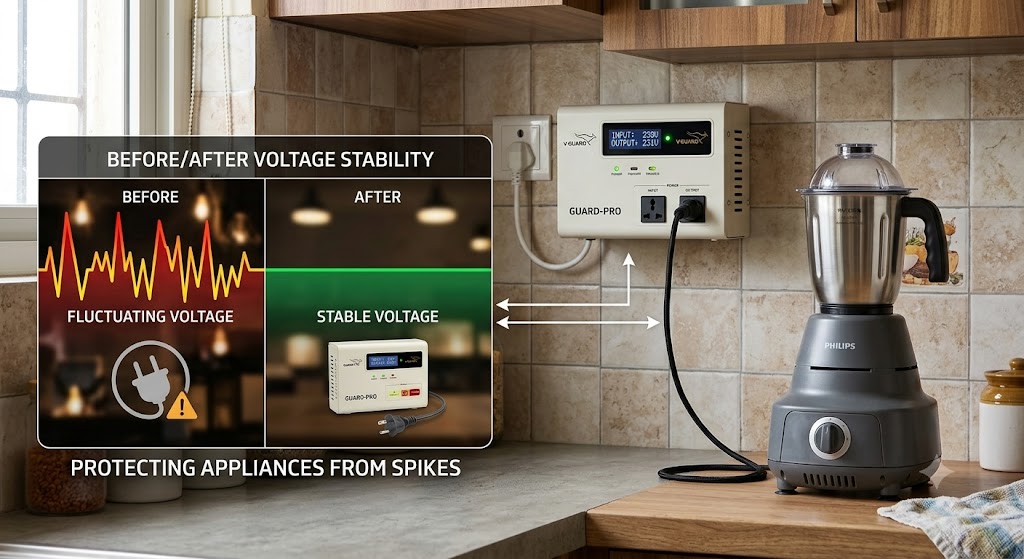
This deserves its own mention because it’s genuinely under-discussed. In many parts of India, especially smaller towns and areas with older electrical infrastructure, voltage doesn’t stay a steady, clean 220-240V. It dips during peak hours, spikes when power is restored after an outage, and these fluctuations stress the motor’s windings in ways that pure “usage and cleaning” advice doesn’t cover.
If your area sees frequent power fluctuations, a simple voltage stabiliser for your mixer grinder (and other motor-driven appliances) can meaningfully extend its working life. It’s a small one-time cost that protects a motor you’ll otherwise be paying to repair or replace much sooner than expected.
Practical Tips to Extend Mixer Grinder Lifespan
A few habits genuinely make a measurable difference to how long your mixer grinder lasts, beyond the basic cleaning advice you’ve probably already heard:
- Use a voltage stabiliser if your area has frequent power fluctuations
- Give the motor a 2-3 minute rest between back-to-back heavy grinding tasks
- Avoid running the same jar for both wet and dry grinding without proper cleaning in between, since residue buildup adds extra load
- Get the coupler and gasket checked once a year, even if nothing seems wrong, since these wear out quietly and are cheap to replace early
- Don’t ignore a slightly louder-than-usual motor sound – catching wear early is far cheaper than a full motor replacement later
What Indian Users Say About Their Mixer Grinder’s Lifespan
“My mother’s old mixer ran for almost 18 years before the motor finally gave up. My new one is already making strange noises after just 3 years. I think the build quality difference between then and now is real.” – Anjali, Nagpur
“We live in an area with a lot of power cuts and after I got a stabiliser fitted for the kitchen sockets, my mixer grinder has run without a single issue for 4 years now, compared to my last one which lasted barely 2.” – Suresh, Patna
“I always assumed all mixer grinders last about the same, until my Philips one easily outlasted two cheaper ones my sister bought in the same period.” – Kavita, Indore
Frequently Asked Questions
- How long does a mixer grinder motor actually last? With regular household use and basic care, most copper-wound motors last 6-10 years, while aluminium-wound budget motors typically last 3-5 years.
- Does Philips mixer grinder lifespan really differ from other brands? Mid-range and premium Philips models generally outperform budget brands of similar price due to better motor winding and build quality, though Philips’ own entry-level models perform closer to other budget options.
- Can a mixer grinder really last 10+ years in India? Yes, particularly premium models with copper-wound motors, used moderately and protected from voltage fluctuations, regularly cross the 10-year mark.
- Is it worth repairing an old mixer grinder instead of buying new? Generally yes, if the repair cost stays under 40% of a new unit’s price and the appliance is under 6-7 years old; beyond that, replacement usually makes more financial sense.
- Does jar material affect overall mixer grinder lifespan? Indirectly yes – cracked or scratched jars force you to use the appliance less efficiently and can add load on the motor coupler over time.
Joint Family vs Nuclear Family: Does Usage Pattern Change Lifespan?
Here’s something worth thinking about if you’re shopping for a new mixer grinder: the same model can show very different Mixer Grinder Lifespan numbers depending on your household size and cooking habits.
A joint family running the mixer 6-8 times a day for masalas, batters, and chutneys puts far more cumulative thermal stress on the motor than a nuclear family of two or three using it once or twice daily. If your household falls into the heavier-use category, it’s worth investing in a model with a higher wattage motor and copper winding from the start, rather than buying a budget unit and replacing it every 2-3 years, since the long-term cost often works out similar or even higher with the budget route.
On the flip side, smaller households using a mixer lightly can often get away with a mid-range model and still see it comfortably cross the 8-10 year mark, simply because the motor isn’t being pushed as hard or as often.
Final Word
Mixer Grinder Lifespan in India isn’t just about the brand sticker on the box – it’s a mix of motor quality, how your home’s electricity behaves, how often the appliance is used, and a bit of basic care along the way.
A mid-range or premium mixer grinder, looked after reasonably well and protected from voltage swings, can realistically serve your kitchen for 8 to 12 years or more. Next time you’re choosing between two models, spend two extra minutes checking the motor winding type and reading what genuine users say about that specific model’s lifespan it’ll save you a lot more than two minutes down the road.
Also Read:
- 9 Mixer Grinder Buying Mistakes Almost Every Indian Household Makes
- Mixer Grinder Gasket Replacement: How to Fix Leaks and Replace a Worn-Out Gasket
- Which Motor Is Used in Mixer Grinder? Types, Working, BLDC vs Universal Motor Explained
- How to Store Mixer Grinder Properly: 8 Simple Tips to Make It Last Longer
Sourabh researches and writes about home appliances, kitchen appliances, and common appliance problems to help readers make informed buying decisions. He covers mixer grinders, refrigerators, air conditioners, washing machines, and appliance troubleshooting.
At ReviewSpot, Sourabh compares manufacturer specifications, product features, warranty information, pricing, and customer feedback to turn technical appliance information into practical buying advice. His goal is to help readers understand their options, avoid costly mistakes, and choose products that fit their needs and budget.
ReviewSpot distinguishes manufacturer information, customer feedback, and editorial analysis, and does not describe products as hands-on tested unless they have actually been tested.