
9 Mixer Grinder Buying Mistakes Almost Every Indian Household Makes (And How to Avoid Them)

Buying a mixer grinder sounds like a five-minute job, doesn’t it? Walk into the shop, point at the shiniest one, check the price tag, and you’re done. Except a few weeks later, the jar starts leaking, the motor screams like it’s about to take off, or worse, it just stops working right when you’re making chutney for guests.
Sound familiar? You’re not alone. Many Indian households have experienced problems such as leaking jars, excessive noise or motor failure after buying a mixer grinder.
This guide walks you through the most common Mixer Grinder Buying Mistakes Indian buyers make, why they happen, and exactly how you can dodge every single one of them – even if you’ve never bought a kitchen appliance on your own before.
The Biggest Mixer Grinder Buying Mistakes in One Glance
If you’re short on time, here’s the short version. The most common mistakes are:
- Choosing a mixer grinder purely on the basis of high wattage
- Ignoring the jar material and going only by brand stickers
- Not checking warranty terms beyond the box sticker
- Buying the wrong jar capacity for your family size
- Skipping a check on the local service network
- Forgetting to test the noise level before buying
- Overlooking speed settings and the pulse function
- Trusting brand name alone instead of checking the actual model
- Not reading the return or replacement policy before paying
How We Identified These Buying Mistakes
We identified these common buying mistakes by comparing manufacturer specifications, product features, warranty information, current marketplace information and common buyer considerations for Indian kitchens. We focus on mistakes that can affect product suitability, operating convenience, maintenance or overall value. The recommendations are editorial analysis based on these sources and are not based on hands-on testing.
Mixer Grinder Buying Mistakes
Now let’s go through each one in detail, with real reasons why these mistakes cost you money and peace of mind in the long run.
Mistake #1: Choosing a Mixer Grinder Based on Wattage Alone
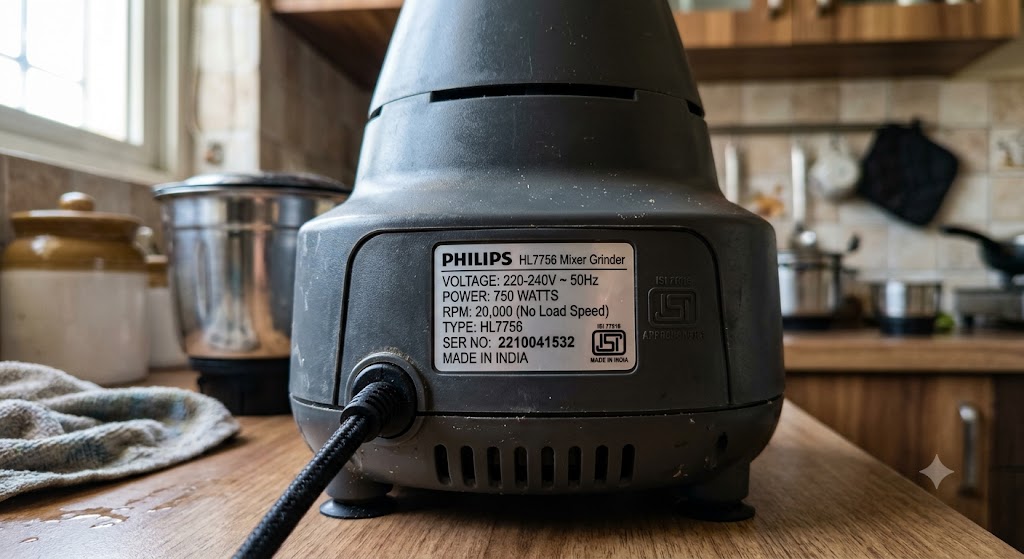
This is, without doubt, the number one Mixer Grinder Buying Mistake in Indian households. The moment we hear “750 watts” versus “550 watts”, we assume bigger number means better grinding. It doesn’t always work that way.
Wattage tells you how much power the motor consumes, not how well it grinds. A 550-watt motor with a well-designed blade and proper gear mechanism can outperform a 750-watt motor with a poor blade angle. What actually matters more is:
- Blade design and the angle at which blades are set
- Motor type copper winding motors last longer than aluminium winding ones
- RPM (rotations per minute) of the motor, not just watts
Motor winding material can be one factor to consider, but wattage alone does not tell you how long a mixer grinder will last. Also check the manufacturer’s specifications, construction quality, warranty and service support.
Choosing a mixer grinder only by wattage can be misleading. If noise is another priority, compare our silent mixer grinder guide before buying
Mistake #2: Ignoring Jar Material and Build Quality
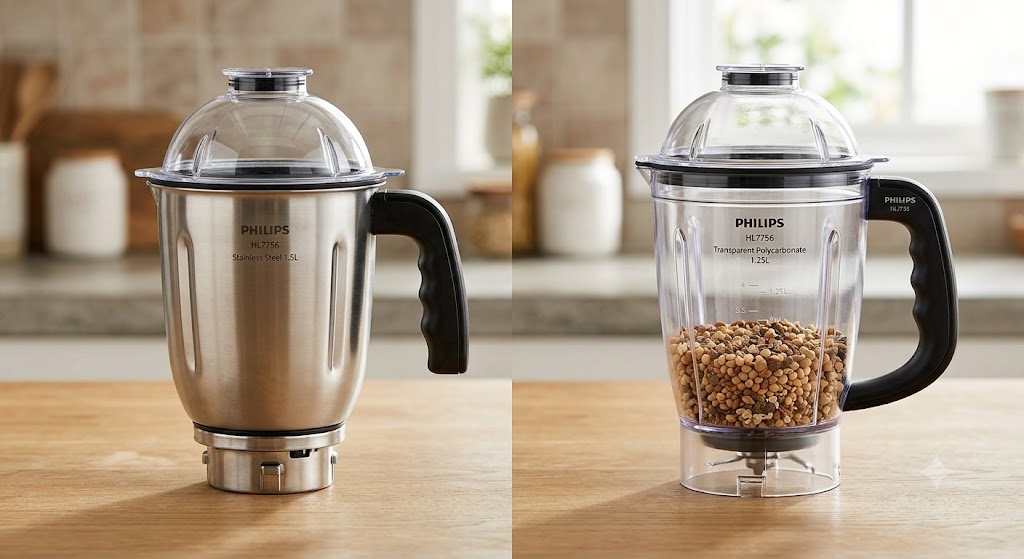
Jars look more or less the same in the shop, all shiny and new. But the material used decides how long they last and how safe they are for daily Indian cooking, which involves a lot of hot liquids, oily masalas, and acidic ingredients like tamarind and tomatoes.
Here’s a simple breakdown to keep in mind:
| Jar Material | Pros | Cons |
| Stainless Steel | Durable, doesn’t stain, handles hot liquids | Slightly heavier, costs a bit more |
| Polycarbonate Plastic | Lightweight, transparent so you can see the contents | Can scratch, may absorb turmeric or chilli stains over time |
| Mixed (Steel body, plastic lid) | Balanced cost and durability | Quality depends heavily on the brand |
For most buyers, stainless-steel jars are practical for regular grinding because they are durable and easy to clean. Transparent plastic jars can be useful when you want to see the contents while grinding. Check the manufacturer’s recommended use and the actual jar construction rather than choosing purely by material.
Choosing the right jars is just as important. Read our complete mixer grinder jar guide before purchasing.
Mistake #3: Not Reading the Warranty Terms Properly

Most buyers see “2 Year Warranty” printed on the box and feel satisfied. But that warranty almost never covers everything. This is one of the sneakier Mixer Grinder Buying Mistakes because the fine print usually says something like “1 year on product, 2 years on motor only”.
Before paying, always ask and confirm in writing or on the invoice:
- Is the warranty on the whole product or just the motor?
- Are jars, blades, and rubber gaskets covered, even partially?
- Check whether the warranty relating to electrical supply, accessories, misuse or installation provided?
- Is the warranty card linked to the dealer or to the company directly?
A longer warranty is useful only if the brand provides accessible service and replacement support in your area. Check the manufacturer’s service-centre locator before buying.
Mistake #4: Buying the Wrong Jar Capacity for Your Family Size
This sounds obvious, but it’s one of the most repeated Mixer Grinder Buying Mistakes. A bachelor living alone ends up buying a 1.5 litre jar set meant for a joint family of six, and a family of seven ends up struggling with a small 0.5 litre chutney jar for everyday dal and batter needs.
Here’s a rough guide based on household size:
- 1-2 people: 0.5 to 1 litre main jar is usually enough
- 3-4 people: 1 to 1.5 litre jar works comfortably
- 5+ people or households that cook for guests often: 1.5 litre jar plus an extra smaller jar
Buying a jar that’s too big for your daily needs also means the motor works harder on smaller quantities, which can reduce its life over time.
Mistake #5: Overlooking Speed Settings and the Pulse Function
Many buyers don’t even check how many speed settings a mixer grinder offers before buying, assuming all mixers work the same way. They don’t. A 3-speed mixer with a pulse function gives you far more control – for example, a slow grind for soft idli batter and a quick pulse for coarsely ground chutney.
A pulse function can make it easier to control short bursts of grinding, particularly when you want a coarse texture. It is useful, but it should not be treated as an essential feature for every buyer.
Mistake #6: Skipping a Check on the Local Service Network

This is the mistake that comes back to bite buyers the hardest. A mixer grinder is a appliance that will eventually need a part replaced – a jar gasket, a blade, or a coupler. If the brand has no authorised service centre within your city or even your state, you’ll end up either paying heavy courier charges to send it to the company, or simply throwing it away.
Before buying, do a quick search for the brand’s service centre locator and check if there’s one within reasonable distance of your home. Tier 1 cities usually have wide coverage, but if you’re in a smaller town, this check becomes even more important.
Mistake #7: Trusting the Brand Name Without Checking the Actual Model
“It’s [Brand Name], so it must be good” is a trap. Big brands sell dozens of models, ranging from budget entry-level versions to premium ones, and not every model from a trusted brand is built equally well. Some budget models cut corners on motor quality or jar material just to hit a lower price point.
Instead of going by brand alone, look up the specific model number online, read genuine buyer reviews for that exact model, and compare specifications side by side rather than assuming the logo guarantees quality.
Mistake #8: Ignoring the Noise Level
Indian kitchens are often connected to the living area, and a mixer grinder that sounds like a jet engine taking off isn’t fun to use early in the morning or late at night, especially in homes with young children or elderly family members. Noise level is rarely mentioned on the box, but it’s worth asking about or checking reviews for.
If possible, ask the shop to switch the mixer on for a few seconds before buying, or check video reviews online where you can actually hear the sound levels of different models.
If noise is a major concern, don’t assume that every high-end mixer grinder is quiet. Compare low-noise mixer grinder models by their design, noise level and price before making a purchase.
Mistake #9: Not Reading the Return or Replacement Policy
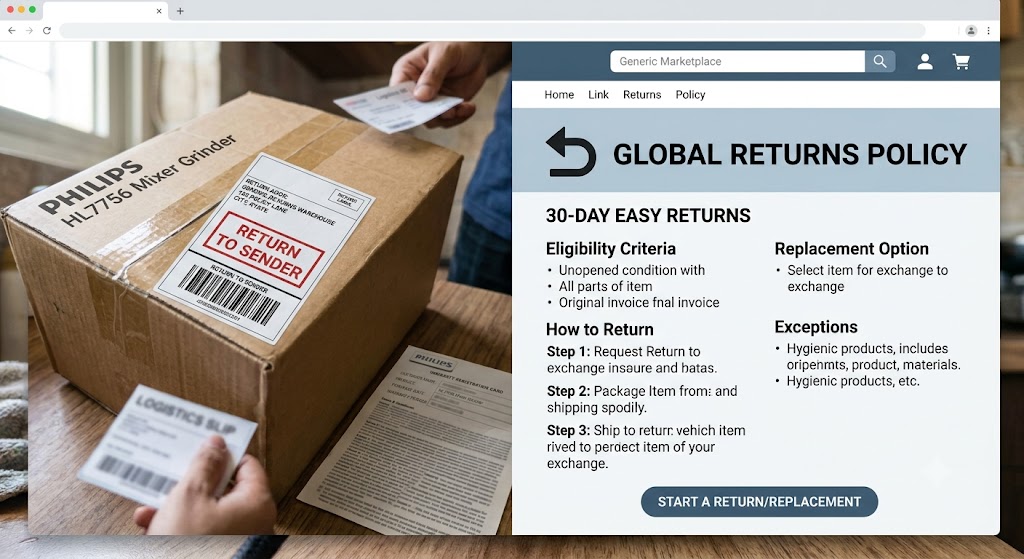
Whether you’re buying online or from a local shop, always check the return window and what conditions apply. A mixer grinder bought online with only a 7-day replacement window for “manufacturing defects only” leaves you with very little protection if something goes wrong after that window closes.
Always check:
- Number of days within which you can return or replace the product
- Whether it’s a replacement-only policy or a refund as well
- Who bears the pickup and return shipping cost
What Buyers Commonly Overlook
- Wattage is not everything: A higher wattage does not automatically mean a better mixer grinder. Consider your regular grinding needs, jar sizes and motor specifications.
- Jar size matters: Choose jar capacity based on the quantity you normally prepare, not just your family size.
- Copper winding is not a guarantee of durability: Motor design, cooling, workload, construction and protection features also affect durability.
- Warranty coverage matters: Do not look only at the warranty period. Check what is covered, exclusions and the service or replacement process.
- Check service availability: Before buying, check whether authorised service support and spare parts are available in your area.
- Jar material is only one factor: Consider the jar’s construction, capacity, intended use and the manufacturer’s instructions instead of choosing only by material.
- Consider what you grind: A mixer used mainly for chutneys has different requirements from one used for dry spices, coconut, nuts or batter.
- Read the manufacturer’s instructions: Check maximum quantities, operating time and instructions for hot liquids before using the appliance.
- Do not assume inverter compatibility: Check the mixer grinder’s power requirements against your inverter’s continuous and peak capacity.
- Do not choose only by price: Compare jars, motor specifications, warranty, service support and suitability for your regular use before deciding.
A Simple Pre-Purchase Checklist
- Confirm motor type (copper vs aluminium winding) and RPM, not just wattage
- Check jar material suited to your daily cooking – steel for heavy use, plastic for lighter jars
- Read the complete warranty terms, not just the headline number
- Pick jar capacity based on your actual family size and cooking habits
- Verify speed settings and pulse function for batters and chutneys
- Search for the brand’s service centre near your location before buying
- Look up the specific model’s reviews instead of trusting the brand name alone
- Ask about or research the noise level if your kitchen is close to living spaces
- Read the return and replacement policy carefully, especially for online purchases
Buying Online vs Buying from a Local Shop
This is something competitor articles on this topic rarely cover, but it directly affects how easily you can avoid the mistakes listed above. Both online and offline buying have their own advantages, and picking the wrong channel for your situation is itself a small but costly Mixer Grinder Buying Mistake.
| Buying Online | Buying from Local Shop | |
| Price Comparison | Easy to compare across platforms and festive sale prices | Limited to what’s in stock at that shop |
| Physical Check | Cannot check jar build or hear motor noise before buying | Can physically check jar thickness, switches, and ask for a demo |
| Warranty Activation | Usually instant via invoice, but service request can take longer | Shopkeeper often helps with warranty registration and first service call |
| Return Process | Defined return window, but pickup can take a few days | Faster exchange if the shop is nearby and cooperative |
If you’re someone who likes to physically test the build quality and hear the motor before buying, a local shop with a demo facility works better. If you’re comfortable relying on detailed reviews and want the best festive-season pricing, online buying makes more sense – just make sure you check seller ratings and genuine buyer photos, not just the product description.
Frequently Asked Questions
Is higher wattage always better for grinding hard items like dal or coffee?
Not necessarily – a well-built blade and motor combination matters more than the wattage number alone.
Can I use a mixer grinder with an inverter during power cuts?
Most can run on an inverter, but always confirm the load capacity required, since mixer grinders draw a sudden high current at start-up.
How often should jars and blades be replaced?
There is no fixed replacement interval for mixer-grinder blades. Replace or service them when they become damaged, excessively worn or no longer perform properly.
Does a more expensive mixer grinder always last longer?
Price helps, but build quality, motor type, and after-sales service network matter just as much as the price tag.
Final Word
A mixer grinder is one of those appliances that quietly runs your kitchen every single day, often multiple times a day. Getting the purchase right the first time saves you money, saves you the irritation of repeated service visits, and honestly, saves your mornings from turning chaotic.
Avoid these common Mixer Grinder Buying Mistakes, do a little homework before you pay, and you’ll end up with a mixer grinder that serves your kitchen well for years rather than months.
Also Read:
- 10 Types of Mixer Grinder blades & their uses: Which One to Use When?
- How to Reduce Mixer Grinder Noise? 15 Simple Ways to Make Your Kitchen Quieter
- Which Motor Is Used in Mixer Grinder? Types, Working, BLDC vs Universal Motor Explained
- Mixer Grinder Coupler Guide: Price, Replacement, Common Problems & Easy Fixes
Sourabh researches and writes about home appliances, kitchen appliances, and common appliance problems to help readers make informed buying decisions. He covers mixer grinders, refrigerators, air conditioners, washing machines, and appliance troubleshooting.
At ReviewSpot, Sourabh compares manufacturer specifications, product features, warranty information, pricing, and customer feedback to turn technical appliance information into practical buying advice. His goal is to help readers understand their options, avoid costly mistakes, and choose products that fit their needs and budget.
ReviewSpot distinguishes manufacturer information, customer feedback, and editorial analysis, and does not describe products as hands-on tested unless they have actually been tested.